Neutrino Atlas – discovering the invisible

Neutrino Atlas · Open knowledge platform
What do we actually know about those components of our universe that elude our direct perception? What insights have been gained over the past decades – and what technological possibilities might develop from them?
The Neutrino Atlas is an international, freely accessible knowledge platform that brings together scientific findings, historical developments and current research projects. It invites visitors to discover a world that constantly surrounds us and yet lies largely outside our everyday perception.
Figures according to the Neutrino Atlas, as of 11/2026
A journey into the invisible universe
While we explored the universe for a long time mainly by means of visible light, modern measurement methods now offer entirely different insights into its nature.
Neutrinos occupy a special position here. They arise, among other things, from nuclear reactions in the Sun, from the decay of radioactive substances and from enormous cosmic events such as supernovae.
Every second, around 65 billion solar neutrinos pass through every square centimetre of a surface perpendicular to the Sun near Earth. They also pass through our bodies continuously, without our noticing anything.
Their extremely weak interaction with matter makes them a scientific challenge – but at the same time valuable carriers of information. They can leave regions from which visible light can escape only with difficulty or not at all.
Neutrino research thus opens up an additional route to understanding the universe.
More than a scientific reference work
The Neutrino Atlas brings together insights from different research disciplines and presents them for people with varying levels of prior knowledge.
What the Atlas offers
According to its operators, this includes, among other things:
- Profiles of people from science, research and technology development
- Explanations of scientific terms
- Experiments, detectors and research sites worldwide
- Lessons at different levels of depth
- Historical developments in particle physics
- Original scientific publications and further sources
- Interactive applications and geographical overviews
The multilingual platform offers an easy entry point, especially for people without a scientific background. Those who already have a deeper knowledge of particle physics, quantum mechanics or materials science can explore individual topics at a correspondingly more demanding level.
How a conjecture became scientific certainty
The story of the neutrino shows impressively how our understanding of nature can change.
In 1930, Wolfgang Pauli postulated the existence of a then still unknown particle in order to explain apparent contradictions in radioactive decay processes. Experimental proof followed only in 1956, by Clyde Cowan and Frederick Reines.
Decades more passed before it emerged that neutrinos can change between different states. These so-called neutrino oscillations demonstrate that, contrary to earlier assumptions, neutrinos are not massless.
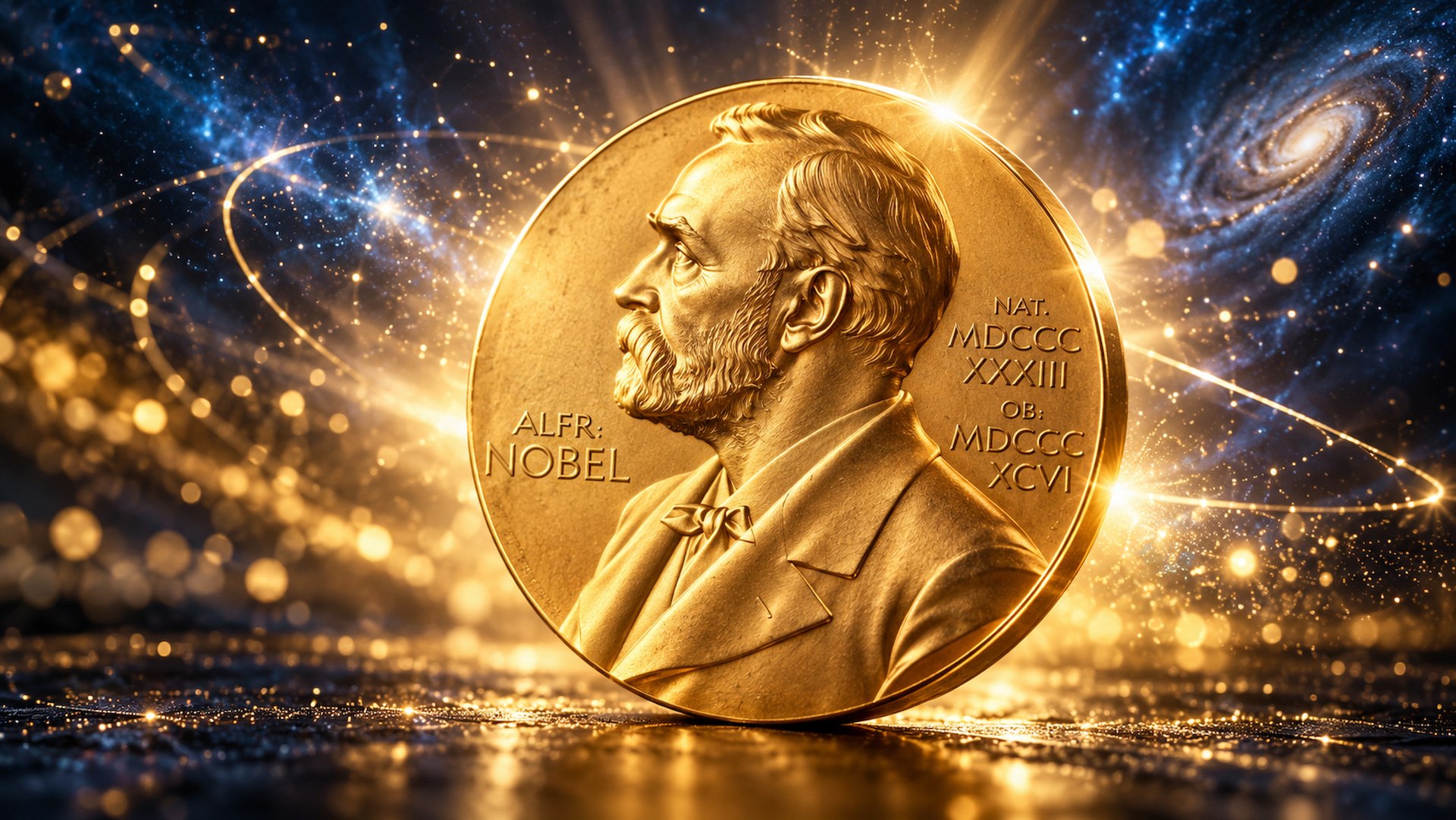
In 2015, Takaaki Kajita and Arthur B. McDonald received the Nobel Prize in Physics for corresponding experimental discoveries.
The story is by no means over. To this day, the exact mass of neutrinos, the ordering of their mass states and possible differences between neutrinos and antineutrinos remain among the open questions of modern particle physics.
The Atlas makes this development easy to follow and shows how theoretical reasoning, experimental research and technical innovation have influenced one another over decades.
Neutrino research as an international joint project
The scale of today’s neutrino research becomes especially visible in its experimental infrastructure.
Deep below the Earth’s surface, in former mines, under water and even in Antarctic ice, facilities are being built with which scientists study the properties of these elusive particles.
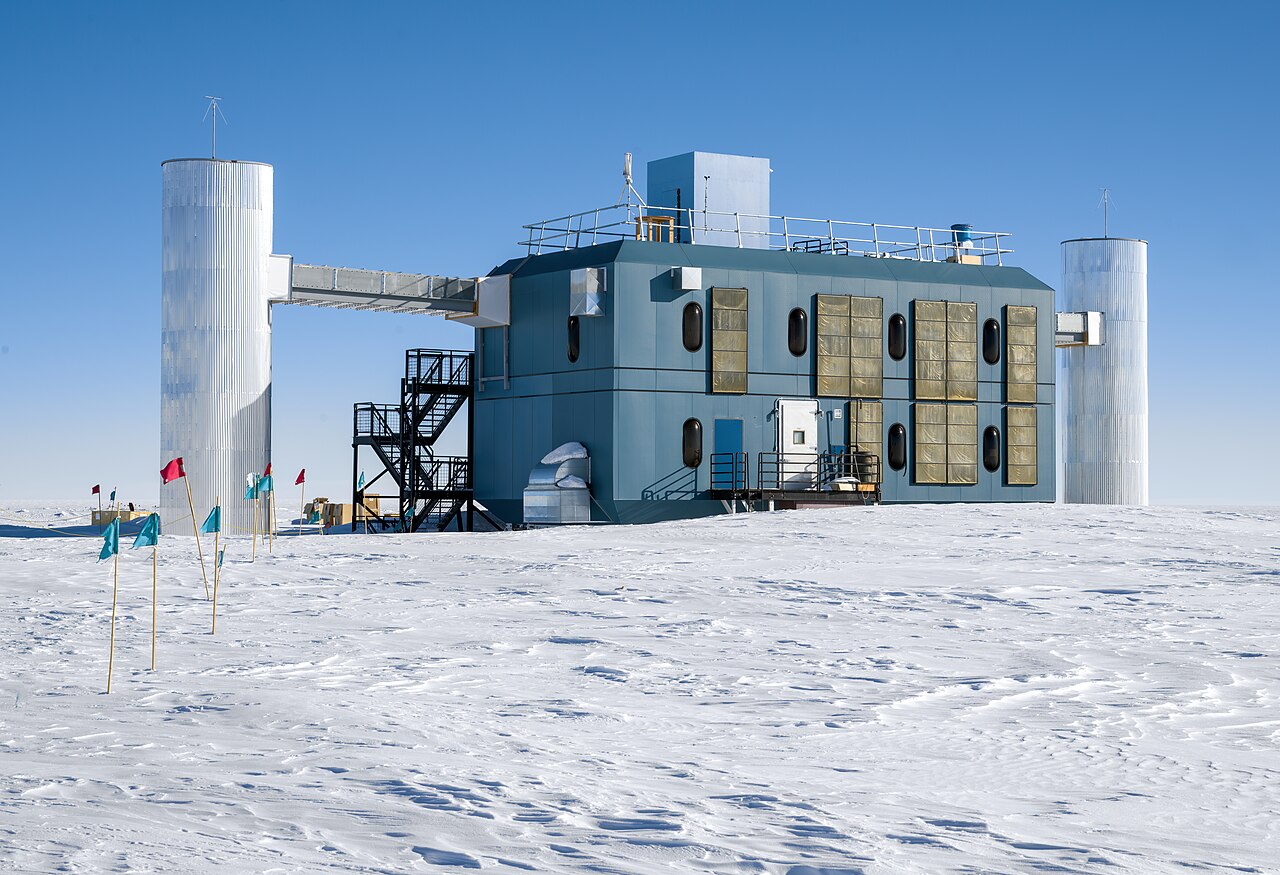
The IceCube Observatory at the South Pole, for example, uses a cubic kilometre of Antarctic ice as part of its detector system. Super-Kamiokande in Japan works with an enormous water tank deep underground. Other projects such as DUNE in the USA and KM3NeT in the Mediterranean expand the experimental possibilities.
The international research landscape shows the importance that the study of the invisible universe has now gained.
In the Neutrino Atlas, these connections can also be explored geographically. Research sites, experiments, scientific institutions and the people involved are brought together in a shared knowledge space.
From basic research to neutrinovoltaics
For the Society for Self-Sufficiency (Gesellschaft für Autarkie), alongside basic scientific research, the question of particular interest is what possibilities new findings might offer for decentralised energy supply.
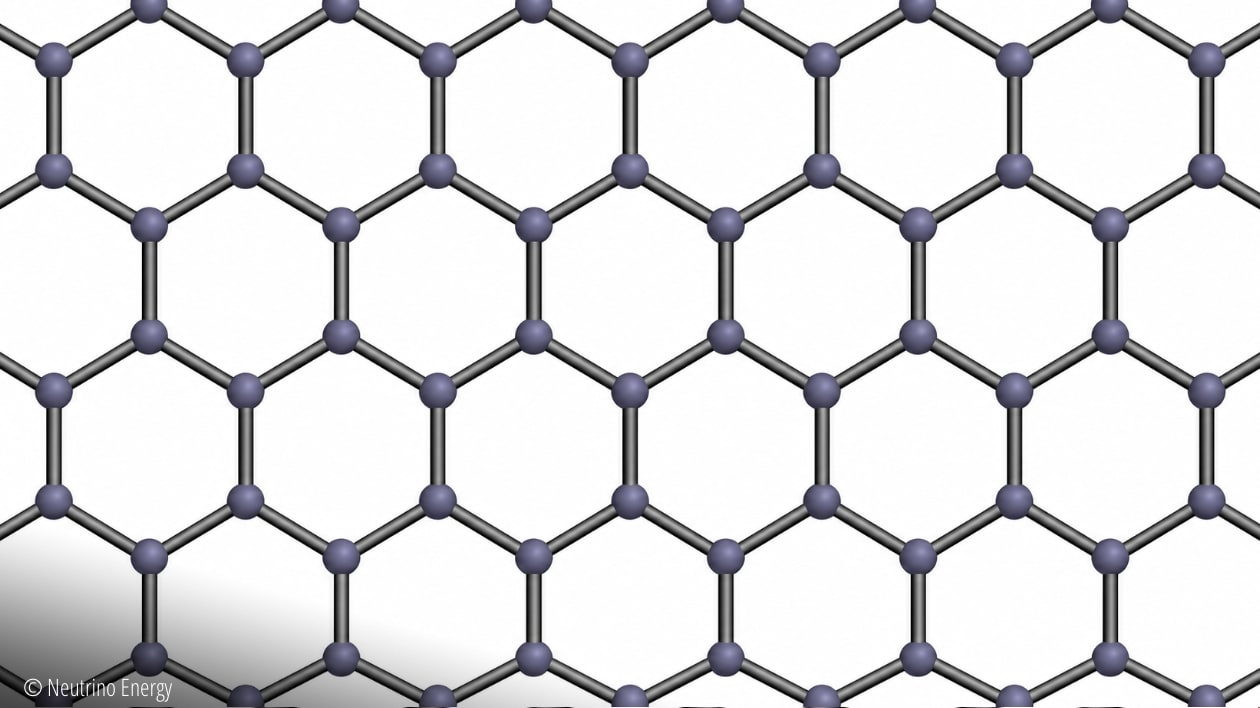
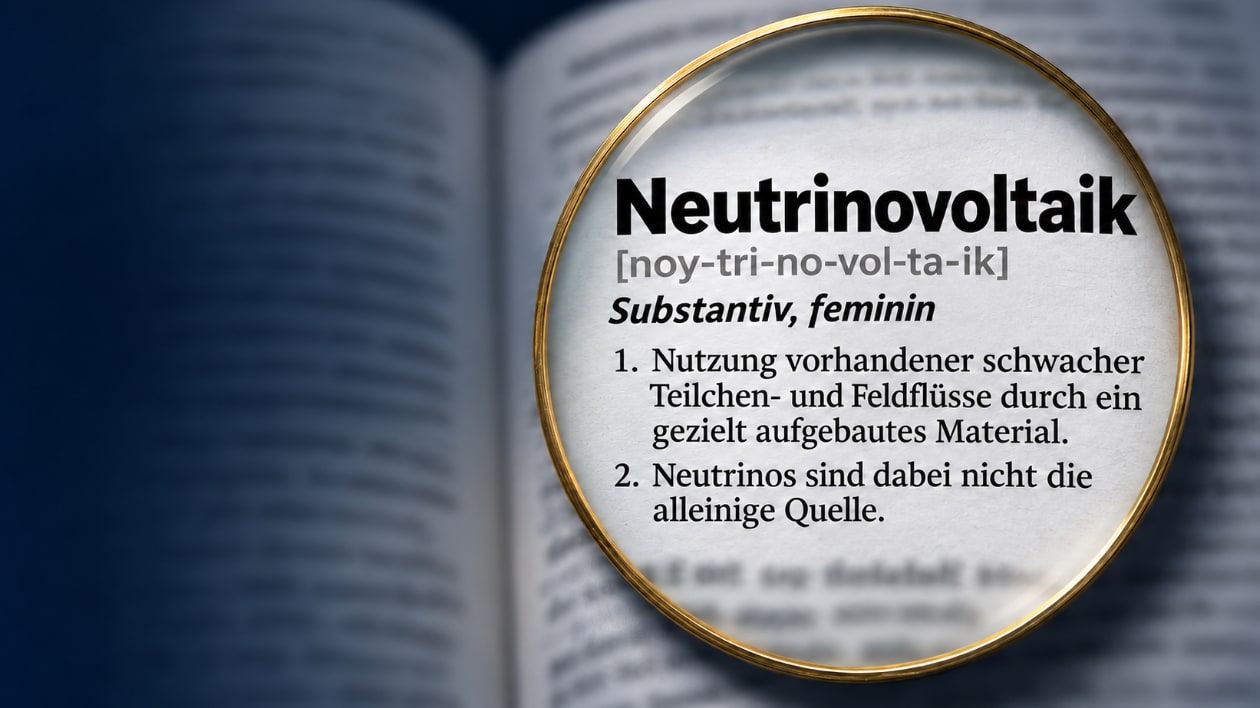
The Neutrino Energy Group has for years been working on the development of neutrinovoltaic materials. Its stated approach is to convert various permanently present energy flows from the environment into electrical energy with the help of special nanomaterials.
According to the company, this is not exclusively about neutrinos, but also about other physical influences and energy transfer mechanisms.
The long-term development goal is systems that can provide electrical energy independently of visible sunlight and as close as possible to where it is consumed.
Such a technology could – given demonstrated performance, economic viability and technical reliability – open up new possibilities for designing decentralised energy systems.
However, the experimentally confirmed findings of neutrino physics and the proof of economically usable neutrinovoltaic power generation are two different scientific and technological questions.
It is precisely this distinction that makes a platform like the Neutrino Atlas interesting: it makes it possible to place developments in their respective scientific context.
Further information on the technology, its development prospects and the activities of the Society for Self-Sufficiency can be found on our neutrinovoltaics topic page.
Putting scientific findings into understandable context
A remarkable feature of such a knowledge resource is the distinction between experimentally confirmed findings, theoretical predictions, open questions and technologies that are still being developed or have only been conceived.
The neutrinovoltaic Power Cube, too, should be regarded as a technology under development.
Confirmed
Experimentally demonstrated findings, such as the mass of neutrinos.
Open
Questions that research is working on, such as the ordering of the mass states.
Under development
Technologies whose performance and economic viability have yet to be demonstrated.
This differentiation makes it easier to distinguish between established knowledge, scientific hypotheses and technological prospects for the future.
It also makes clear that open questions are not a contradiction of scientific progress but an essential part of it.
A knowledge platform for schools and young people too
The Neutrino Atlas is not only suited as a source of information for technically minded adults.
Its multi-level learning concept also gives young people, pupils, students and teachers access to topics that are often covered only in passing in regular lessons.
What is a neutrino? How can almost invisible particles be detected at all? How do we know that they have mass? And what insights might one day lead to new technological applications?
Such questions can be the starting point for independent journeys of discovery, for classroom discussions or for deeper engagement with the natural sciences.
It is not necessary to have mastered all the physical fundamentals beforehand. Different levels of explanation make it possible to approach more complex connections step by step.
Knowledge as the foundation for independence and freedom
Engaging with new scientific findings opens up perspectives that reach beyond individual technologies. It broadens our understanding of what possibilities might exist for shaping future energy supply, economic structures and social development.
Openly accessible knowledge creates a valuable foundation for this. It enables interested people to explore connections for themselves, put developments into context and form their own opinion.
The Neutrino Atlas is an invitation to do exactly that: to learn out of curiosity, to discover scientific connections and also to make room for those questions to which there are still no conclusive answers today.
Discover the Neutrino Atlas now Start with the lessons Frequently asked questions
Sources
- Neutrino Atlas
- Neutrino Atlas – To Understand the Future, We Must Discover the Invisible, Neutrino Energy Group.
- Nobel Prize in Physics 2015
- IceCube Neutrino Observatory
- GAIA – Neutrinovoltaics
Cover image: Neutrino Energy Group
Notes on content provided by authors
Comments
Loading comments …
Become a member to read and write comments. GAIA members read and write comments in the members' portal.
Become a member Already a member? Read the comments in the portal →