Revolutionary technology from Germany for neutrino photovoltaics

The deterioration of the international situation has led to a drastic diversification of the energy industry.
This is leading to resistance against buying fossil fuels from Russia. The current state of the energy sector is characterised by a lack of new, flexible and mature technologies, and it is unlikely that more nuclear, thermal, hydro and solar power plants will be built in the near future. Alternative energy sources are in any case linked to the conversion of solar radiation into electricity.
The sun and the cosmic stars emit various kinds of light that form the visible and the invisible spectrum, with visible light making up only a small part of all the radiation emitted by the universe, while most of it comes from the invisible spectrum.
Light particles such as neutrinos combine with the light emitted by the sun and the invisible spectrum of radiation from other stars and penetrate the Earth from all directions 24 hours a day. The influence of neutrinos and other radiation fields on a multilayer nanomaterial developed by scientists of the German-American Neutrino Energy Group produces neutrino photovoltaics; the material consists of alternating layers of graphene and silicon doped with a proportion of alloying elements. The scientists of the German-American Neutrino Energy Group believe that neutrino photovoltaics could be a real complement to existing forms of power generation, including solar and wind energy.

Holger Thorsten Schubart, managing director of Neutrino GmbH, Germany, chairman of the Neutrino Energy International Group
Limits of photovoltaic solar cell technology
Photovoltaic cells work at maximum output when exposed to direct sunlight. Although solar modules can also generate electricity on cloudy days, their output on cloudy days is much lower than on sunny days.
As a result, solar modules work well in summer, but in winter their output is considerably lower. In many parts of the world there is a problem in winter, when solar panels are practically unusable for a certain period. In addition, snow, dust and dirt have to be constantly cleaned (off the solar cells).
To supply electricity at night and at times of low production, owners and operators of solar modules are forced to store surplus energy in batteries to keep the system running. Batteries, even the most modern, lose efficiency over time, and the manufacture and disposal of high-capacity batteries poses a considerable environmental risk. On top of that, solar modules are relatively expensive, which makes the switch to renewable energy even more costly.
The inexhaustible energy of neutrinos
The Neutrino Energy Group has developed a neutrino energy cube that has none of the disadvantages of photovoltaic solar cells in terms of efficiency and reliability. “What is important for us is that the neutrinos make the atoms in the graphene vibrate by ‘penetrating’ the super-solid nano-coatings,” explains Holger Thorsten Schubart, scientific director of the project and managing director of the company. “The interaction of low-energy neutrinos with the nucleus of matter has been demonstrated by experimental data from the project of the multinational COHERENT group and is known as coherent elastic neutrino-nucleus scattering (CEvNS). We believe that neutrinos with higher energy, including high- and ultra-high-energy neutrinos, also amplify the vibrations of graphene atoms. This interaction can be imagined like the wave a stone thrown into water triggers on the surface, even if the energy loss when passing through the nano-coating may be small. The neutrino flux per square centimetre of the Earth’s surface, however, is about 60 billion particles per second, which produces the ‘graphene’ wave.”
Phenomena such as graphene atom resonance occur when the internal vibration frequencies of the graphene atoms, caused by their thermal motion (Brownian motion), match the frequencies of the graphene atoms caused by neutrino particles or other particles of a radiation field with mass, and the electron recoil increases exponentially when the “graphene wave” comes into contact with the doped silicon layer.
To steer graphene electrons in one direction, the internal symmetry of the nanomaterial has to be broken – what physicists call “inversion”. Normally the forces between graphene electrons are equal, i.e. any incoming energy scatters the electrons symmetrically in all directions. Using high-purity graphene in the production of nanomaterials and adding alloying elements (patent EP3265850A1), the Neutrino Energy Group’s scientists succeeded in breaking the inversion of graphene and causing an asymmetric flow of the incoming energy electrons.
Neutrino photovoltaics is independent of the weather, generates electricity day and night and works in baseload operation. It is therefore no longer necessary to store electricity in large batteries.
Neutrino photovoltaic technology – the most widely used technology of the future
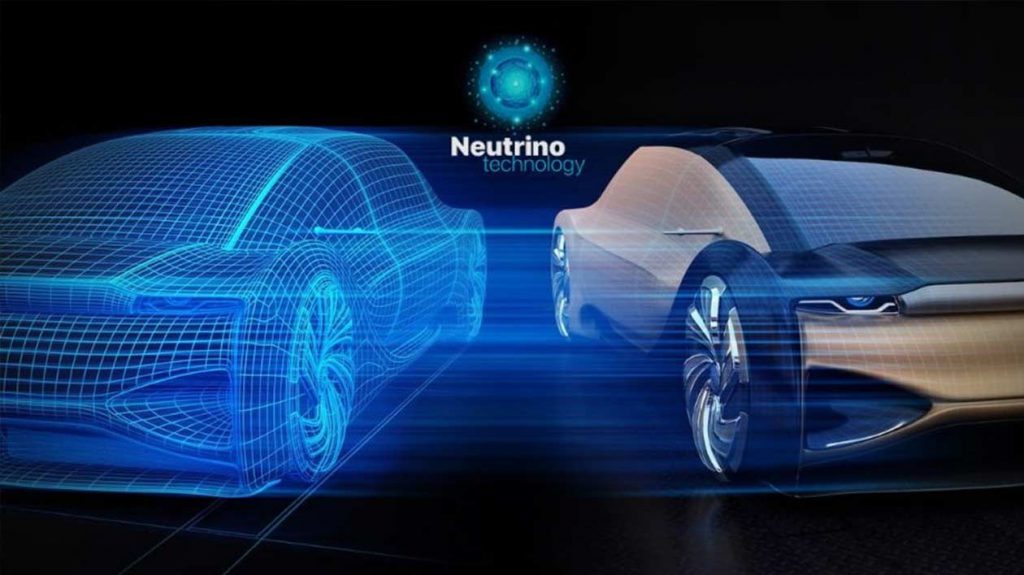
The Neutrino Energy Group is actively developing neutrino photovoltaics for various applications, including the production of a Pi-Car with neutrino photovoltaics built into the body. Neutrino photovoltaics not only complements existing alternative energy sources but, thanks to its enormous advantages compared with other alternative energy sources, can capture a large part of the power generation market:
- Neutrino energy cubes can be set up directly where the energy is consumed, without building power lines, which avoids transmission losses.
- Very low maintenance costs
- 24 hours a day, 365 days a year, regardless of weather conditions, baseload operation.
- Compactness.
- The neutrino energy cube will have both DC and AC outputs, including 380 V.
Industrial production of the neutrino energy cube will start in several countries in the next 2–3 years, including China. China has a group of highly qualified scientists, and Chinese experts have repeatedly proved that they can build plants quickly and to a high standard. In 2017 they founded a research and development centre for neutrino photovoltaic applications in Shenzhen, “Guanwei New Energy Co. Ltd”. With the Chinese leadership’s Agenda 2060 “Energy and environmental protection” and the carbon neutral programme aimed at China’s gradual exit from fossil fuels, the Neutrino Energy Group sees potential for far-reaching cooperation with China in implementing neutrino photovoltaics as part of the “energy transition” and China’s move away from generating electricity from fossil fuels. “We are interested in close cooperation with Chinese companies and experts,” says Holger Thorsten Schubart.
The Pi-Car
Study of an electric vehicle completely independent of charging stations, developed and produced by the Neutrino Energy Group:
The Neutrino Energy Group
The Neutrino Energy Group is a German-American research group. Its aim is to find ways to harness the power of the invisible radiation spectrum. As fossil fuels are limited and climate change requires the development of alternative and CO2-neutral energy sources, this research group is dedicated to an urgent problem. It has succeeded in creating a dense substance that can interact in a specific way with neutrinos and other invisible radiation. This unique substance is used to build the first neutrino photovoltaic cells for power generation. Vapour-deposited layers of silicon and doped graphene are applied to the carrier layer to make the end product. The thickness of these layers is in the nanometre range. When neutrinos and other invisible radiation strike this substance, they generate both horizontal and vertical impulses. It is crucial that the doped materials have the right layer thickness. At the optimum layer thickness, the atomic vibrations caused by the impulses are brought into resonance. As a result, an electric current can be detected in the substrate material. The hypothesis states that the amount of energy that can be harvested depends on the distance travelled in the process. With this approach it will soon be possible to charge electrical devices anywhere in the world without needing a socket or a cable. Simply “collecting” energy from the environment is a viable option. As a result, humanity will have access to an endless supply of clean energy, which will help to slow or halt global warming.
The Neutrino® Energy Group works with a worldwide team of scientists and various international research centres. They research applications for converting invisible radiation spectra of the sun, including neutrinos – high-energy particles that reach the Earth incessantly and can be converted into electrical energy.
The image rights lie with the author of the press release.
Notes on content provided by authors
Comments
Loading comments …
Become a member to comment publicly. GAIA members write comments in the members' portal — under their nickname, visible to everyone.










