Scholé news December 2019

For the 30th anniversary of children’s rights on 20 November 2019, the unschoolers
sent their concept ALTERNATIVES TO THE ANNUAL EXAMS to all school authorities and to the children’s and youth ombudspersons. At www.freilerner.at (German) you can follow how the campaign develops, and perhaps even add your name to the list of supporters. In any case, we are no longer alone: under the title VERBILDET BILDUNG? (Does education miseducate?) – a plea for personality development as a fundamental guiding principle – the head of the Centre for Personality Development and the Promotion of Talent at the University College of Teacher Education in Linz has published an explosive essay that ought finally to shake up those responsible at the Ministry of Education:
Precisely because school inevitably shapes people, the existing school and education system must be fundamentally questioned.
“Schafft die Schule ab” (Abolish school), Oliver Hauschke vehemently demands on the cover of his new book, adding in the subtitle by way of justification that school “does not educate our children” and therefore “must be changed radically”. I would like to contradict this and argue that school does indeed have to be changed radically (or rather: would have to be), but precisely because it does educate our children – or rather miseducates them. To justify this thesis, I start from a well-known quotation by Paul Watzlawick: “One cannot not communicate.” And I adapt this quotation for school: “One cannot not bring up” – or, put a little more cautiously: “One cannot not enter into a relationship”. Teachers who claim to be responsible solely for passing on subject knowledge, while upbringing is solely a matter for parents or the family, are therefore mistaken. For “passing on” is a relational concept which, in the school context too, refers to a social relationship between people. So even “pure knowledge transmitters” pass on values, even if they are the “values” of social distance and indifference.
But if school cannot not bring up – or let us rather say: educate –, if the shaping of human beings inevitably takes place at school, then the immediate question is what image of the human being it is based on, and what school upbringing and education should aim at, what its educational “telos” should be. To answer this question I refer – by way of example! – to the current curriculum of the Neue Mittelschule (Austria’s lower secondary school). It says, among other things (countless other passages could be quoted):
“Teaching must actively contribute to a democracy committed to human rights. The ability to judge and criticise as well as the competence to decide and act are to be promoted; they are decisive for the stability of pluralistic and democratic societies. In an increasingly international society, pupils are to be given an openness to the world that is borne by an understanding of humanity’s existential problems and by shared responsibility. Humanity, solidarity, tolerance, peace, justice, equality and environmental awareness are values that guide action.” (Federal Law Gazette II No. 230/2018, p. 4)
What does the reality of school look like by comparison? Does it not rather confirm the harsh criticism of school and the system that has been voiced at least since Leo Tolstoy, via Ellen Key, Janusz Korczak, Virginia Woolf and Ivan Illich, through to present-day authors such as Richard D. Precht, Ulrich Klemm, Ulrike Kegler, Ken Robinson, Bertrand Stern, Oliver Hauschke and the various unschooling communities, who unanimously argue that, for systemic reasons, school cannot possibly fulfil its very own mission? Does the “regular school” not still (“as a rule”) treat children not according to their individual needs, but rather like geese being force-fed, who must cram compulsory material into themselves without being asked, only to throw it back up at the next test in exchange for a “mark”, after which they can safely forget it again? And above all make no mistakes, because mistakes are the yardstick of assessment, the yardstick of whether one is a “good pupil” or a loser. To put it provocatively: what exactly do the F4F kids miss at their Friday demonstrations? Is it not merely the material they would have forgotten after the next test anyway?
None of this has anything to do with indiscriminate teacher-bashing! For within these systemic requirements, teachers for their part have always been faced with the impossible task of “leading a hiking group of top athletes and disabled people through rough terrain in fog in a north–south direction, in such a way that everyone arrives in the best of spirits and as far as possible at the same time at three different destinations.” That cannot be done!
Let me take up another aspect, that of democratic education, understood as the education of mature, open-minded, politically competent citizens of a vital democracy – an urgent, indeed existential need of a free and democratic society. Is that possible with force-feeding pedagogy? Is school, as a structurally undemocratic or even anti-democratic institution, the right place to develop democratic awareness and a democratic attitude in the sense defined in the curriculum? At this point I refer to Herbert Renz-Polster’s current book, in which a well-known basic idea is examined thoroughly and in a nuanced way: “Erziehung prägt Gesinnung” (Upbringing shapes mindset). But what mindset is shaped in “regular school”? That of conformist, passive recipients of instructions, of listless dutiful workers – and of course that of well-behaved, compliant consumers. But this clearly contradicts a substantial, democratic and critical self-understanding.
Measured against the lofty general goals of the curriculum (or rather curricula!), the school system thus fails to a large extent; it stands in its own way, so to speak, and suffers from structural self-contradictions (under which teachers suffer just as much as pupils). And that is precisely why this system must be changed radically – not because it “does not educate”, but on the contrary, because it miseducates.
In an education system in which the general educational goals defined in the curricula were really to be achieved, (appropriate) personality development would therefore have to be the aspect, the orienting category, the fundamental guiding principle – whether in schools or in tertiary teacher training institutions.
But to achieve this – and here I join the chorus of old and new critics of school – school would indeed have to be changed radically and structurally – or else abolished.
Thomas Mohrs is head of the Centre for Personality Development and the Promotion of Talent at the University College of Teacher Education Upper Austria
Literature:
- Hauschke, O. (2019), “Schafft die Schule ab” (Abolish school): Warum unser Schulsystem unsere Kinder nicht bildet und radikal verändert werden muss (Why our school system does not educate our children and must be changed radically). Munich (mvg Verlag).
- Renz-Polster, H. (2019). “Erziehung prägt Gesinnung” (Upbringing shapes mindset): Wie der weltweite Rechtsruck entstehen konnte – und wie wir ihn aufhalten können (How the global shift to the right came about – and how we can stop it). Munich (Kösel).
Many thanks, dear Prof. Thomas Mohrs, on behalf of the many teachers and learners who suffer under the current school system!
With happy winter greetings, Alexandra
P.S.: As newsletters are not easy to forward, here is a link where the Scholé News have been published as posts for some time now: https://gaia-energy.org/tag/schole/
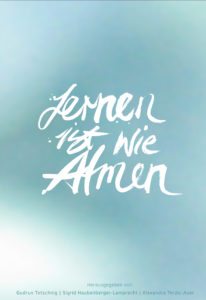
Book tip – “Lernen ist wie Atmen” (Learning is like breathing)
Together with two unschooling mothers, Gudrun Totschnig and Sigrid Haubenberger, we published it ourselves.
We all feel that the time is ripe for this many-voiced account of how unschooling can be lived in practice. Order your own copy on the GAIA marketplace, with a 10 % discount for members. The book is in German.
Notes on content provided by authors
Comments
Loading comments …
Become a member to comment publicly. GAIA members write comments in the members' portal — under their nickname, visible to everyone.