Scholé News May 2021
This time I am sending you an article on EDUCATIONAL FREEDOM that I have just written for the magazine “unerzogen”.
This article is the fifth and last in a series of articles on free learning. My friends from the association freilerner.at – Susanne Sommer, Sigrid Haubenberger, Gudrun Totschnig, Marie-Sophie Frei, Heidrun and Harald Krisa – are all active free-learning parents and have already described various aspects of this way of life in detail, from the legal situation to findings from cognitive science. What I can contribute is the outside view of a sympathetic observer, for I myself belong to another generation and only encountered free learning when my children had already left school.
My personal experiences at 7 different schools are linked with numerous traumatic memories. In classrooms and boarding-school dormitories I always felt as if I were in prison, locked out of the real world. How many exciting things I could have done if I had been free! As it was, my only escape was into the imaginary worlds of books, which I devoured ravenously. When I tell young people what I experienced in Catholic boarding schools, it sounds to them like a horror story from the distant past. Yes, such stories really do belong to a distant past, for in the 50 years since the end of my schooldays much has noticeably improved in our education system – at least on the surface. The basic structure of the system, however, seems to me to have remained the same, for there is a hidden curriculum that the multi-award-winning teacher John Taylor Gatto saw through with crystal clarity and brilliantly described in his book “Dumbing Us Down”. This hidden curriculum ensures above all that children are raised to be functioning cogs that keep the existing system running.
The budget for the bloated civil service apparatus, which tirelessly devises new laws and regulations, rises year after year. How children, parents and teachers are really doing in everyday school life is secondary. Most learners and teachers have to make do with pious wishes and fine phrases about promoting creativity, school autonomy, unfolding potential and so on. As a rule, such buzzwords of modern pedagogy are far removed from reality. Although many committed teachers try to counteract this with great personal effort, the rigid structure of the system ensures that almost all educational institutions in our consumer society continue to produce dependent, passive and gullible consumers.
For many years I stood up for children who, for various reasons, could not manage the adaptation to this system that school demanded. Among them were so-called less gifted children as well as so-called gifted and highly sensitive ones. Anyone who deviates too far from the desired norm of the pupil who is willing and able to adapt must expect to be stigmatised. The special talents each of my charges brought with them did not interest those in charge. They saw only their “school deficits” and recommended various therapies whose sole aim was to make the child fit for school as quickly as possible. All suggestions to adapt the system to the needs of the children instead fell on deaf ears or met with open indignation. Although I got terribly angry about this many times, I never had the obvious idea of simply turning my back on the system at some point…
I owe this aha moment to André Stern. His book “…und ich war nie in der Schule” (… and I never went to school) suddenly showed me the way out. Despite all my disappointment over half-hearted or failed school reforms, I had never dared to think such a “radical” thought until then. So I first had to experience in my own life how deep the unconscious programme sits that was instilled in all of us in childhood! That is why I feel great compassion for anxious parents who cannot imagine education as anything other than schooling. For I remember only too well how long it took me to notice the blinkers I was wearing and to think beyond this seemingly immovable boundary.
My next step towards liberation was a trip to the legendary Schetinin school in November 2013. In the Russian village of Tekos I saw with my own eyes what young people are capable of when they are allowed to follow their inner impulses for learning and growth. The approximately 150 girls and boys aged between 9 and 18 whom I met there radiated serious self-confidence and cheerful inner calm. Their days were filled with physical and mental activities they had freely chosen. They organised their community projects themselves, according to the needs of everyday life, natural conditions such as weather and season, the goals they had set together and the particular wishes of individual participants. They were supported by learning companions who were hardly older, mostly graduates of the Schetinin school. The learning companions’ task was to intervene as little as possible and only to make sure that everyone always felt well: physical, emotional and mental well-being was recognised and taken seriously in Tekos as THE decisive prerequisite for successful learning and development!
Visitors could marvel at every turn at the fruits such an attitude bears: the pupils had built, furnished and decorated the houses in which they lived and worked with their own hands, with carvings and murals. They had largely planted and harvested the vegetables that came to the table themselves. For the virtuoso singing and dance performances with which they occasionally even appeared in public, they had sewn the costumes themselves and worked out the complex choreography together. In Tekos there was a library and an internet connection, but no curricula, no grades, no classes, no lessons. Groups of four to ten pupils joined together to acquire certain fields of knowledge with the help of diagram work. Diagram work is a very creative method, actively developed further by each individual group of pupils in Tekos, in which emotional access to a topic plays at least as important a role as the cognitive content at hand.
Filled with these overwhelming impressions, I returned to Vienna and, together with a friend, founded an association to promote free, self-determined learning. To show anxious, worried parents that their children have unsuspected abilities, we held courses in seeing without eyes. Mums and dads were amazed when their children could often recognise colours and shapes after just half an hour, even though their eyes were covered by opaque black glasses. The effect on the children was even more convincing: the newly discovered ability noticeably strengthened their self-confidence – but only as long as their parents shared their joy! When a suspicious father accused his son of cheating on the way home, the ten-year-old burst into tears and from then on really could not see anything blindfolded…
Through our association I got to know and love more and more pioneers of self-determined learning personally. These families need support only in legal matters; otherwise I have never met more lively and present adults and children. Outsiders often think that people who are charged by the authorities as lawbreakers and regularly sentenced to pay fines are under constant stress. In reality, most free-learning parents experience only short phases of angry despair when they have once again failed to make courts or youth welfare offices understand their position: that as parents they feel obliged to defend their children’s right to self-determination to the best of their knowledge and belief, while the officials stubbornly invoke the letter of a dead law…
In the long calm phases in between, free-learning families lead a far more relaxed and peaceful life than families with children who have to go to school every day. It is precisely this undisturbed self-determined life that is a thorn in the side of the authorities. No wonder, for it really does shake the foundations of the subject state to which they owe their posts and which they are supposed to uphold. For the state authorities, the child’s welfare is a general legal concept. Whether the individual child actually feels well is not even up for debate. Several times I have seen educationalists and psychologists appointed by judges only able to confirm that the free-learning children they had to assess lacked nothing – except the school reports that Father State still defines as indispensable proof that the child’s welfare is being safeguarded. A young person without school qualifications has no chance in working life, according to a ruling of the Supreme Court. From countries where unschooling is legally permitted, there are numerous studies proving the opposite. But these studies were deliberately ignored by the Austrian courts.
Since I work professionally with kinesiology and systemic constellations, meeting the free learners was a particularly happy coincidence for me. My profession has taught me that physical or emotional problems are almost always a sign that a person has strayed from their individual path in life. Because the kinesiological test makes it possible to access a person’s information field, I can pass on to those seeking advice the tailor-made answers from their own inner self. My work is therefore about making the inner voice of people seeking help audible to them again. This incredibly varied and enriching work of translation confirms the attitude of the free learners: however different people’s needs and problems may be, the healing message from within is basically always the same: “Follow your impulses! Trust life! Go your own way and don’t worry about what others say. Only then can you fulfil your unique purpose in life and be happy!”
Day in, day out I deal with the suffering of people who have been so confused by external circumstances and internalised constraints that they no longer perceive their own dreams and needs at all. The few who have become aware of this are only the tip of the iceberg, for on closer inspection we live, as a whole, in a society traumatised by self-alienation. Finding one’s way back to one’s own track, from which most were pushed as small children, is hard emotional work and can take years or decades. What a gift it is when a child does not have to leave its unique path! No more valuable gift is conceivable, for a person whose needs and heartfelt wishes were respected in the decisive formative phases of childhood will respect themselves, their fellow human beings and nature throughout their life. And they will also not need external incentives such as fame or wealth in order to fulfil their purpose in life joyfully.
Unfortunately, there are only a few such lucky children in our civilisation. The free-learning children I have had the privilege of getting to know personally are definitely among them. From them I was able to study how differently and diversely individual paths of development unfold and how much the parents, too, grow mentally and emotionally as they mindfully accompany their children. I have watched in amazement how little children need whose natural needs are taken seriously. How soon they justify the trust placed in them by showing, at an early age, a quite unusual degree of self-esteem, self-confidence, independence and competence in mastering the tasks they have chosen themselves. Their behaviour also proves how absurd the common opinion is that children need the compulsory company of their peers for social reasons. No – children are by nature social, cooperative beings and find friends among people of all ages if they are allowed to choose them themselves and are not brought up to compete with their peers!
What our society owes to the courageous parents who enable their children to grow up in freedom cannot yet be estimated. From the outset, these children bring with them the necessary prerequisites to create a cooperative, peaceful new world. Since the beginning of the coronavirus crisis, it has become increasingly clear that we cannot go on living as before. The tug-of-war between security and freedom, heteronomy and self-determination, is coming to a head. Constant tests, compulsory masks and the threat of compulsory vaccination at schools have opened the eyes of many sensitive people. More and more parents, grandparents and even teachers are daring for the first time to say out loud that our current school system is obviously not geared to the well-being of children.
Some of them, who had long toyed with the idea of turning their backs on this system, are now finally finding the strength under the pressure of circumstances to stand up actively for themselves and their children. Fathers, mothers and committed teachers are joining forces to found new places of learning as associations, where children are really to be given the chance to develop their innate potential freely. Incidentally, the Schetinin school, which was closed in 2019 after the death of its founder, is now also looking towards a new future: young educators from Germany and Austria, together with former pupils of Mikhail Schetinin, are working to spread his ideas and to reopen the school in Tekos.
Tekos is a large boarding school – from the outside, the exact opposite of free learning in the smallest setting of one’s own family. But in both places I have met only contented children. Bullying, or the motivation and discipline problems so feared by parents and teachers, seem to exist neither in Tekos nor among the free learners. What do these seemingly opposite forms of education have in common?
- Trust in the nature of the child. Every child is by nature designed to learn and to unfold its potential step by step. Nobody may – indeed, nobody should – force it into this extremely pleasurable activity! What matters, rather, is that the child feels well and is surrounded by mindful, loving people; everything else then follows as if by itself. The title of a book about experiences with self-determined learning that I published together with Gudrun Totschnig and Sigrid Haubenberger expresses this idea very clearly: “Lernen ist wie Atmen” (Learning is like breathing).
- Respect for the child’s right to self-determination. In Tekos, of 100 applicants no more than one or two remained who could fit harmoniously into the existing community and absolutely wanted to stay there. In some free-learning families with several children, some want to stay at home while others at some point decide to attend a school or a learning group. Their parents respect both.
The many committed people who are currently founding new places of learning will, I believe, only be successful in the long term if they adhere to these two principles. The question of which learning method would be best will hopefully soon become as superfluous as endless discussions about the necessary teaching materials, the ideal size of a learning group or the required training of teachers or learning companions, on which many alternative education projects have already foundered. All these questions are features of the old education system, in which the focus was on the achievements demanded by the system and the certificates awarded by the system. As soon as we turn our gaze around and focus on the needs of the children actually in front of us, we adults learn to see the environment we are in through their eyes. In any setting, whether inside a building or outdoors, in the countryside or in the city, unspoilt children keep discovering new possibilities to play and in doing so to discover themselves and the world. Voluntary learning is thus nothing other than play!
From us adults, children and young people need only loving companionship, answers to their questions, sometimes an escort and, in any case, sincere joy in their discoveries. Whatever else they would like, the children will tell us – and we will be amazed at how modest most of their wishes are. Let us throw our fears overboard! Let us rather look forward to the wonderful surprises that could await us if we embark on the adventure of freedom. For not only in our children but also in ourselves we will experience how much unused creativity is in all of us and what we are capable of when we act truly voluntarily and from the deepest conviction!
With green-and-golden May greetings Alexandra
Newly revised: “Lernen ist wie Atmen” (Learning is like breathing) as an eBook
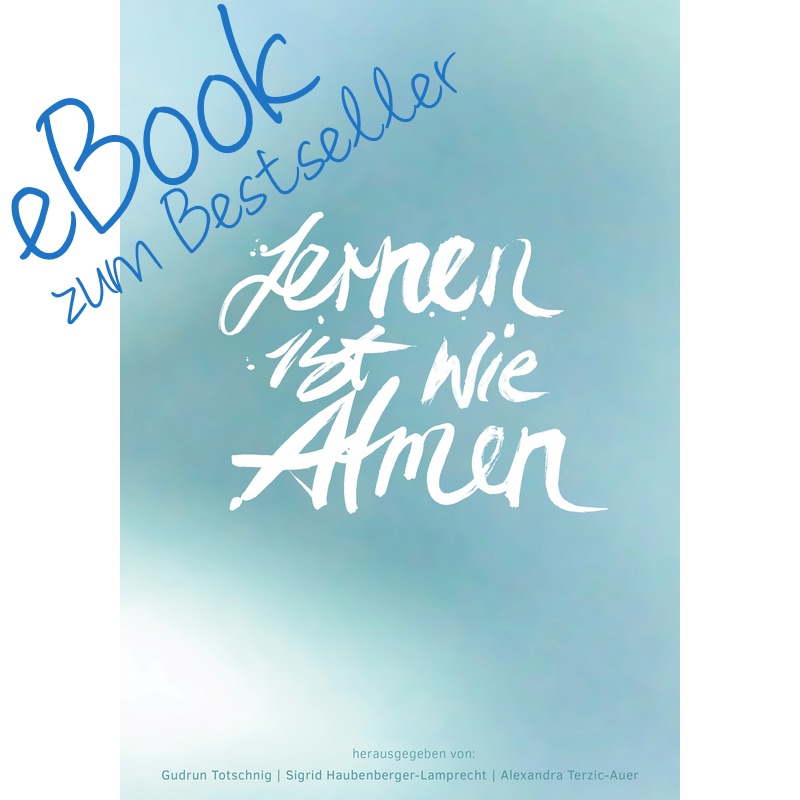 Together with two free-learning mothers, Gudrun Totschnig and Sigrid Haubenberger, we self-published it and have now also made it available as an eBook (in German).
We feel that, especially in this time of distance learning, experiences from free learning can help people find their bearings.
Let the reading sample inspire you, or buy the eBook as a PDF on the GAIA marketplace. GAIA members get a 10% discount when ordering.
Notes on content provided by authors
Comments
Loading comments …
Become a member to comment publicly. GAIA members write comments in the members' portal — under their nickname, visible to everyone.