Scholé news January 2021
Last week I was invited to a 90-minute Zoom meeting
organised by a professor at the University of Teacher Education in Linz. The topic of this philosophicum was “homeschooling or learning”. A desperate mother described her everyday life with a baby, a toddler and a bright school starter who is interested in everything except completing boring school assignments under his mother’s supervision.
One case that stands for tens of thousands of similar ones: the teacher passes on the pressure the school authority puts on her one to one. She makes the mother afraid that her child might not reach the class target, whereupon the mother puts pressure on the child, who desperately resists being forced to learn. Brain-friendly learning is indeed impossible under such conditions, so the child’s behaviour is entirely justified. The mother senses this too, but stronger than her natural urge to stand by her child consistently is her own fear of not meeting the system’s demands. And so, against her will, she becomes an accomplice…
We have all experienced scenes like this countless times. Behind them lies a concept of education (in German, Bildung) closely related to words such as Bühnenbildner (stage designer), Maskenbildner (make-up artist) or Marionetten-Bildner (puppet maker) – in other words, one based on artificial control: it gradually turns living children into talking dolls who parrot whatever the script called a curriculum dictates. Instead of running around, playing together and curiously exploring the world, they have to sit still, learn to read from boring texts, draw numbers and letters or click on them on a computer. As a result, they have to systematically suppress their homesickness, their urge to move and their own interests. Because they could not bear the pain of this, they have no choice but to repress their true feelings. They still look like human beings, but they act like puppets. For whether something is right or not, whether it is beneficial, neutral or harmful to them, each individual can only find out through their living feeling. Once they have cut themselves off from it, they become a will-less tool. They now need leadership – an authority that tells them what they (like everyone else) should believe, do or not do.
Self-determined people stand up for a completely different concept of education, one that does without artificial control and is related to words such as Gebirgsbildung (mountain formation), Blütenbildung (flower formation) or Fruchtbildung (fruit formation). It describes a natural process that develops according to its own laws rather than to a predetermined plan. Of course the natural educational process must also be accompanied by adults, but its driving force comes from within, from the living feeling that guides each individual along their own path and protects them from manipulation. Advertising brochures for educational institutions like to invoke this natural concept of education with terms such as individualisation or unfolding of potential, because advertising appeals to feelings. A jumble of laws and regulations, however, ensures that in everyday school life teachers mostly end up orienting themselves towards the puppet concept after all.
That is why I believe we must finally distinguish precisely between the two concepts of education in theory, even if in practice they hardly ever occur in pure form, but rather in varying mixtures. Where the fundamental distinction between training according to a curriculum and the free unfolding of potential is missing, discussions about education simply go round in circles. And experience shows that in the end everyone is frustrated, and once again the call goes out for new laws, more school subjects, even more money and even more control – although nobody has been able to find their way through the impenetrable thicket of official regulations for a long time.
Above all, though, it is high time to turn our attention around by 180 degrees: from problem-focused thinking to solution-oriented thinking. There are so many positive examples – in mainstream schools, in private schools, among homeschoolers and unschoolers – that deserve to be brought into the spotlight! They stimulate the imagination and encourage diversity. I would like to see discussion rounds in which each participant presents a concrete, constructive example and describes in detail what particularly impressed them about it. The differences and similarities between the projects presented could then become the subject of a lively exchange of views from which everyone takes something away.
At the philosophicum last week I tried to steer the discussion towards positive examples, but the suffering that enforced homeschooling is currently causing teachers, parents and children was too great. The educators and parent representatives present needed to vent their frustration. For the first time, however, I had the impression that the structural, systemic aspect of the problems is coming to the fore: more and more people are beginning to understand that this is where the real problem lies. That is the desired side effect of the dramas we are currently experiencing: pain and anger contribute to awakening.
That, sadly, the majority of people are still cut off from their living feeling becomes particularly clear in times of corona, of course. Although we have unprecedented access to information, the complexity of the medical, economic and political aspects of this crisis cannot be grasped by the intellect alone. Not even by the brightest minds. Whether someone becomes a follower or a dissident in times of crisis, however, has never been a question of intelligence, but always a question of character and depth of feeling. But how many people are brave enough, or even still able, to listen to their hearts?
What is one to say when journalists who have studied the rise and fall of dictatorships (perhaps even the conspiracy, uncovered thanks to WikiLeaks, through which the Iraq war was started in 2003) do not shy away from portraying small children as a danger to old people when they hug their granny?! Yet anyone who dares to call billion-dollar pharmaceutical companies that test insufficiently researched vaccines on elderly people a danger is immediately branded a conspiracy theorist by the same journalists. And the mass of readers, listeners and viewers dutifully adopts the view of the leading media – which is probably where the term “leading media” comes from :-))
For people who would rather distrust small children or their closest friends and relatives than question the good intentions of the powerful, I recently came across the lovely term CONSPIRACY DENIERS in the wicked alternative media :-)
Of course the alternative media scene, too, should be taken with a pinch of salt, above all because it is a playground for the secret services. Thanks to almost unlimited financial and other resources, it is easy for this invisible power apparatus to recruit plenty of often well-meaning people: by deliberately planting half-truths or fake news, they are meant to sow confusion and discredit the operators of alternative channels. Here, too, one can only trust one’s feelings. In any case, I am glad and grateful that these free internet media exist. For me they are a kind of antidote to the scaremongering of public broadcasting. Consumed in excess, of course, they can stoke fears and discourage all the more. That is why one should not stop at listening to and watching alternative news.
To my great joy, over the past months the sharing of links and personal comments has given rise to a truly worldwide community of global citizens and local activists, welded closely together by their spirited resistance against inhumane measures. What unites them is their determination, in the global struggle between heteronomy and self-determination that we are witnessing, not only to obtain or spread background information but also to give their personal best: although they are constantly confronted with defamation, disinformation campaigns, police harassment and censorship, these dissidents are determined not to continue the cycle of hatred and violence.
Nor do they want to be divided any longer into right and left, believers and non-believers, old and young, educated and uneducated. They try not to react to defamation with anger, to fend off attacks by peaceful means, to replace confrontation with meditation, and to trust the voice of their conscience rather than promises of security. They refrain from mouthing empty phrases and prefer to argue with hard figures and facts. In the midst of the crisis they nevertheless want to focus on the positive and use every opportunity to contribute to their own well-being and that of other living beings. Of course they do not always succeed, for they are people like you and me :-)
But the selfless actions of the first courageous dissidents have created a pull that attracts more and more like-minded people and lets them grow beyond their fears and worries. Strengthened by the feeling of not being alone, they too are now rolling up their sleeves, trusting in the victory of good and celebrating life in all its colourful diversity. A critically minded old lady said to me on the phone yesterday: “We are seeing so much suffering and depression everywhere right now that one is almost obliged to be cheerful!”
That we may all come through the turbulence of 2021 strengthened and cheerful – that is my heartfelt wish for all of us!
Alexandra
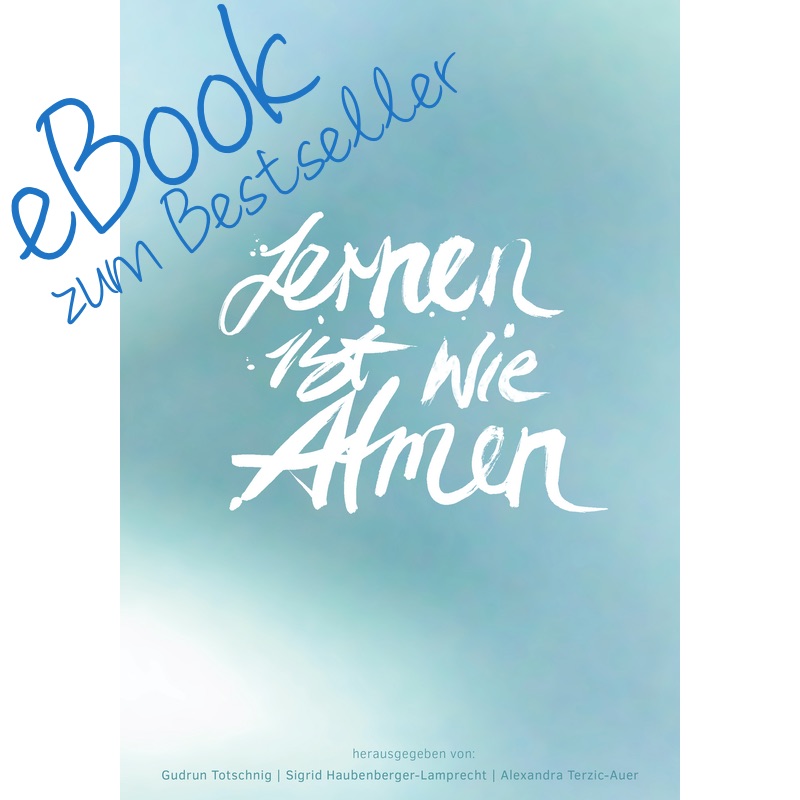
Now revised – “Lernen ist wie Atmen” (Learning is like breathing) as an eBook
Together with two unschooling mothers, Gudrun Totschnig and Sigrid Haubenberger, we published it ourselves and have now also made it available as an eBook.
We feel that, especially in this time of distance learning, experiences from unschooling can help people find their bearings. Let the reading sample inspire you, or buy the eBook as a PDF on the GAIA marketplace (the 10 % member discount applies here too). The book is in German.
Notes on content provided by authors
Comments
Loading comments …
Become a member to comment publicly. GAIA members write comments in the members' portal — under their nickname, visible to everyone.