Open letter to the education authorities, 2020/02
“You are not what you intend to do, but what you do.” C. G. Jung
Dear officials responsible for the Austrian education system,
There is a wide gap between the goals and the results of the Austrian education system. For decades it was assumed that this gap could be closed simply by investing more: more money for new schools, more staff, more school subjects, more childcare and so on. It is understandable that you, as civil servants working in education, have traditionally been concerned above all with legislation aimed at extending state childcare (the right to a nursery place, a further compulsory year of kindergarten, all-day schools, holiday care, compulsory education or training up to the age of 18 and so on). Most people regard such measures as social progress, and in many cases that is true, because of course there are winners in this development. You yourselves very probably belong to the many people whose personal memories of school are mostly positive. School prepared you well for your career in public service, and the extension of care hours, controls, evaluations and the like improves your career prospects.
If you look at the facts and figures without prejudice (for instance in the official Austrian national education report), however, you cannot close your eyes to the fact that there is evidently a growing number of children and young people whom our education system does not serve. Very few of them can turn to expensive private alternatives. But since these children, too, depend on your goodwill, I warmly ask you to change your perspective for a moment and put yourselves in the shoes of those who lose out in our current education system:
The very youngest, who suffer lasting emotional harm because their bond with their parents was broken off too early. The sensitive oddballs who, for all sorts of reasons, feel like outsiders at kindergarten, in the playground and in the classroom. The children who do not fit the norm and are labelled “gifted”, who are unhappy in lessons out of boredom. The children who do not fit the norm and are labelled “not gifted enough”, whose self-confidence is broken early on at school. The children who love to move and spend their whole school career feeling like caged animals. The victims and perpetrators of bullying, both of whom develop disturbed social behaviour. The school “good-for-nothings”, school refusers and dropouts whose manual, entrepreneurial, social or artistic talents go undiscovered and wither because the education system offers them no room to develop. The many committed teachers who no longer feel able to cope with everyday school life.
When burnout rates among teachers are rising dramatically and, according to the Medical University of Vienna, 24.6 % of 10- to 18-year-olds are already mentally ill or under psychological strain, surely alarm bells should be ringing for you too! If the young people affected were able to put the cause of their problems into words, they would first name the unbearable stress caused by standardised expectations at school and at home. Asked in depth, psychologists and therapists would also confirm that it is the growing pressure at school to conform to norms that intensifies existing strains and creates new ones.
When a schoolchild costs the Austrian taxpayer more than €10,000 a year on average, and yet 40 % of pupils in compulsory education still cannot read and do sums well enough to “connect” to further learning after eight years of lessons, it is time to question the STRUCTURE of our education system. These many “failed” young people are not all hopelessly stupid, nor did they always have only bad teachers, nor are they victims of irresponsible or educationally deprived parents! Such a catastrophic result rather raises the fundamental question of who has to adapt to whom: should teachers and learners continue to adapt to the rigid requirements of our education system? Or will this education system finally be adapted to people’s real needs?
Why should experienced teachers have to put up with politicians meddling in their craft? Although the largest meta-analysis carried out to date, by John Hattie, covering more than 50,000 individual studies, found that marks contribute almost nothing to learning success, Austrian teachers are now to be forced, in some cases against their convictions, to give marks to young children again? In the official school guidelines, the legislator has laid down highly welcome educational goals. Are these guidelines – creativity, the unfolding of potential, school autonomy and so on – to remain nothing but hollow advertising slogans? Or can parents and teachers, to whom the well-being of the next generation is entrusted, actually follow them and, if in doubt, invoke them?
Unfolding potential means nothing more and nothing less than supporting each individual learner as well as possible in following his or her own inner learning plan. Wherever people put this concept into practice without lazy compromises, they very soon find that the ratio of effort to results improves dramatically. Most of you will have observed in small children how natural learning processes unfold: nothing but love and attention is needed for a baby to learn to crawl, walk and talk – each in its own way, one earlier, another later.
Education experts do not need to invent new solutions, because they already exist – thanks to visionary people who have recognised that we cannot prepare today’s children for tomorrow’s challenges with yesterday’s methods. They are clever, curious people who have seriously engaged with the findings of neurophysiology and cognitive science. Mindful, compassionate people who are aware that every child is unique and incomparable, which is why any attempt to standardise them does them violence. They are active, committed people who no longer want to work with coercion and pressure, but do everything they can to create inviting places of learning for those who fall by the wayside in today’s school system.
Against all outside resistance, individual pioneers have already created alternative places of learning that take to heart the insight that TEACHING and LEARNING can easily come into conflict: LEARNING is an active process, an interplay of heart, hand and head steered by intrinsic motivation. TEACHING, on the other hand, turns others into passive objects unless they have asked to be taught. In their daily life with children whose innate curiosity and enthusiasm they were determined to preserve, educational pioneers have recognised that binding curricula and compulsory examinations on “the syllabus” often hinder individual learning processes more than they help them (hence the high dropout rates in the conventional school system). Humanity’s knowledge is growing and changing at a breathtaking pace. Today’s children have learning paths open to them that we could not have dreamed of only a few years ago. Why should we limit these many opportunities to cramming dusty school material?!
Reforms of the education system meant to strengthen creativity and personal responsibility are announced again and again. Such reforms cannot be decreed from above. They have to come from below, from creative, self-responsible people who are prepared to stand up for their convictions. As those responsible for education, please support such private initiatives and be prepared to learn from them! Many a promising project has soon foundered on lack of money and on the authorities’ lack of understanding. Please change course and decide to cooperate with progressive educational initiatives inside and outside the school system! The Austrian education system, one of the most expensive in the world, will not be able to avoid profound change. Its future lies in a commitment to diversity and in fruitful cooperation between the authorities and civil society.
A first step in this direction would be FREE CHOICE IN EDUCATION to safeguard the welfare of children. It would give parents back their responsibility. It would spur teachers on to give their best. In conventional schools, the atmosphere in lessons would ease noticeably as soon as the “troublemakers” could switch to alternative or informal educational paths. FREE CHOICE IN EDUCATION would give officials far more room for manoeuvre. It would give taxpayers adequate results for their money and help employers find the motivated, creative staff they are already desperately looking for. Above all, every child would then really have the chance to unfold its individual potential by taking the educational path or paths that best suit its particular talents and needs.
In the unbroken hope of a thaw – warm early-spring greetings, Alexandra
P.S.: As newsletters are not easy to forward, here is a link where the Scholé News have been published as posts for some time now: https://gaia-energy.org/tag/schole/
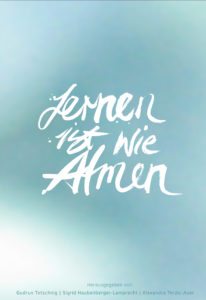
Book tip – “Lernen ist wie Atmen” (Learning is like breathing)
Together with two unschooling mothers, Gudrun Totschnig and Sigrid Haubenberger, we published it ourselves.
We all feel that the time is ripe for this many-voiced account of how unschooling can be lived in practice. Order your own copy on the GAIA marketplace, with a 10 % discount for members. The book is in German.
Notes on content provided by authors
Comments
Loading comments …
Become a member to comment publicly. GAIA members write comments in the members' portal — under their nickname, visible to everyone.