Scholé news September 2019
As early as the 1930s, an American educator dared to do something
that most of today’s education experts sadly lack the courage to do. Louis Paul Benezet put himself in the children’s position and thought about what they should become: independent-thinking adults, or people who need precisely prescribed rules for every situation in life because their thinking has not been schooled but over-schooled.
Instead of struggling with arithmetic rules, he thought, children should first learn to express themselves precisely in language and to develop their innate logical abilities through concrete tasks. For this, it would be enough to read them lots of stories, to explore topics that interest them, to let them tell of their own experiences and to gradually familiarise them with distances, heights, lengths and differences in weight. Based on these ideas, he developed a remarkable experiment that turned common teaching concepts on their head.
Last week, Radio Orange broadcast a programme with the education spokespeople of the ÖVP, SPÖ, NEOS and the Greens. The presenter, Michael Karjalainen Dräger, had invited an unschooling mother and me to put questions to the politicians. Their answers revealed that they know hardly anything about unschooling, but at least nobody spoke out against it publicly. The unschooling mother gave the education officials present some information material on informal paths of learning, and I took the opportunity to hand them a paper about an astonishing educational experiment. If its results were taken seriously, it could make life enormously easier for many pupils – which is why I am so keen to spread it!
In every family I know there are people with maths traumas – from the primary school child struggling with arithmetic homework to the grandfather who for many decades has had to resit his maths A-level exam (Matura) in his nightmares… Benezet’s experiment made it clear to me why:
Dear representatives of Austrian education policy,
As the politicians responsible for education, you are facing a dramatic situation: according to the national education report, 42% of those leaving compulsory schooling do not even meet the minimum requirements in the core subject of mathematics. Lack of money cannot be the decisive factor, because Austria’s spending on education is 42% above the EU average. On top of the good €100,000 that taxpayers spend per pupil over 8 years of compulsory schooling comes the money spent on private tutoring, where mathematics is by far the leader.
The problem is not new and unfortunately not limited to Austria. Despite numerous scientific studies and teaching reforms, it has become even worse over the past decades. I would therefore like to draw your attention to an experimental study from the 1930s whose author placed the problem of mathematics teaching in a wider context and thus arrived at a practicable solution:
In his writings (https://www.inference.org.uk/sanjoy/benezet/), the educator and education researcher Louis Paul Benezet (1878–1961) explains his concept very vividly with concrete examples. Benezet was not a theorist but a pragmatist and a compassionate human being. Day after day he saw the fatal consequences of teaching that – as we would put it today – concentrates only on training the left hemisphere of the brain, and he was no longer willing to accept this. As superintendent, he looked for teachers who would help him prove his insights experimentally. The result: children who received no mathematics teaching at all until the end of their 6th school year, but were instead able to develop their feel for language, their reading skills and (through rough estimates) their natural logic free of stress, that is, without drill, were superior in many respects to their peers in regular classes. What astonished observers most: in the standard mathematics tests at the end of the 7th school year, after a single year of mathematics teaching, these children did significantly BETTER than children of the same age who had “enjoyed” 7 years of conventional mathematics teaching!
This experiment, which was successfully repeated at various schools with many pupils (most of them children of immigrants!), PROVES the correctness of Benezet’s theory – “highly controversial”, according to Wikipedia – that dealing with abstract numbers and formulae too early confuses the child’s brain and has a negative effect on its innate powers of comprehension in all areas (!). Only children whose thinking and powers of expression were able to develop freely, because for years they were allowed to engage actively and creatively with topics of their choice, are then also able to cope with abstract numbers and formulae. Many committed teachers will be glad to implement such a programme for developing potential!
If you have children or grandchildren, please follow Benezet’s insights: don’t do sums with them, tell them stories! Go through the world with them with your eyes open – let them watch whatever fascinates them along the way for as long as they like. Draw their attention to the different shapes and heights of houses or trees, to birdsong and to the colours of the falling leaves. Let them experiment playfully with earth, air, water and fire. Try to answer their questions or to find people from whom they can learn what they want to know…
I hope that in doing so you will come to know and appreciate the state of leisure for heart and mind (scholé) that is the precondition for personal development!
Warmly, Alexandra
P.S.: As newsletters are not easy to forward, here is a link where the Scholé News have been published as posts for some time now: https://gaia-energy.org/tag/schole/
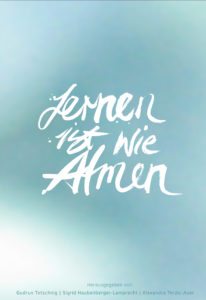
Book tip – “Lernen ist wie Atmen” (Learning is like breathing)
Together with two unschooling mothers, Gudrun Totschnig and Sigrid Haubenberger, we published it ourselves.
We all feel that the time is ripe for this many-voiced account of how unschooling can be lived in practice. Order your own copy on the GAIA marketplace, with a 10 % discount for members. The book is in German.
Notes on content provided by authors
Comments
Loading comments …
Become a member to comment publicly. GAIA members write comments in the members' portal — under their nickname, visible to everyone.