Swiss e-mobility plans vs. Car Pi


Switzerland could reportedly ban the non-essential use of electric vehicles this winter.
Policymakers are preparing for an energy problem in the colder months. The basis for the report is the “Ordinance on restrictions and prohibitions on the use of electrical energy”. At present this is only a draft, which the Federal Council is drawing up as an emergency measure to prepare for a possible electricity shortage.
To secure the country’s electricity supply, the proposed ordinance regulates “restrictions and prohibitions on the use of electrical energy”. For a crisis, four possible escalation levels are described, within which restrictions would ideally be implemented in stages. Only at escalation level 3 is e-mobility mentioned as one of many possible solutions. “Private use of electric cars is only permitted for absolutely necessary journeys (e.g. work, shopping, visits to the doctor, court appointments, attending religious events),” it says. According to the document, should Switzerland actually experience an electricity shortage, temporary driving bans for electric cars could also be among the preliminary measures.
Whether Switzerland will actually impose a driving ban on electric cars is still uncertain, but even such a negative situation seems to have a very positive side. As the Swiss government takes all these steps to cope with the energy crisis and get through the winter, a very interesting topic has recently emerged that is now receiving more attention than ever. The protagonist of this hot topic is one of the most ambitious projects humanity has ever undertaken: a car that simply draws its power from the environment rather than from a socket.
For many years nobody believed such a goal could be achieved, but that is no longer the case. Because ambient energy acts like a constant petrol pump, an infinite stream of cosmic radiation from the sun, light, neutrinos and other invisible radiation now makes this goal easily attainable for an electric car. Proof that electricity can be generated from invisible radiation is provided by the inventors of the remarkable new vehicle Car Pi, the private science and technology company called the Neutrino Energy Group.
On the basis of the international cooperation between the renowned C-MET institute in Pune, India, and the Neutrino Energy Group in Berlin, Germany, the Car Pi project is being developed, designed and advanced to create a unique car that draws its energy not from a charging station but simply from the environment – completely independent of “dishonest” electricity from burning fossil fuels. Thanks to the strategic work of C-MET’s mathematicians and physicists, it will be possible for the first time to combine the work of the Neutrino Energy Group, which has already made a number of important contributions to neutrino technology, with the development of the materials needed to build the Car Pi. This makes the innovation one of the most ambitious projects humanity has ever undertaken, and it is moving ever closer to realisation.
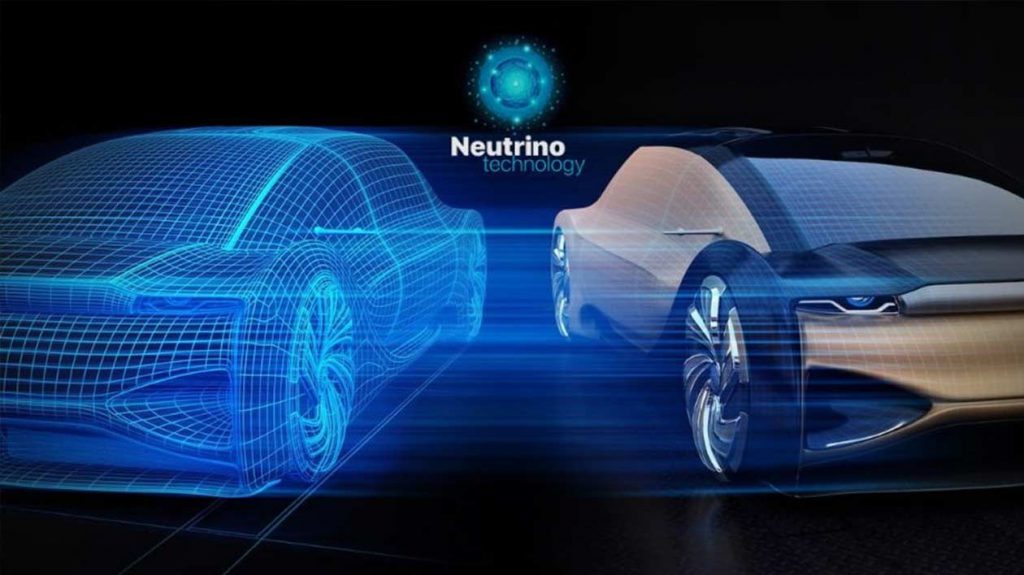
Car Pi study
The Neutrino Energy Group chose the name “Car Pi” because the value of pi is infinite. Just as the digits of this value go on forever, the innovative energy technology of the Car Pi will drive this incomparable automotive innovation forward indefinitely. This remarkable vehicle generates its own energy by using neutrinos and other invisible radiation. This makes it the first car in the world that does not have to be charged at a normal charging station but supplies itself with the energy it needs to keep going forever, whether it is driving or simply standing still. Depending on local circumstances, simply parking the car outdoors for an hour can provide a range of up to 100 kilometres.
The Car Pi obtains the fuel for its operation from an infinitely available, ecological and sustainable element – namely through the use of unique nanomaterials such as doped graphene mixed with Kevlar and carbon fibres. This creates unique cells that capture the passage of neutrinos and other forms of invisible radiation and trigger a subatomic oscillation. They thus contribute to the transition from the use of fossil fuels to clean and lasting energy sources. Thanks to neutrinovoltaic technology, the Car Pi is the first car in the world that supplies itself with energy completely independently of location and in an environmentally friendly way.
The automotive industry is on the verge of one of the greatest breakthroughs in automotive engineering. Holger Thorsten Schubart, the visionary mastermind behind the Neutrino Energy Group, will not achieve it alone. Schubart and a multinational coalition of like-minded scientists and engineers in the United States, India and other countries are striving to make the Car Pi a reality. So there is no reason for mobility to “fall by the wayside” just because our current technologies are not yet sufficiently decentralised and ecological. As soon as there is a solution like the Car Pi, countries – such as Switzerland at present – will no longer need to forge plans to ban electric vehicles from their roads. The way into the future will always be lit by innovations on a new level. It is therefore only a matter of time before major car manufacturers take up the Neutrino Energy Group’s concept.
The Neutrino Energy Group
The Neutrino Energy Group is a German-American research group. Its aim is to find ways to harness the power of the invisible radiation spectrum. As fossil fuels are limited and climate change requires the development of alternative and CO2-neutral energy sources, this research group is dedicated to an urgent problem. It has succeeded in creating a dense substance that can interact in a specific way with neutrinos and other invisible radiation. This unique substance is used to build the first neutrino photovoltaic cells for power generation. Vapour-deposited layers of silicon and doped graphene are applied to the carrier layer to make the end product. The thickness of these layers is in the nanometre range. When neutrinos and other invisible radiation strike this substance, they generate both horizontal and vertical impulses. It is crucial that the doped materials have the right layer thickness. At the optimum layer thickness, the atomic vibrations caused by the impulses are brought into resonance. As a result, an electric current can be detected in the substrate material. The hypothesis states that the amount of energy that can be harvested depends on the distance travelled in the process. With this approach it will soon be possible to charge electrical devices anywhere in the world without needing a socket or a cable. Simply “collecting” energy from the environment is a viable option. As a result, humanity will have access to an endless supply of clean energy, which will help to slow or halt global warming.
The Neutrino® Energy Group works with a worldwide team of scientists and various international research centres. They research applications for converting invisible radiation spectra of the sun, including neutrinos – high-energy particles that reach the Earth incessantly and can be converted into electrical energy.
The image rights lie with the author of the press release.
Notes on content provided by authors
Comments
Loading comments …
Become a member to comment publicly. GAIA members write comments in the members' portal — under their nickname, visible to everyone.










