The supply chains for batteries/BESS 🔋

Herbert Saurugg, saurugg.net
Source: Marco Felsberger
The article warns of a possible accumulation of several crisis developments in winter 2026/27. The decisive date, it argues, is 10 November 2026: on that day, both Chinese export restrictions on battery precursors and production equipment and certain controls on rare earths could be tightened again. At the same time, the pressure from hybrid attacks and the demand generated by Europe’s rearmament are increasing.
Dependence on China persists
Europe is trying to become less dependent on China through new battery cell factories in Hungary and Poland. In the author’s view, however, the dependence is merely shifting:
- 83 per cent of the battery storage cells delivered in the first half of 2026 came from ten large manufacturers, all of them Chinese.
- Around 97 per cent of global anode material capacity is said to be Chinese.
- For LFP cathode material, the Chinese share is about 90 per cent.
- The machinery for cell production also often comes from China.
European factories may therefore assemble the cells in Europe, but they still need Chinese precursors and equipment. A formal “Europeanisation” of production thus does not remove the strategic vulnerability.
Batteries as critical infrastructure
Battery storage is relevant not only for the energy transition, but also for maintaining critical functions during grid outages. It determines how long, among others,
- control centres,
- telecommunications sites,
- pumping stations and
- other critical facilities
can continue to operate during a power outage.
In this context, the author places batteries alongside transformers. For transformers, lead times of more than two years are possible. Both components therefore directly affect the ability to restore damaged or failed infrastructure.
Multiple competition for scarce resources
In addition, several areas of demand are competing for the same industrial capacities:
- Europe’s grid operators need batteries, transformers, electronics, mechanical engineering capacity and skilled workers.
- European rearmament draws on many of the same resources.
- According to their National Defense Strategy published in January 2026, the USA could, in a crisis, first serve their own needs and support Europe only to a limited extent.
Europe’s previous planning, which assumes it can automatically count on American industrial support in an emergency, must therefore be questioned as a deliberate political assumption.
Increasing pressure from hybrid attacks
The article links the supply chain risks with a growing threat to critical infrastructure from Russia. For Germany, the author cites – referring to a confidential BKA (Federal Criminal Police Office) report on which NDR, WDR and the Süddeutsche Zeitung are said to have reported – the following for the period between January and the end of August 2026:
- 747 suspicious drone incidents,
- a total of 1,068 drones,
- more than 165 suspected cases of sabotage.
These figures also included reconnaissance and suspected cases, but in the author’s assessment nevertheless pointed to systematic observation of critical and military facilities.
Polish Prime Minister Donald Tusk is said to have described a scenario for the months leading up to spring in which drones or missiles violate NATO territory, cause damage and are then portrayed as “accidental”. The aim could be to test the practical credibility of Article 5 of the NATO treaty. French President Emmanuel Macron, too, is said to have warned of an intensification of the Russian hybrid threat and ordered protective measures against drone and cyber attacks.
The central message is: a major attack may not be imminent, but the campaign below the threshold of war is already under way.
10 November as a possible turning point
In October 2025, China announced export controls on an important intermediate stage of the battery supply chain:
- anode material,
- cathode material,
- machinery for cell production.
These rules were temporarily suspended as part of a trade agreement. The suspension is due to end on 10 November 2026. After that, Beijing could again approve or delay exports on a case-by-case basis.
As an example, the author points to the Chinese graphite restrictions of 2023 and 2024: before a regulation took effect, exports were first brought forward, followed by months of approval delays. Factories did not have to close immediately, but buyers outside China had to wait considerably longer.
In parallel, suspended export controls on rare earths could also become relevant again on this date. These would affect, among other things, magnets, electric motors and defence supply chains – even where the end products are manufactured outside China.
From price increases to distribution conflicts
The market is already said to be tight:
- Industry stocks last only about eleven days.
- Production lines are running at more than 90 per cent capacity.
- Lead times are 45 to 60 days.
- Standard battery cells are about 22 per cent more expensive than a year earlier.
The author distinguishes between two crisis phases:
- Price phase: Components become more expensive, which is initially mainly a budget problem.
- Allocation phase: Suppliers decide which customers are still supplied at all. Small buyers lose access first.
The author expects this second threshold between the fourth quarter of 2026 and the second quarter of 2027.
Political and operational consequences
In the author’s view, there is so far no political prioritisation of critical buyers. It has not been decided whether, for example, a water utility would take precedence over a data centre in the event of a shortage – comparable to the prioritisation rules created during the gas supply crisis of 2022.
Governments are therefore faced with the questions:
- Which storage systems, spare parts and components are considered critical?
- Who will be supplied first in the event of a shortage?
- What strategic reserves need to be built up?
For operators of critical infrastructure, on the other hand, immediate practical questions are decisive:
- How many hours can critical sites actually be operated self-sufficiently?
- Which spare parts do they hold themselves?
- For which components do they rely on deliveries within a week?
- What happens if numerous other operators order from the same supplier at the same time?
Key message
The article does not claim that Russia, China and the USA coordinated these developments. Its thesis is rather that bottlenecks arising independently of one another coincide:
- possible Chinese export restrictions,
- European rearmament,
- limited American support,
- strained battery and transformer markets,
- hybrid attacks on critical infrastructure.
As a result, not only could prices rise, but above all fierce distribution struggles could develop over batteries, transformers, electronics, spare parts and skilled workers. The author recommends watching the first two weeks of November 2026 in particular. If the suspension is not extended, delays at European battery factories could become noticeable from December.
This article first appeared in German on saurugg.net – with kind permission of Herbert Saurugg. Licence: CC BY-NC-SA 4.0, Herbert Saurugg. Translated from German by GAIA.
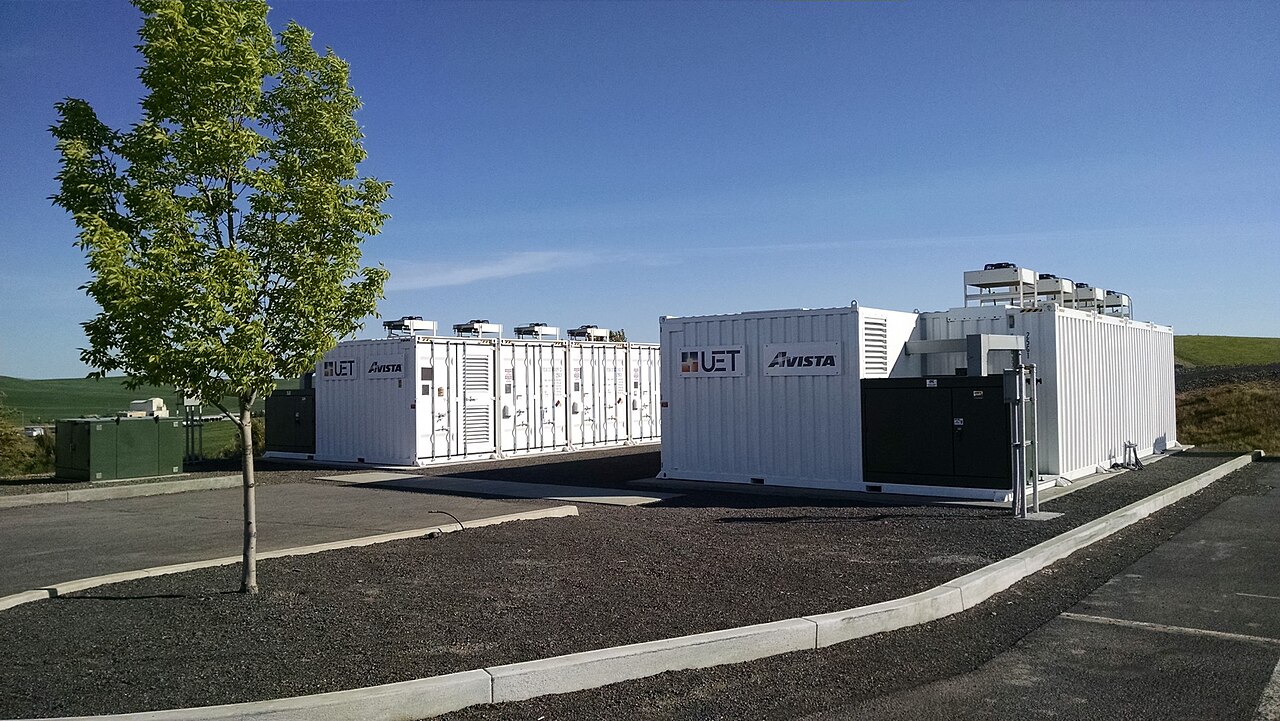
Cover image: UniEnergy Technologies / Wikimedia Commons, CC BY-SA 4.0
Notes on content provided by authors
Comments
Loading comments …
Become a member to comment publicly. GAIA members write comments in the members' portal — under their nickname, visible to everyone.