Beyond megawatts


Neutrinovoltaics as the world’s largest negawatt power plant
In 1983, the energy economist Amory Lovins coined a term that should actually have changed the energy debate permanently: negawatt. A negawatt is a watt of power that does not need to be generated in the first place because it has been saved, avoided or made superfluous by a different system architecture. The cleanest unit of energy is the one that never has to be produced. This is precisely where the real significance of neutrinovoltaics comes in.
No, “negawatt” is not a typo, but a deliberately coined word.
It is made up of “nega-” as in negative, avoided or saved and “watt” as the unit of power. What is meant, then, is a watt that does not need to be generated in the first place because efficiency, savings or a different system structure make it superfluous.
A simple example: If an old incandescent bulb is replaced by an LED, less electricity is needed for the same lighting. The power saved is, in this sense, called negawatts.
A negawatt is power that does not have to be generated, transported or stored because efficiency or a changed energy architecture makes it superfluous.
Traditionally, the negawatt idea was associated mainly with efficiency measures: LED lighting instead of incandescent bulbs, better building insulation, more efficient industrial motors or intelligent consumption control. These measures are important, sensible and measurable. But they only describe the first level of the negawatt principle. The second level is more far-reaching: systemic negawatts do not arise because less is consumed, but because whole categories of infrastructure are no longer needed.
This is where the economically decisive difference lies. It makes a difference whether an existing cost block is reduced – or whether the system architecture is changed so that this cost block no longer arises at all. Less grid expansion, fewer reserve power plants, less storage, less fuel logistics, fewer transmission losses: these are not ordinary efficiency gains. They are infrastructures that, under a different energy architecture, simply no longer have to be built, financed, operated and maintained. The original explicitly calls this second category “infrastructure voids”: physical systems that would not need to exist in the first place under a different energy order.
Neutrinovoltaics helps reduce infrastructure because, under this energy architecture, it no longer has to be built, financed, operated and maintained.
The real question behind the energy question
The dominant energy policy discussion of 2026 is still a supply-side discussion. It asks: how many new power plants are needed? How many kilometres of transmission lines? How many billions must be invested in grid reinforcement to support electrification, AI infrastructure and industrial decarbonisation at the same time?
These questions are real. But they remain structurally incomplete. They assume that the basic architecture of the energy system remains unchanged: central generation, large-scale transmission, grid losses, reserve capacity and storage problems. The only question then is which energy source is fed into this system: coal is replaced by solar, gas by wind, fossil power plants by large renewable plants. But the system principle largely remains.
The negawatt approach asks a different question: how much infrastructure becomes superfluous when energy is generated directly where it is consumed?
This question becomes even more urgent in the age of artificial intelligence. AI infrastructure creates a load profile for which the existing energy system was not designed. Data centres, autonomous systems, inference processes and permanent digital infrastructure need electricity that is available permanently, stably and independently of location. They do not tolerate supply gaps. Solar power is strong when the sun shines. Wind power is strong when the atmosphere plays along. Both can make valuable contributions. But neither delivers by itself what AI infrastructure absolutely needs: guaranteed continuity.
This creates a structural tension between intermittent generation and permanent demand. Every kilowatt hour of continuously, locally generated energy replaces not only central power generation. It also replaces the entire chain of infrastructure that would otherwise be necessary to ensure security of supply: backup capacity, storage, grid reinforcement, reserve power and load management. The systemic multiplier is considerable – and it grows with every new data centre that goes online.
An infrastructure equation: the Schubart master formula
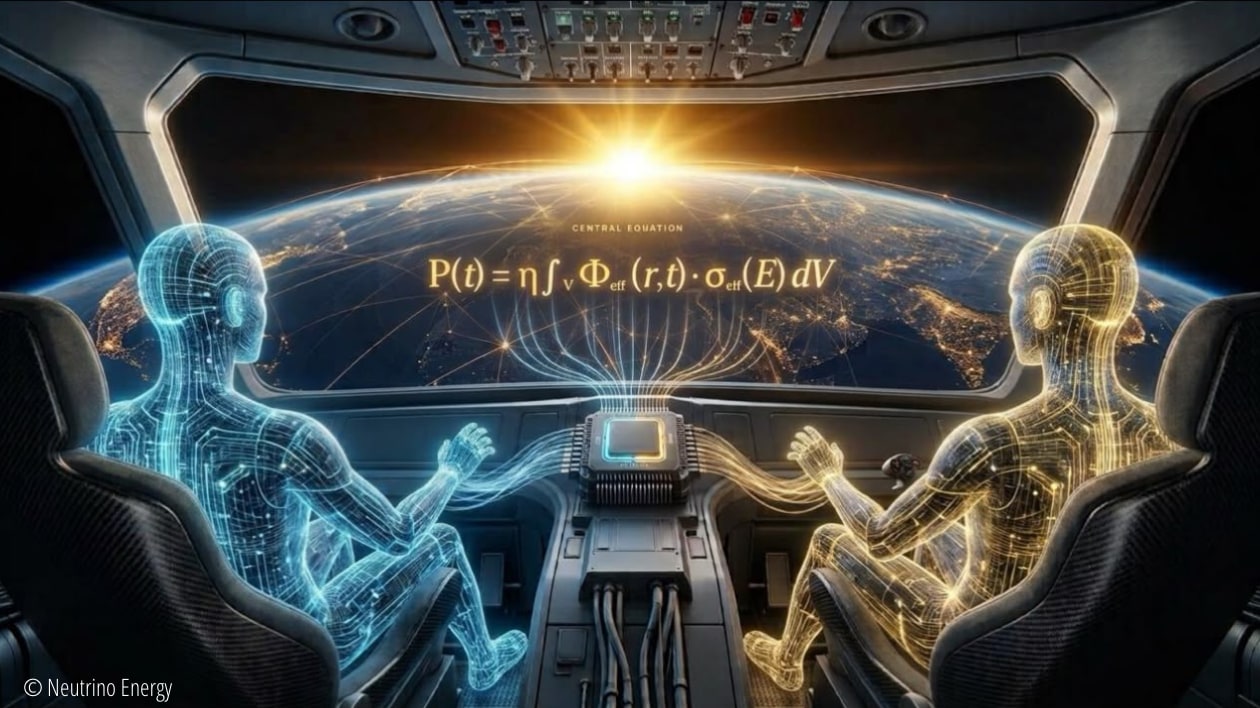
At the centre of the study is the so-called Schubart master formula, developed by Holger Thorsten Schubart, mathematician and systems architect of the Neutrino® Energy Group. The formula describes mathematically how ambient energy from neutrinos, cosmic muons, electromagnetic background fields and thermal fluctuations could be converted into electrical energy via specially developed nanomaterials.
The underlying equation is:
This equation describes the continuous electrical output power of a system that converts multi-channel ambient flows into electrical energy. It takes into account effective flux densities, interaction cross-sections, the active material volume and thermodynamic efficiency limits.
Every term of this equation stands for a physically measurable quantity. The efficiency η is limited by the first law of thermodynamics. The term Φ_eff(r,t) integrates contributions from various ubiquitous ambient sources: neutrino momentum transfer, cosmic muon flux, thermal gradients and electromagnetic background fields. These quantities are present everywhere on Earth – regardless of weather, time of day or geographical location.
The volume reference of the equation is particularly important. Output does not scale primarily with surface area, as with classic solar systems, but with the active material volume. This fundamentally shifts the scaling logic.
The original refers to several experimental foundations that support this physical argument: the 2015 Nobel Prize in Physics, which confirmed that neutrinos have mass and therefore carry momentum; the COHERENT experiment at Oak Ridge National Laboratory, which in 2017 demonstrated coherent neutrino interactions with whole atomic nuclei; and work by Professor Paul Thibado at the University of Arkansas, who showed that free-standing graphene membranes can convert ambient fluctuations into measurable electrical power. This research was not developed for neutrinovoltaics, but it confirms physical processes on which the model is built.
In the original, the statistical consistency of the model is described using Monte Carlo simulations and multi-parameter analyses. According to these, the internal mathematical and physical consistency of the approach reaches confidence levels at or beyond the six-sigma threshold – the standard that particle physics reserves for discoveries. This is explicitly not a statement that industrial scaling has already been fully completed. It is a statement that the architecture described is consistent to a high degree with independently confirmed experimental physics.
Read as an equation for infrastructure, the formula does not just describe a system for generating electricity. It describes a system that generates electricity where it is consumed – continuously, without fuel deliveries, without long-distance transmission and without the classic need for storage. In this sense, neutrinovoltaics is not just an energy generation technology. It is a negawatt technology.
The architecture of displacement
The Neutrino Energy Group sees itself as a globally distributed innovation ecosystem in which Schubart’s mathematical framework is translated into technical platforms. These platforms each follow the same basic logic: local continuous energy replaces not only electricity from the grid, but also parts of the infrastructure that would be needed to supply this electricity centrally.
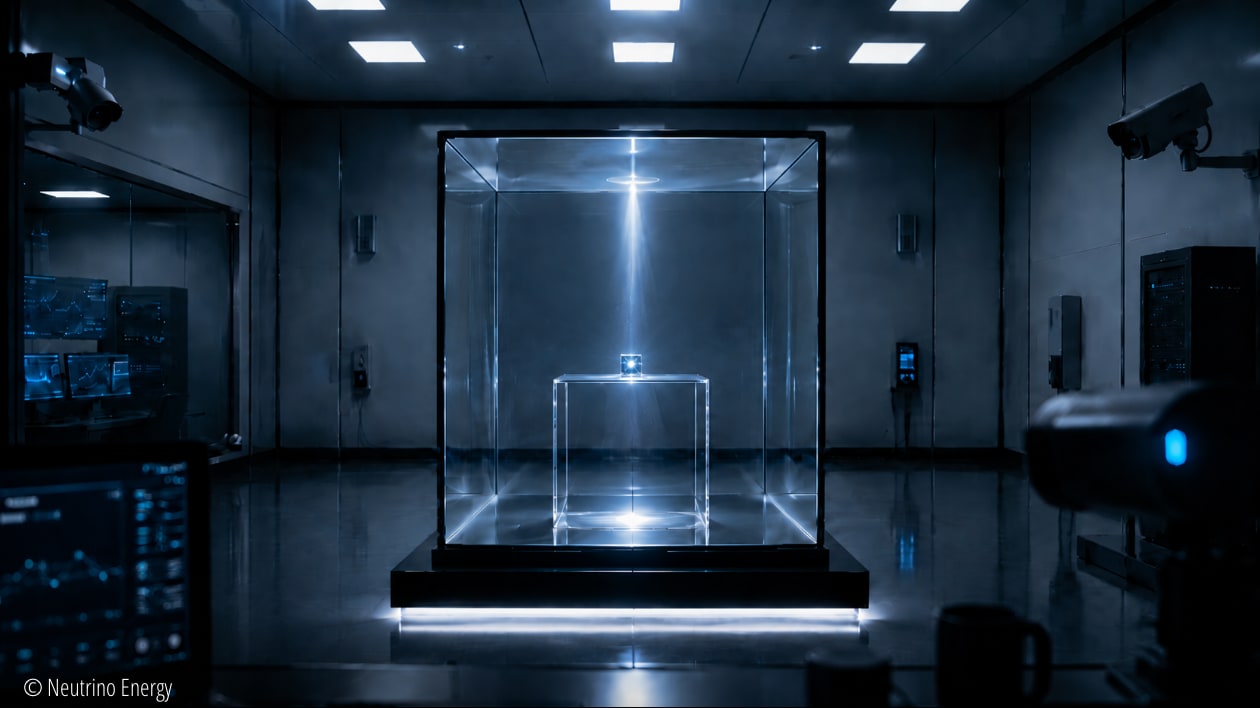
- The Neutrino Power Cube is described in the original as a compact solid-state unit with 5 to 6 kilowatts of continuous net output. Each individual unit would reduce grid losses, reserve capacity and grid reinforcement at the place of use that would be required if this load were supplied centrally. One million such units would correspond to 5 gigawatts of decentralised continuous output. The direct generation value is only part of the significance. The value of the infrastructure that is not needed in the first place can be greater: lines, reserve power plants, transformers, redispatch measures, storage and peak load capacity.
- The Neutrino Life Cube transfers this logic to humanitarian fields of use. It combines continuous energy supply with water treatment. This could reduce or replace two infrastructure chains at once: fuel deliveries and water transport.
- The Pi Nautic platform integrates the same material architecture into maritime structures. The goal is to displace the diesel auxiliary generators that today power electrical systems on commercial and private vessels.
- The Pi Car concept uses neutrinovoltaic layers in vehicle bodies. This could generate a relevant share of a vehicle’s energy needs directly in the vehicle structure. That would not only save electricity but reduce the need for charging infrastructure.
- Pi Fly is described as a persistent stratospheric platform that continuously uses ambient flows at high altitude and is thus intended to avoid the fuel logistics that limit today’s autonomous flight systems.
All these platforms are different expressions of the same calculation: continuous local energy generation does not just remove a load from the grid. It also removes the infrastructure that would have to be built to serve this load reliably.
The underestimated load of billions of small devices
When people think of energy infrastructure, they usually see power plants, high-voltage lines, substations and large battery storage. However, a considerable share of global grid load comes from a different source: the permanent small-scale consumption of billions of devices.
Refrigerators, routers, televisions, computers, smartphones, lighting systems, smart home components, security cameras and chargers individually often need only small amounts of power. Taken together, however, they form an enormous, permanent base load on the world’s power grids.
If such devices were in future supplied directly by integrated neutrinovoltaic systems, their energy demand would not be “reduced”. From the grid’s point of view, it would disappear. A single self-powered refrigerator reduces grid load by only a few watts. A billion self-powered devices would make a measurable part of global grid infrastructure superfluous: fewer distribution connections, fewer low-voltage transformers, less peak load management, less reserve capacity, less battery storage, less charging infrastructure.
This is the most radical expression of the negawatt principle. It is not just about consuming less. It is about generating directly at the point of consumption – and thereby making the infrastructure behind this consumption redundant.
In the long term, the effect of neutrinovoltaics could therefore come not only from a few large Power Cubes. It could arise from millions and later billions of small integrated applications that quietly, permanently and bit by bit disappear from the grid.
The largest power plant nobody had to build
What would the world’s largest power plant look like if its goal were not to generate as many watts as possible, but to make as much infrastructure as possible superfluous?
It would be decentralised instead of centralised. It would work at the place of consumption instead of far away from it. It would generate continuously and thus reduce the need for storage and reserves. It would need no fuel, no long-distance line, no classic grid connection and no transmission over long distances.
The world’s largest power plant might therefore in the end not be a classic megawatt power plant. It could be a negawatt power plant. Perhaps the most important energy installation of the 21st century will not be visible as a single place. Perhaps its most important achievement lies not only in the watts it generates, but in the negawatts it spares the world.

The decisive question is therefore no longer just: how much energy can we generate? Increasingly, it is: how much energy infrastructure does this make superfluous?
Conclusion: independence through a change of architecture
In this article, neutrinovoltaics stands not just for an additional energy source. It stands for a fundamental change of architecture: away from central generation, long transport routes, reserve capacity and infrastructure burdens – towards local, continuous, material-integrated energy.
This is precisely its liberating core. Those who can generate energy directly where it is needed reduce dependencies: on grids, fuel chains, supply logistics, price shocks and central control structures. The technical vision of the Neutrino Energy Group is thus also a systemic vision: not only to make energy cleaner, but to bring it closer to people, devices, vehicles, homes and communities.
In this sense, the negawatt is not less energy. It is more independence – through infrastructure that is not needed in the first place.
Sources
Notes on content provided by authors
Comments
Loading comments …
Become a member to comment publicly. GAIA members write comments in the members' portal — under their nickname, visible to everyone.