CO2: function and origin


Complete lack of understanding among politicians and the media about the function and origin of CO2
Dr. Peter F. Mayer, tkp.at (German)
The misinformation now also being spread through advertising is truly unbelievable. CO2 is increasingly portrayed as the most dangerous enemy. Yet without CO2, life as we know it would not be possible – nor would inanimate things such as rocks, some of which can even be responsible for the CO2 in the air.
Today our atmosphere consists of about 99% nitrogen and oxygen – more precisely 78% and 21% – with argon, at 0.93%, the third most abundant. At only 0.04%, carbon dioxide is one of the trace gases.
The most important “greenhouse gas” is of course water vapour, which can vary between 7% in the humid tropics and 1% in an icy climate. And what we breathe out contains about 5% CO2 and about 6% water vapour.
And water in liquid or gaseous form is a major transporter of heat from hot to cool places. In the real world, carbon dioxide contributes little to heat transport, and as a gas it does not store heat either.
And the recorded changes in climate trends were mainly caused by changes in solar activity and changes in the Earth’s orbit; CO2 has a negligible influence.
However, the crazy media, politicians and their bureaucrats have turned it into a molecule with a very frightening political function, making fear a growth industry for ambitious governments. Instead of being undeservedly maligned, carbon dioxide molecules should be celebrated.
In its essential role as a food source for life, CO2 is a rock in the surf. The saying is apt, because carbon dioxide came – and still comes – from hot rock and, in order to sustain life, is eventually turned into cool rock. The rocks formed from carbon dioxide are also known as coral or, with chemical variations, as limestone or dolomite. When you enjoy the mountain scenery in Kals in East Tyrol or in Davos, you are in fact looking at wonderfully sequestered carbon dioxide. When the rock is transformed by heat and pressure, it can be prized as fine marble, as in Karibib in Namibia.
Life was originally made possible by a special organism known as cyanobacteria; and if society needs to know only one equation, it should be the one for photosynthesis:
Carbon dioxide + water + sunshine = glucose + oxygen
The function of photosynthesis is defined like this:
“Photosynthesis is the process by which the energy of the sun is captured and converted for use in the living cell. In addition, it is the first process in the transfer of atoms from the inorganic to the organic.”
CO2 forms not only rock but whole mountains of this material. The Dolomites even rise to a height of about 3,300 metres – the ultimate in bleached coral reefs raised from the sea. The foundations of such a mountain range would sink thousands of metres below today’s sea level. The huge cold-water corals on many ocean floors represent an enormous binding of carbon dioxide that remains out of sight.
Hot rocks beneath the sea and in fiery skerries or fissures, as well as the oceans, constantly outgas CO2. The crucial step is to put the emissions of industrial society into perspective. The Vostok core records of temperatures and CO2 concentrations show that climate warming precedes the rise in CO2 by about 800 years. Rising temperatures force a rise in CO2, not the other way round.
So some rocks supply life-giving carbon dioxide, which has recently fallen into disrepute as a means of raising taxes and enforcing regulations. Conversely, rocks have bound CO2 in remarkable ways. During the Cambrian, around 550 million years ago, the atmospheric concentration was 7,000 ppm or 0.70% – about 17 times higher than today’s ridiculous 400 ppm.
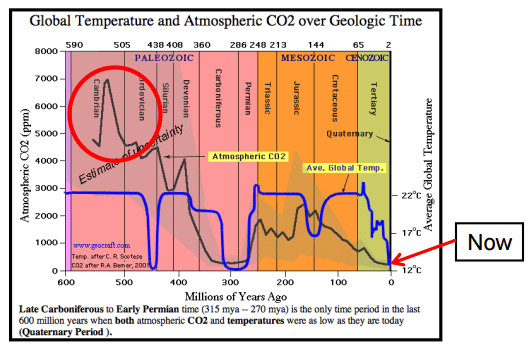
And where has all that atmospheric CO2 gone? Quite simple: it became rock on the sea floor or piled up in the mountains.
Geologically speaking, today’s concentrations in the atmosphere are rather low. Moreover, below 150 ppm, all life on our once hospitable planet would come to a standstill.
Corals and other marine organisms have quietly turned a politically powerful trace gas into rock. That this works within natural geological trends is shown by the long rise in sea level of about 100 metres since the beginning of the last interglacial around 12,000 years ago. This was accompanied by a rise in temperature of about 10 degrees Celsius.
In fact, corals are still turning CO2 into rock. They thrive at tropical temperatures and don’t care whether sea level rises or falls. Wherever it is, they will be there. They have been doing so for hundreds of millions of years.
It is understandable that the recent rise in carbon dioxide levels has been accompanied by a remarkable “greening” of global vegetation. As measured by satellites, plants are growing everywhere – from the poles to the tropics, from the seas to rocky mountain peaks. Satellite-based instruments measuring the solar-induced chlorophyll fluorescence of plants provide direct evidence that global photosynthetic activity has increased in recent decades – and with it the greening of former arid areas (German).
A final note for those who imagine they can “manage” the planet’s temperature: don’t waste time and money on CO2. Concentrate on where efforts are effective: change the solar cycle, cosmic rays, the Earth’s orbit, plate tectonics and ocean currents.
This article has been shortened. The full article can be read in the original.
Original article on tkp.at (German)


CO2 as a raw material
We have pointed out in the past that CO2 is available as a valuable resource. It is not only nature that makes use of this gas, for example in photosynthesis. Carbon dioxide can also be put to use by us as a society. Perhaps it will soon even be possible to generate sustainable renewable energy from it. Various projects give us hope.
Let us please ask ourselves whether, when the media either declare other opinions inadmissible or at least defame them, there might not be economic interests behind it. In Europe that would be nothing new.
Notes on content provided by authors
Comments
Loading comments …
Become a member to comment publicly. GAIA members write comments in the members' portal — under their nickname, visible to everyone.