Energy transition in the EU without fossil fuels possible?

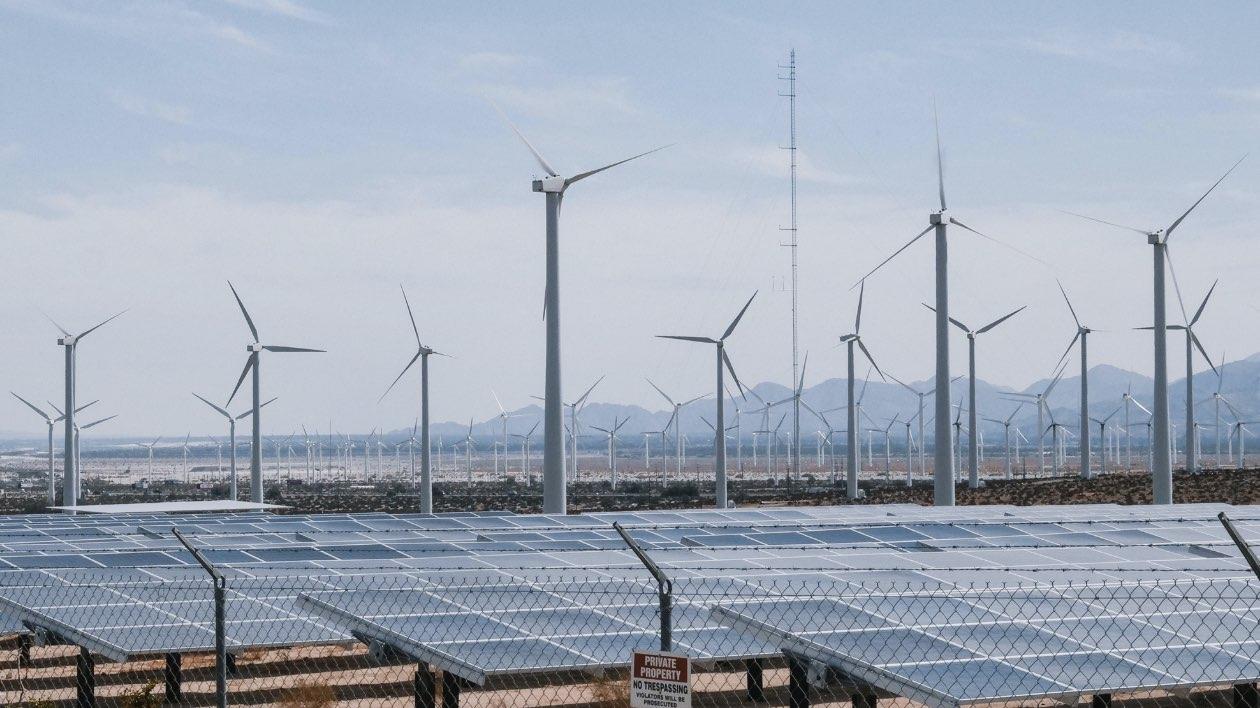
The growing crisis in the European energy sector is forcing the authorities to look for energy solutions for this winter and the next.
Half of all newly built houses in the EU are already being fitted with solar panels, and the European Commission plans to equip all commercial and public buildings with solar panels and to install them on all new residential buildings from 2029. According to Bloomberg, the European Commission estimates the cost of these measures at 565 billion euros, although practice shows that the estimated costs can certainly be doubled.
But even laypeople know that the efficiency of solar modules drops drastically in winter because of the short daylight hours and the many cloudy days of the year. Does this mean that more solar panels have to be installed in order to generate enough electricity in winter? And what is to be done with the surplus generation from these solar cells in the summer months? Either some of them would have to be switched off, or the surplus generation would have to be fed into the central system. In the summer months, however, electricity prices in Europe have repeatedly been negative for years, indicating a surplus on the market that is due to the operation of the solar panels and wind turbines already installed.
The lack of electricity needed in the winter months can be offset by wind turbines, as they produce most electricity in winter and less in summer. There are, however, a number of problems, since the most favourable sites for wind turbines are already in use, and installing additional wind turbines at less favourable sites reduces the utilisation of installed capacity. In Germany, for example, the most favourable sites for wind turbines are in the north, while industrial consumers are mostly located in the south. Even now, when sun and wind are abundant, the existing transmission lines cannot cope with the flow of electricity from north to south.
Last summer showed that the lack of rainfall led to a drastic decline in electricity generation from hydropower, while rising water temperatures and low water levels reduced power generation and even shut down some nuclear power plants, as in France. For all these reasons, it is questionable whether it is possible to build electricity generation on renewable energy sources alone, or at least to create an efficient electricity supply system. Building an electricity system on weather-dependent technologies is probably not a sensible or practicable option.
The economic component of an electricity system based on renewable energy is very important, as in the near future the population will not be able to pay rising energy bills and companies will no longer be competitive. This will inevitably lead to more bankruptcies, unemployment and lower tax revenues for the budget. The beginning of this process can already be observed in Germany, where energy-intensive industries have been relocated to the USA and other countries where gas and electricity costs are many times lower than in Europe.
If this situation continues for several years, the destruction of industry will be irreversible and Europe will face deindustrialisation, which will mean a serious decline in living standards, with the USA and China being the main beneficiaries. The first sign of the problems of the European economy is the significant devaluation of the euro against the US dollar. The authorities of the European states and the European Commission naturally understand the difficult situation of the EU economy, but for ideological and political reasons they are unable to change anything.
In some places it is only a smouldering fire, in others the house is already on fire. Either way, the future viability of our economy is at risk; irreversible damage is threatening.

Robert Habeck
German Minister for Economic Affairs and Climate Action, to dpa on 27 September 2022
The energy crisis has accelerated the development of new alternative technologies in the fields of power generation, energy storage systems and new materials. Progress in the development of batteries, which are important for the spread of electric cars, is particularly clear. But the development of new technologies in power generation using so-called “free energy” must also be looked at very closely.

Holger Thorsten Schubart, CEO Neutrino Energy Group
Many ordinary people think that “free energy” is the creation of a mythical perpetual motion machine, which is a fallacy. The law of conservation and conversion of energy states that energy does not arise out of nothing and does not disappear anywhere, but only passes from one form into another or from one body to another. This principle underlies the neutrinovoltaic technology developed by the Neutrino Energy Group. The emergence of graphene and research into its properties enabled the company’s president, the mathematician Holger Thorsten Schubart, and his colleagues to create a multilayer material of alternating layers of graphene and doped silicon that converts the thermal Brownian motion of the graphene atoms, as well as the kinetic energy of the surrounding radiation fields, including neutrinos, into electrical energy.
Why has graphene become the nanomaterial that makes it possible to generate electricity, and why do other nanomaterials not have this ability? The answer lies in the peculiarity of graphene’s crystal lattice, in which the carbon atoms are in sp² hybridisation and are connected via σ and π bonds to form a hexagonal two-dimensional crystal lattice. It has been proven that graphene cannot exist in 2D, but only in 3D. A team of scientists at the University of Arkansas examined graphene deposited on a copper plate. Using a scanning tunnelling microscope, they observed changes in the position of the atoms. In doing so they made a very significant discovery: in graphene, waves appeared like those on the surface of the sea, arising from a combination of small spontaneous movements and leading to larger spontaneous movements. The thermal displacement (Brownian motion of the atoms) of one atom, amplified by the particles of the surrounding radiation fields and adding up with the displacements of other atoms, leads to surface waves with horizontal polarisation, known in acoustics as Love waves. Owing to the peculiarities of graphene’s crystal lattice, its atoms vibrate as if in tandem, which distinguishes these movements from the spontaneous movements of molecules in liquids.
In an interview with Research Frontiers, Professor Thibado (University of Arkansas) explained: “This is the key to using the motion of 2D materials as an inexhaustible energy source. Tandem vibrations cause waves in a graphene layer that make it possible to harvest energy from its surroundings with the help of state-of-the-art nanotechnology.”
Holger Thorsten Schubart has repeatedly pointed out that it is graphene’s ability to respond to temperature and ambient radiation fields by increasing the amplitude of the vibration of graphene atoms up to resonance that enabled the Neutrino Energy Group to solve the technological problem of generating electricity from “free energy”. The use of virtually impurity-free graphene, the choice of alloying elements and the technology developed for spraying graphene and silicon onto metal foils made possible an effect that physicists call “skew scattering”, in which electron clouds deflect their motion in one direction, i.e. an electric current. Licensed industrial production of 5–10 kWh power sources using neutrinovoltaic technology is to begin in Switzerland at the end of next year or the beginning of 2024.
This development will undoubtedly initiate the process of creating an autonomous and decentralised power generation system, even though it will take many years before neutrinovoltaics affects the overall energy balance; but this decision can be seen as the first real and practical step towards a CO2-neutral power generation system.
Whereas with the Tesla BTG a large increase in the receiver area (aluminium foil) was needed to increase the power generated, with the Neutrino Energy Group’s receiver the receiver plates could be stacked like a stack of writing paper, i.e. connected in series. Connecting the plates in series increases the output voltage of the compressed stack, so that the desired voltage is reached by varying the number of plates. The compressed stack of receiver plates is housed in a hermetically sealed casing to prevent oxygen from entering. Several such modules were connected in parallel to obtain the required output current.
At present, licensed industrial production of Neutrino Power Cubes with a net capacity of 5–10 kW⋅h is in the preparatory phase in Switzerland. These power supplies will have an electronic control system that can supply devices with 220 and 380 volt alternating current as well as connections for direct current devices. Commercial production is expected to start at the end of 2023.
On the basis of research, Holger Thorsten Schubart concluded that electricity is generated by the thermal Brownian motion of the graphene atoms and the kinetic energy of particles in the surrounding radiation fields, above all neutrinos. He explains the structural solution of the multilayer coating on the metal foil as follows: “The multilayer arrangement of alternating layers of graphene and doped silicon causes the forces between the graphene electrons to get ‘out of balance’. The overall effect is what physicists call ‘skew scattering’, in which clouds of electrons deflect their motion in the same direction, which is called direct current. Also crucial is the use of pure graphene, containing practically no impurities, and the technology of doping and depositing graphene and silicon layers, which are deposited in a vacuum and without access to oxygen.”
The discovery of the two-dimensional form of carbon, graphene, and applied research into its properties will make it possible to create a fundamentally new configuration of decentralised power generation. The first steps in this direction were taken confidently and convincingly by the Neutrino Energy Group, which announced to the world the creation of a unique autonomous direct current source that can find its widest application in many industries, from power generation to the automotive industry.
The Neutrino Energy Group
The Neutrino Energy Group is a German-American research group. Its aim is to find ways to harness the power of the invisible radiation spectrum. As fossil fuels are limited and climate change requires the development of alternative and CO2-neutral energy sources, this research group is dedicated to an urgent problem. It has succeeded in creating a dense substance that can interact in a specific way with neutrinos and other invisible radiation. This unique substance is used to build the first neutrino photovoltaic cells for power generation. Vapour-deposited layers of silicon and doped graphene are applied to the carrier layer to make the end product. The thickness of these layers is in the nanometre range. When neutrinos and other invisible radiation strike this substance, they generate both horizontal and vertical impulses. It is crucial that the doped materials have the right layer thickness. At the optimum layer thickness, the atomic vibrations caused by the impulses are brought into resonance. As a result, an electric current can be detected in the substrate material. The hypothesis states that the amount of energy that can be harvested depends on the distance travelled in the process. With this approach it will soon be possible to charge electrical devices anywhere in the world without needing a socket or a cable. Simply “collecting” energy from the environment is a viable option. As a result, humanity will have access to an endless supply of clean energy, which will help to slow or halt global warming.
The Neutrino® Energy Group works with a worldwide team of scientists and various international research centres. They research applications for converting invisible radiation spectra of the sun, including neutrinos – high-energy particles that reach the Earth incessantly and can be converted into electrical energy.
The image rights lie with the author of the press release.
Notes on content provided by authors
Comments
Loading comments …
Become a member to comment publicly. GAIA members write comments in the members' portal — under their nickname, visible to everyone.










