Graphene harvests ambient energy


Graphene – a harvesting machine for the clean energy of our future
In the 1960s, scientists were convinced that obtaining usable energy from the random motion of tiny particles was a dead end. Fortunately, this view has now been refuted. The particles were apparently just “waiting” for the right material. A graphene energy harvester from the University of Arkansas (USA) is now putting this effect to use.
Putting Brownian motion into practice
Before we turn to the University of Arkansas, let us stop off at Brown University in Rhode Island for a short introduction to Brownian motion, or more precisely Brownian molecular motion – because it is the key to everything.
In 2016, researchers at Brown University and Lawrence Berkeley National Laboratory gave an overview of the state of science on Brownian motion. They noted that the phenomenon had already been described in 1827 by the botanist Robert Brown, after whom the motion is named. Under the microscope he observed “the incessant and irregular motion of small grains suspended in a liquid”. “In the classical sense, the phenomenon refers to the random motion of a particle in a medium, e.g. dust in a liquid,” the researchers explain.
“Today this theory can also be applied to describe the fluctuating behaviour of a general system that interacts with its environment […]” The researchers name numerous fields of application, including the microrheology of viscoelastic materials, artificial Brownian motors and the self-propulsion of active matter, fluctuation theorems for states far from equilibrium, and quantum fluctuations. Microrheology refers to measuring the flow of matter.
The beginnings of a graphene energy harvester
There is now a great deal of scientific activity around Brownian motion – considering that only a few generations ago such work was hardly supported. “Extracting useful work from random fluctuations in a system in thermal equilibrium was long considered impossible,” the University of Arkansas explained in a press release in August 2023. A series of lectures by an influential US physicist in the 1960s led to discussion of “Brownian energy harvesters” being dropped for a long time. That time is now over – above all thanks to the discovery of graphene in 2004. Graphene is a two-dimensional material that you can even make yourself very easily. If you stick a piece of adhesive tape onto a piece of graphite, such as that in pencil leads, and pull the tape off again, you already have graphene, simply speaking. Of course, that is not yet two-dimensional graphene. But it is the beginning of manual, experimental extraction and reproduction – the separation of graphite into its individual freely oscillating layers: graphene.
Subsequently, numerous research projects have looked at how graphene can be transferred from adhesive tape onto other carrier materials – conductive ones, for example. There are now various high-tech approaches to this at the nano level. Let us return to the University of Arkansas’s new graphene energy harvester. A research team at the university has been studying the wave motion of freely oscillating graphene sheets for more than 10 years. In August 2023 it reached a milestone, published as a study entitled “Charging capacitors from thermal fluctuations using diodes” in the journal Physical Review E.
It was mainly about thermal fluctuations, because that is the key. The team observed that graphene sheets ripple up and down at ambient temperatures and presented a way of using these fluctuations in practice.
The way from wave to work
The research team led by Professor Paul Thibado of the university’s physics department already has a head start. In summer 2023, the University of Arkansas highlighted the team’s work on GEH technology (graphene energy harvester). Here is the university’s explanation (a line break was added for readability): “GEH uses a negatively charged sheet of graphene suspended between two metal electrodes. When the graphene flexes upward, it induces a positive charge in the top electrode. When it flexes downward, it positively charges the bottom electrode. This creates an alternating current. With diodes wired in opposition, allowing the current to flow both ways, a pulsating direct current is produced. This then drives a load resistor.” Word got around quickly: at the beginning of 2024 the research team received a five-year grant of USD 904,000 from the WoodNext Foundation to actively continue developing its graphene energy harvester.
From nanowatts to kilowatts
The research there focuses on sensor-scale applications, not on developing large new graphene solar cells or wind turbines. But the GEH is creating a “ripple effect” across the entire renewable energy industry, because it shows new possibilities for a wide range of applications. Unlike battery-powered sensors, a GEH would draw energy from its local environment and could possibly last several decades before it had to be replaced.
Remote sensing with non-battery-powered sensors can, for example, help maximise the efficiency of wind turbines and fix potential maintenance issues before they become actual problems. Recent concerns about the safety of offshore wind farms in Europe underline the need for more accurate, long-lasting sensors.
Other climate-related sensing applications Thibado named include managing logistics fleets, tracking livestock, soil sensors, climate monitoring in agriculture, monitoring manufacturing processes, smart power grids and waste management. The team’s next goal is to increase the power of the sensors with the help of the WoodNext Foundation.
“We have successfully developed a process for making graphene-based structures for harvesting energy,” Professor Thibado said in a press statement at the beginning of 2024. “But our current structures do not yet harvest enough energy. The collaboration with WoodNext will allow us to optimise these structures so that they can harvest enough energy to power sensors permanently.”
The team will have a lot to do over the next five years. The WoodNext grant envisages harvesting energy from various ambient sources, namely solar, thermal, acoustic, kinetic, non-linear and ambient radiation.
Who is WoodNext?
The WoodNext Foundation is a philanthropically funded foundation based in Texas. It was set up in 2021 by Roku CEO and founder Anthony Wood and his wife Susan. Since then it has funded numerous projects that “advance human progress and remove barriers to living a fulfilled life”. “Because of the Wood family’s strong ties to Texas, WoodNext’s geographical focus is on the southern United States. But the WoodNext Foundation also makes grants in other regions, nationally and internationally,” the foundation explains. Texas is at the forefront of the switch to clean energy, despite resistance from its current political leadership. So it is hardly surprising that a Texas-based foundation is helping to promote the field of sustainable clean energy. In 2022, WoodNext had already given financial support to the National Renewable Energy Laboratory to promote innovation in wave energy and solar-powered desalination.


Decentralised energy
Neutrinovoltaic® is also based on freely oscillating graphene. It consists of wafer-thin coated surfaces folded into small volumes.
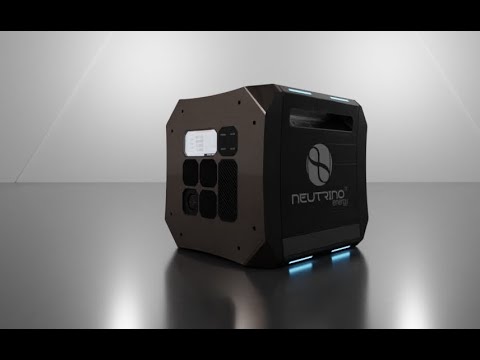
This technology is being developed by the international scientific Neutrino® Energy Group, led by Holger Thorsten Schubart, as the basis for clean energy generation. Its first practical application, the Neutrino® Power Cube, will bring about a rethink of decentralised, baseload-capable, environmentally neutral renewable energy. But the work of the research teams in the USA already hints that there is no horizon for such applications – that is how versatile Neutrinovoltaic® will be. And just as inexhaustible. It will change us for the better.

Notes on content provided by authors
Comments
Loading comments …
Become a member to comment publicly. GAIA members write comments in the members' portal — under their nickname, visible to everyone.