Graphene: New Horizons for Energy Supply


Doped graphene
Research into the properties of two-dimensional materials, especially graphene, is opening up opportunities to develop groundbreaking technologies in various fields. Priority areas for such technologies are energy conversion, energy storage and electric mobility.
Despite 20 years of intensive international research on graphene, new publications appear almost every year revealing previously unknown properties of this material. These discoveries open up new possibilities for developing revolutionary technologies and make graphene one of the most dynamic fields of research in science and engineering. There are tens of thousands of publications on the subject worldwide.
In graphene, electrons behave as if they had no mass, although they do in fact have mass. This unusual behaviour is described by quantum mechanics, in which electrons are regarded as matter waves. As a result, the charge carriers achieve exceptionally high mobility. Graphene also has unique properties: it conducts electricity and heat (about 5,000 W/m·K) extremely well, is extremely strong and can stretch by up to 20% of its original length. Its optical properties are also remarkable.
Graphene has the remarkable ability to generate electric current under the influence of artificial and natural radiation fields over a wide range of wavelengths. This property makes it a promising material for generating electricity in various devices. Scientists at the National University of Singapore led by D.A. Bandurin have shown in their investigations that under terahertz radiation graphene displays electrical properties that make its application even more attractive.
Investigations into terahertz radiation
- Dirac electrons and terahertz radiation: The study shows that Dirac electrons in graphene, when exposed to continuous terahertz (THz) radiation, can be thermally decoupled from the crystal lattice. This activates hydrodynamic electron transport.
- Superballistic electron flow: In this state, the resistance of graphene constrictions falls because of the superballistic flow of correlated electrons induced by THz radiation.
- Viscous electron flow: It is assumed that the electrons in graphene can behave like a single fluid that interacts and moves together. The viscosity of this electron flow decreases under the influence of terahertz radiation, making the “electron fluid” more fluid.
These findings open up new possibilities for using graphene in energy generation and could lead to more efficient and versatile applications.
The conclusions of the Neutrino Energy Group agree with the findings on graphene’s ability to generate electric current under the influence of various ambient radiation of the invisible spectrum, including terahertz radiation, as well as through the thermal motion of the graphene atoms. The Singapore scientists carried out their experiments with single-layer graphene doped with additional electrons to give it metallic properties. The result of these experiments was the development of the first practical device that uses viscous electron flow to detect THz waves.
By contrast, the research of the Neutrino Energy Group’s scientific staff aims to develop a practical technology for fuel-free electricity generation from graphene. Initial experiments in the early years showed, however, that single-layer graphene does not generate enough energy to allow industrial implementation of the technology. The solution was to develop a multilayer nanomaterial consisting of alternating layers of graphene and silicon with doping elements. These layers are applied to one side of a metal foil, with the volume fraction of graphene between 50 and 75%.
Graphene as a multilayer nanomaterial
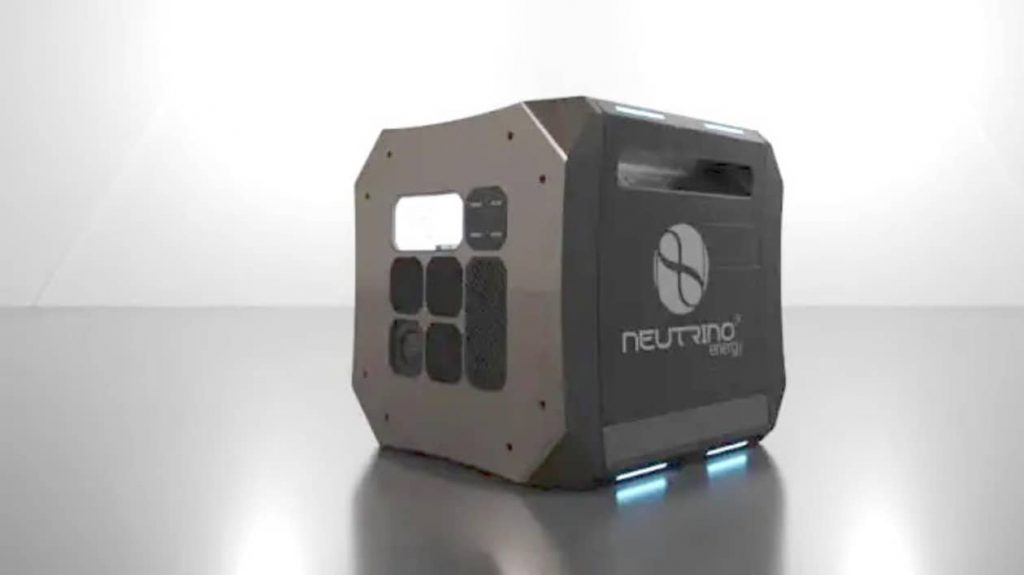
The scientists of the Neutrino Energy Group have developed a groundbreaking graphene-based technology that enables fuel-free electricity generation. This innovation could form the basis for a decentralised energy supply. In recent years, development has progressed considerably from invention to industrial production of Neutrino Power Cubes, a kind of generator. The first step in this development is the production of fuel-free power generators with an output of 5–6 kW (Neutrino Power Cube), for which orders for 2025–2026 have already been concluded. The advantages of the Neutrino Power Cube over conventional power generation technologies, including solar and wind installations, are:
- Graphene power source: no protection or operating costs required
- Dimensions of the Neutrino Power Cube: approx. 800 x 500 x 900 mm
- Service life: approx. 15–20 years
- Connections: devices with direct and alternating current: ~380/220/48/24 V (AC), direct current –48/24 V (DC).
- Power generation: in continuous operation 24 hours a day, 7 days a week, 365 days a year
- Design: low-noise operation, no rotating parts
- Grid connection: works autonomously, fuel-free electricity generation, no grid connection required
- Placement: close to the point of consumption, thus avoiding transmission losses in the power grids
These findings open up new possibilities for using graphene in energy generation and could lead to more efficient and versatile applications.
Continued active research into the properties of graphene and the technologies for producing it, as well as into other two-dimensional materials, promises the emergence of important new technologies – but the graphene technology neutrinovoltaics is the undisputed leader in the practical application of graphene in energy generation.
Author: Rumyantsev L. K., n-n-n.ru (Russian)
Notes on content provided by authors
Comments
Loading comments …
Become a member to comment publicly. GAIA members write comments in the members' portal — under their nickname, visible to everyone.









