Graphene & Ghost Light: energy becomes visible


From pencil lead to a neutrinovoltaics demonstration
What if energy generation were no longer tied to sun, wind or classical sources – but took place permanently from the environment? Advances in materials research around graphene and new demonstration concepts such as the “Ghost Light” are giving an increasingly tangible answer to this. Graphene – a single atomic layer of carbon – was long regarded as a scientific curiosity. Today it is developing into a key material for the next generation of energy generation. Research shows that graphene is able to absorb even the smallest energy fluctuations from the environment and convert them into electrical voltage. These include:
- thermal motion (Brownian motion)
- ambient electromagnetic radiation
- other microscopic energy impulses
The linked original article describes this development as the “secret life” of the material: invisible processes that take place continuously – regardless of time of day or weather conditions. This shifts the paradigm: energy is no longer primarily “harvested” but permanently extracted.
Neutrinovoltaics: continuous energy from the environment
Technologies such as neutrinovoltaics are emerging on the basis of these physical effects. They combine materials such as graphene with multilayer structures in order to make even weakly interacting particles and ambient energy usable. A frequent objection is:
“Capturing such particles is impossible.”
Following claims in the media
This is a classic straw-man argument. Modern approaches are not based on “capturing” individual particles, but on:
- continuous momentum transfer
- collective material effects
- nanoscale energy conversion
 Comparable to photovoltaics, which does not store individual photons but uses their energy flow.
The “Ghost Light” Invisible energy becomes visible
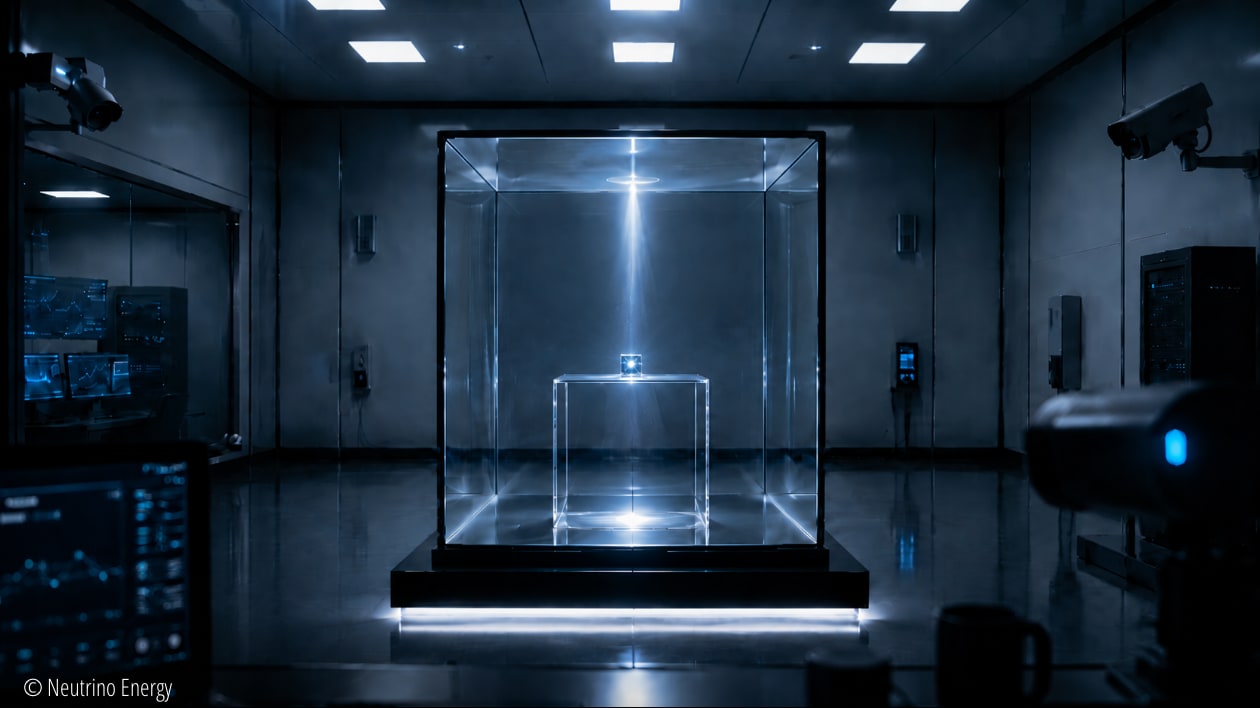
With the Ghost Light project, this abstract technology is translated into a tangible form for the first time. It describes the first demonstration of energy conversion within neutrinovoltaic processes, which is now being worked on as part of the cooperation in China founded in October 2025. The concept is deliberately minimalist:
- a completely transparent cube
- material: optical crystal glass without visible openings
- at the centre: a small light source that seems to float
 This light source has a diameter of a few millimetres and glows diffusely. It constantly emits cold white light (approx. 6000–6500 K), does not flicker and requires no visible external energy supply. The impression it creates:
a star captured in a crystal.
This light source has a diameter of a few millimetres and glows diffusely. It constantly emits cold white light (approx. 6000–6500 K), does not flicker and requires no visible external energy supply. The impression it creates:
a star captured in a crystal.
Technical principle (high level)
Inside the glowing core is a fully integrated microsystem. All components are hidden at the centre – without cables, batteries or external connections. The aim is not maximum light output but a clear effect: visible, continuous energy without a recognisable source.
- wafer element for energy conversion (based on energy from the environment)
- energy storage (buffer for electrical charge)
- simple micro power control
- highly efficient light emitter (point LED)
The proof of concept of a new class of energy
Ghost Light is not a product in the classical sense, but a deliberately reduced demonstration object – comparable to the first solar cells, which once made the principle of photovoltaics comprehensible not only technically but also visually. The focus is not on its function as a light source but on its function as a mediator: Ghost Light translates a complex, invisible physical principle into a form that can be experienced directly.
Its role is primarily communicative. The object makes technology intuitively understandable, sparks discussion and provides access to a phenomenon that otherwise escapes direct perception. The permanent, seemingly inexplicable emission of light creates a moment of irritation – and this gives rise to the central question that Ghost Light deliberately provokes: where does this energy come from?
In its symbolism, the cube goes far beyond pure design. It stands for the idea of so-called “ghost particles” – invisible energy flows that act continuously through matter. At the same time it embodies the transformation of the invisible into something perceptible and thus marks the beginning of a new aesthetic of energy, in which not only performance but also understanding and visibility play a role.
Just as early photovoltaic applications once became a symbol of the energy transition, Ghost Light has the potential to establish itself as an iconic object of a new generation of energy technologies – a generation based on continuous, ubiquitous energy generation.
- nanomaterials and their resonance properties
- energy harvesting concepts
- scaling through nanostructures
- new approaches to decentralised energy generation
Conclusion: Visibility changes understanding
The developments around graphene and neutrinovoltaics show that energy is not just a resource – it is an omnipresent physical field.
The Ghost Light will make this idea visible for the first time. And that is precisely its strength – not as a finished solution, but as proof that a new understanding of energy has already begun. For independence arises exactly where energy no longer has to be sought – but is always there.
Notes on content provided by authors
Comments
Loading comments …
Become a member to comment publicly. GAIA members write comments in the members' portal — under their nickname, visible to everyone.