Why power grids need to think decentrally

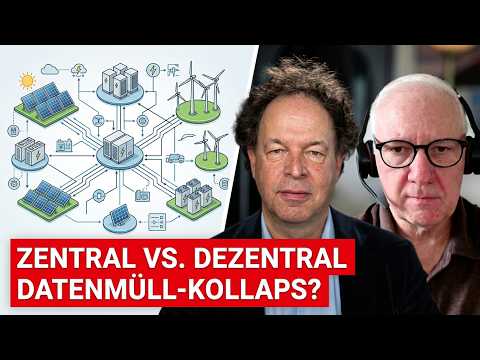
Decentralised intelligence in the power grid
The energy transition is often discussed as a question of generation, expansion and political targets. But at its core it is about something deeper: the physical stability of our power grids. This is exactly where Dr. Fette comes in, in conversation with Prof. Krauter. His topic: central versus decentralised intelligence in grid control. And his core message is clear: the structures of the past cannot simply be carried forward when the electricity system is changing fundamentally. In the past, large synchronous machines dominated the grid. Their inertia, damping behaviour and well-known control mechanisms ensured that many underlying oscillations and dynamics in the system quickly died away. That is why classic considerations such as load flow, short-circuit calculation, power quality and central control systems could be relied on for a long time. But that time is coming to an end. With photovoltaics, battery storage, heat pumps, charging infrastructure, e-mobility and inverter-dominated plants, new dynamic interactions are arising in the grid.
The power grid is becoming more dynamic
Using concrete measurement examples, Dr. Fette shows that relevant grid phenomena do not only occur at 50 hertz or in the classic harmonic range. Very low-frequency dynamics, resonances and interactions between plants are also decisive. These can occur in customer installations, distribution grids and high-voltage grids. Particularly critical: such effects are often not sufficiently detected by classic power quality analyses. You have to look at the entire relevant frequency range to understand what is actually happening in the grid.
A central example is the effect of inverters, PV systems and production processes on certain frequency bands. Dr. Fette describes how conclusions about plants, manufacturers, resonance processes and risks can be drawn from measurement patterns. In some cases, such dynamics even led to accelerated ageing or destruction of transformers and switchgear. This shows: grid stability is not an abstract calculated value. It determines service life, operational safety and investment costs.
The decisive system conflict arises where central structures try to master decentralised dynamics with central data collection. Dr. Fette considers precisely this to be unworkable in practice. If countless controllable consumers, storage systems, electric cars and plants sent all their measurement data to central systems, gigantic amounts of data would arise. In the conversation it is calculated that, at the corresponding scale, such central data transmission could generate a multiple of total internet data traffic. At the same time, according to his analysis, around 99.998 per cent of this data would be unusable redundancy — data rubbish rather than a basis for decisions.
Decentralised intelligence instead of a central flood of data
This makes it clear: more data does not solve the problem, better data evaluated locally does. Grid control must take place where the physical effect arises: on site, decentralised, with reduced and relevant information. Central systems still have a role, but not as a collecting pool for everything. They should only receive those condensed and meaningful quantities that are really necessary for system operation, planning, budgeting and strategic decisions.
The flexibility potential is particularly important here. Battery storage, electric cars, controllable loads and decentralised plants are not disruptive factors, but can serve the system if they are intelligently integrated. Dr. Fette says that this potential is hardly used today. Storage in particular can act as a new element in the grid: not simply as a load and not simply as a feeder, but as an asset class of its own with a special ability to stabilise, dampen and optimise.
Frequency indicators also play an important role here. According to Dr. Fette, certain control tasks can be carried out using frequency information without the need for a fully digital communication network. This is an essential idea: system stability does not necessarily have to come from total networking, permanent data collection and central control. It can also be achieved through local intelligence, physically meaningful indicators and fast decentralised reactions.

The Solarstammtisch (solar get-together) in Stockerau on 3 June 2026 takes up exactly this subject in practice.
The talk “E-Auto Laden im Mehrparteien-Wohngebäude und Flottenbetrieb bereits möglich?” (Is charging electric cars in apartment buildings and fleet operation already possible?) deals with concrete applications of the flexibility that is often still underestimated in the grid debate. From 5 pm electric vehicles can be viewed; the meeting begins at 6 pm in the Kaiserrast Stockerau. This links the fundamental system question with a very practical perspective: how can e-mobility, charging infrastructure and local energy intelligence be brought into everyday life in a meaningful way?
Information on the public get-togethers (German)
Conclusion
The future of stable power grids does not lie in ever greater centralisation, but in meaningful decentralisation.
Anyone who wants to collect all data centrally creates complexity, costs and overload. Anyone who evaluates relevant information locally and makes intelligent use of flexibilities such as storage, electric cars and controllable consumers creates resilience.
For us, this idea is central: independence does not come from blind dependence on central control structures, but from distributed responsibility, local competence and technical systems that enable freedom instead of curtailing it. Decentralised grid intelligence is thus not only a technical necessity, but also a contribution to more self-determination.
More posts on the topic

Warum Stromnetze dezentral denken müssen

Energy self-sufficiency in practice

Energy sovereignty begins locally

Esbjerg: how energy self-sufficiency can work
Vegetable oil instead of petroleum
5-point plan for radical EEG reform
Europe is falling behind – and why it hurts

Feldheim: how a small village leads the energy transition

Plus-energy house – blackout-proof thanks to sunflowers

Electric cars: how often do they really catch fire?!

Gigantic development in battery technology
Switching to 100% renewable energy earned us EUR 1,000
ORF magazine Konkret | “4 Wände – 4 Hände” pays a visit
Scarcity is driving up fossil and nuclear energy prices

The misery of political energy cosmetics

What does “Clean Disruption” mean?

Cobalt – are children toiling for our electric cars?
Tesla “light years” ahead – Herbert Diess fears for the VW Group
Tesla’s market value rises to 731 billion dollars
E-mobility: time is running out
Wer nichts verändern will, wird auch das verlieren, dass er bewahren will.
Wolfgang Löser, Erster energieautarker Bauernhof Österreichs, Energiepionier
Notes on content provided by authors
Comments
Loading comments …
Become a member to comment publicly. GAIA members write comments in the members' portal — under their nickname, visible to everyone.