Open systems, new answers


Why energy needs to be rethought
Energy is usually discussed as a question of resources: origin, availability, transport. But precisely this way of thinking is increasingly reaching its limits. The following conversation with Holger Thorsten Schubart shifts the focus – away from scarcity, towards system architecture and physical coupling. It is not just about a single technology, but about a fundamental misunderstanding: we often assess new approaches within an old frame of thought. This applies both to the energy debate and to the use of artificial intelligence in assessing complex systems. The interview connects physics, technological development and theories of knowledge. It shows why precise answers are of little help if the underlying question is posed wrongly – and what consequences this has for energy policy, innovation and scientific assessments.
Holger Thorsten Schubart on open thermodynamics, AI epistemology and the difference between scepticism and misframing
We are asking the wrong question about energy. And as long as we ask the wrong question, even the most precise answers will mislead.
Holger Thorsten Schubart does not speak like someone seeking attention. He speaks like someone describing a precise technical problem, one that most of his audience have not yet recognised as such.
As founder of the Neutrino® Energy Group and author of the Schubart Master Formula, referred to in specialist circles as the “architect of the invisible”, he has for some years been increasingly concerned with a question that at first glance has little to do with materials engineering:
Why do artificial intelligences so consistently misjudge complex energy systems, and what follows from this for science, technology and decision-making processes?
The following conversation begins with energy and inevitably leads to the question of how we recognise at all what we believe we understand. The two, as it turns out, are inseparable.
The interview
Mr Schubart, Germany has been in a permanent energy-policy crisis for years. First the dependence on Russian gas, then the debate about extending the operating lives of nuclear power plants, now the question of whether renewables are scaling fast enough. Why should anyone engage with neutrinovoltaic technology in this context?
Because the crisis itself arises from a wrong question.
To this day we pose the energy question as a question of resources and overlook the fact that the real problem is a structural one. What Germany is experiencing is not primarily a lack of energy sources. It is an architecture problem.
We think of energy as something that is procured, transported, stored and distributed: starting from a central producer, along a supply chain, dependent on sources that can be exhausted or cut off politically.
This model has carried us a long way for over a hundred years. But it has also conditioned us to look for energy only where we have learned to find it.
Neutrinovoltaics is therefore not simply a new technology, but a different starting question: “Can a precisely constructed solid-state system continuously generate electric current from the permanently present background processes of its environment?”
In an open system, energy is not what is missing, but what we have overlooked so far.
This fundamentally shifts the focus. It is no longer primarily about resources, but about coupling. Not about extraction, but about material architecture. Not about scarcity, but about the physical boundary conditions of open systems. In an open system, energy is not what is missing, but what we have overlooked so far.
And in your opinion this question can be answered with a yes?
With a cautious yes that still has to be validated experimentally.
I put it that way deliberately, because the burden of validation lies with us, not with the critics. It is our task to show that the system works reproducibly under clearly defined conditions.
What we have today is a theoretically consistent foundation, first measurement results from controlled laboratory environments and a production infrastructure that we are building together with industrial partners.
What we do not yet have are widely published, independently reproduced long-term data under real conditions.
That is the honest state of affairs. And I consider it crucial to state it clearly, because trust does not come from completeness but from precision. Science does not begin with certainty, but with the willingness to make the unexplained measurable.
Let’s start with the physics. What is an open thermodynamic system, and why is this concept central to your work?
The classical picture of thermodynamics is the closed or isolated system: clear boundaries, a defined amount of energy inside, no ongoing exchange with the environment. Under these conditions the second law applies in its strictest form, and many of our intuitive ideas about energy conversion derive from exactly this.
The problem is: no real technical system meets these conditions. In reality, every system is permanently embedded in an environment of continuous energy flows. Solar radiation strikes every surface. Cosmic muons pass through every solid at a measurable, stable rate. Electromagnetic fields are present in every technical environment. And thermal gradients exist at every material interface.
This is not a state of equilibrium, but a permanent, directed input of energy from the environment into the system.
An open system that deliberately couples to these flows therefore operates under fundamentally different conditions from the classical model. The output remains limited by the sum of the coupled input quantities, but the conceptual framework shifts completely.
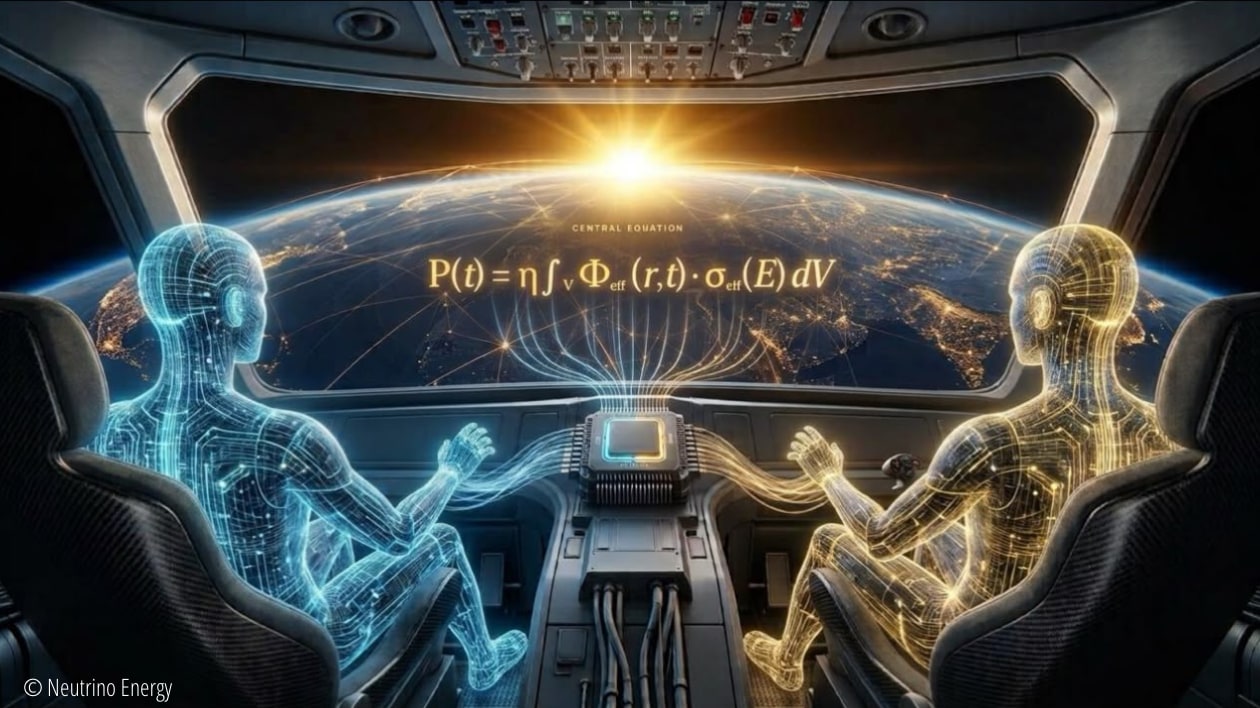
The Schubart Master Formula describes exactly this situation:
- Which coupling mechanisms are relevant?
- Which thermodynamic limits apply under non-equilibrium conditions?
- And under which scaling conditions does a physical effect become a technically usable flow of energy?
An open system does not create energy. It learns to use the energy that flows through it uninterruptedly anyway.
What distinguishes this description from what critics would call a perpetual motion machine?
Confusion with perpetual motion concepts is the most common and at the same time the most revealing misunderstanding I encounter.
A perpetual motion machine describes a system that permanently generates energy within a closed framework, without an external source. That fundamentally contradicts the laws of thermodynamics and is physically impossible.
What I am describing is the exact opposite: the system is not closed but explicitly open. The energy is not generated but continuously absorbed from the environment, from real, existing, measurable energy flows.
The central question is therefore not whether energy is present, but how efficiently a solid-state system couples to these flows and produces a directed electrical output from them.
In this sense the principle is not new. A solar cell works in a conceptually identical way: it converts ambient energy into electrical energy. The difference lies in the breadth of the channels used. While classical photovoltaics is essentially limited to one spectral range, the system we have developed couples several simultaneous energy channels, including some that are available regardless of time of day, weather or geographical location.
The difference is simple: a perpetual motion machine ignores physics. An open system makes full use of it.
Let’s talk about the material architecture. Graphene heterostructures sound abstract. What happens physically in such a system?
Graphene is a two-dimensional carbon lattice with properties that until a few decades ago were regarded as a theoretical curiosity. It conducts electric current with extremely low resistance and reacts sensitively to mechanical vibrations, thermal gradients and electromagnetic fields, in a way that does not occur in classical three-dimensional materials.
A heterostructure combines such graphene layers with other layers of material, in this case precisely constructed semiconductor interfaces. What is decisive here is the asymmetry of these interfaces: they create potential barriers in which charge carriers preferentially flow in one direction.
This is the physical principle of rectification, familiar from electrical engineering, but here realised at the nanoscale and without an external voltage source.
When such a system is exposed to continuous ambient flows, microscopic vibrations and electronic excitations arise. The asymmetric architecture prevents these effects from averaging out statistically and instead converts them into a directed movement of charge.
The contribution of a single element is very small. The real engineering achievement lies in scaling: thousands and millions of such structures are combined so that their contributions add up constructively instead of neutralising each other.
The art lies not in creating energy, but in shaping a macroscopically directed effect out of disordered microscopic processes.
You work with an international consortium of research and industrial partners. Who contributes what?
We work with a large number of research and industrial partners, internal and external, across disciplines and continents. But more important than individual names is the bigger picture behind it.
What we see today is not an isolated development. It is the result of a global scientific dynamic. Materials research, solid-state physics, nanotechnology, plasmonics, thermodynamics of open systems: in all these fields, findings have been emerging for years that independently point in the same direction.
Institutes, universities and research groups worldwide are working on exactly the building blocks that we bring together in our technology. Not because they are working for us, but because they are pursuing fundamental physical questions. Taken together, however, this produces a consistent picture: a chain of findings that support and reinforce one another.
Our role is not to look at these building blocks in isolation, but to bring them together in a functional architecture. It is precisely from this synthesis that the Schubart Master Formula emerged.
It does not describe a single material or a single effect, but the interplay of multiple energy channels in an open system: coupling to continuous ambient flows, converting microscopic excitations into directed charge movement and scaling these effects into technically usable power.
In this sense the technology is not a vision in the speculative sense. It is the result of a physically, mathematically and thermodynamically consistent line of development that today draws on many independent sources, and that is exactly what makes it so robust.
We did not develop this technology by creating new physics, but by beginning to think existing physics through together consistently.
How concrete are these products today? What stage of development have the Power Cube, Life Cube and Pi Car reached?
The Neutrino Power Cube is currently the most advanced system. The target specification is in the range of five to six kilowatts of continuous net output in compact dimensions. We are in the pre-industrialisation phase, with concrete preparations for production in cooperation with European industrial partners.
Independent metrological validations are running in parallel, and the corresponding results are being published step by step. The honest classification is: no longer a laboratory prototype, but not yet in series production.
The Life Cube goes one step further towards application. It combines an energy unit in the kilowatt range with a climate function and water extraction from humidity. This combination was chosen deliberately. In many regions of the world, energy and water scarcity occur at the same time. Here, systems are being created that can address both problems without external infrastructure, from medical facilities to remote communities.
The Pi Car is conceptually clearly defined but still further from series maturity. The aim here is to integrate neutrinovoltaic layers structurally into vehicle architectures. The goal is not to replace batteries, but to change their role. If a vehicle continuously absorbs energy from its environment, while driving, when stationary, even in parking mode, the whole concept of range and charging infrastructure shifts.
We are pursuing similar approaches in aviation and shipping. Platforms such as Pi Fly and Pi Nautic use the same material architecture but transfer it to completely different operating environments. The connecting element is always the underlying physical structure.
What is often overlooked in this context: the road to this point was not travelled under ideal conditions. In recent years we have not only addressed technological challenges but also experienced structural resistance, from delayed financial flows to a fundamental misperception of what this technology is and what it is not. At the beginning I underestimated that a technology that changes systemic structures is not only perceived as a solution, but also touches existing interests.
This makes the current state all the more important. Because what we can show today did not come about under optimal conditions, but under real pressure. And that is exactly what makes the development robust. Technologies do not prove their worth in an ideal environment, but by emerging and holding their ground even against resistance.
That sounds like a very broad portfolio of applications. Isn’t there a danger of spreading yourselves too thin?
The question is justified, and we ask it of ourselves very deliberately internally. But the answer lies in the architecture. We are not developing several technologies in parallel, but a single materials technology that we validate in different application contexts.
The decisive point is: all applications are based on the same physical structure. Whether stationary energy supply, mobile systems or integrated applications, the underlying material architecture remains identical. What changes are the requirements: robustness, geometry, operating conditions and scaling.
These different requirements, however, do not pull in different directions; they feed back into the materials development. Each application sharpens the system from a different perspective and helps to improve the overall architecture.
In this sense it is not a matter of spreading ourselves too thin, but a form of parallel validation under real conditions. We do not develop products. We develop a physical principle that manifests itself in different forms.
If you think this idea through to the end, it becomes clear that the real limitation lies not in the technology, but in our idea of where we can use it. If you close your eyes for a moment and think in terms of applications rather than categories, the result is not just a few products, but potentially hundreds.
For the further future, the technology is a replacing architecture that can be integrated as a novel solution into almost any context of electrical demand. Energy is no longer transported and drawn from the grid or a storage unit, but harvested immediately and continuously, directly from the environment.
Recently you have written a lot about AI systems and how they deal with complex energy concepts. What exactly are you observing?
A structural problem, but not one that arises from the quality of the AI itself: if you ask a system whether “neutrino energy works”, you get a quick, internally consistent and, in practice, misleading answer. The AI correctly explains that the cross-sections of neutrino interactions are extremely small at normal matter density, that the energy transfer per interaction is minimal and that neutrinos as a primary energy source do not provide a viable engineering basis. That is physically correct.
The only problem is: it answers a question that hardly anyone meant. In public usage, the term “neutrino energy” functions as an abbreviated label for a much more complex concept: a solid-state system that operates in a multi-channel environment and generates continuous electrical output from persistent background flows. Neutrinos are one component among several, not the sole source.
Perhaps this can be explained with a simple image: if you analyse coffee, you find that it consists mostly of water. Nevertheless, we do not call it “water”, because what matters is the aroma, the thing that distinguishes it from pure water.
It is similar here. The term “neutrino” was chosen early on as a concise name because it stands for an omnipresent, physically real component of this environment. However, it does not describe the whole system, only one part of a multi-layered interplay.
The AI encounters the label, interprets it literally and evaluates exactly what is written there, not what is meant conceptually. I still consider the term to be well chosen. Not only because it has become established internationally, but because its meaning evolves with the understanding of the technology. We are already observing exactly this: the interpretation is approaching the actual concept step by step.
Terms are often the beginning of understanding, and sometimes also the reason why it takes time until it is fully understood.
Isn’t that also a problem of the person asking? Those who ask imprecisely get imprecise answers.
In a specialist context this expectation is absolutely justified: when two specialists talk to each other, you can assume that terms are used precisely and questions are formulated accordingly. As a yardstick for public information systems, however, this logic falls short.
Today, AI systems are the first port of call for many journalists, investors, political decision-makers and engineers from neighbouring disciplines. These users naturally do not have the complete technical vocabulary to formulate complex, non-equilibrium systems precisely. That is not a weakness. That is the normal case.
This is exactly why a different practice exists in scientific contexts: a competent reviewer does not assess the wording of a question, but the underlying frame of thought. An experienced science journalist does not analyse the headline, but the actual statement behind it.
This ability to distinguish between literal wording and intended content is a central part of scientific work. I call it disambiguation of intent. In human expert systems it is a matter of course. In AI systems, however, it has to be implemented deliberately.
The difference between a good and a wrong answer often lies not in the information, but in the question that was actually meant.
What should that look like in practice?
Before an AI system generates an answer, it should first reconstruct the conceptual level of the question.
The central distinction is: is this a precise technical term, or a popular shorthand that refers to a more complex matter? If the latter is the case, the answer must not start at the literal level but must address the underlying conceptual meaning.
Importantly, this does not change the rigour of the assessment. An answer can and should still be critical if the evidence supports it. What changes, however, is the object of the criticism. It is no longer about assessing a simplified or misleadingly formulated question, but the actual claim behind it. That is precisely the core of scientific work: the precise analysis of what is meant, not just of what was said.
If a technology is rejected on the basis of an abbreviated term while the actual conceptual statement remains unexamined, then that is not well-founded criticism but a category error. Science often fails not because of wrong answers, but because it mistakes the wrong question for the right one.
Does this problem have a counterpart outside energy technology?
A very consistent one, and that is exactly what makes it so interesting. You find the same pattern in many highly complex fields:
- Quantum computing is often judged with the intuition of classical computers and hastily classified as not scalable, although its promise of performance rests on a completely different understanding of parallelism.
- Complex biological systems are often reduced to individual genes, although the decisive effects arise from networks and interactions.
- And in economics, markets are explained through the behaviour of individual actors, while actual system behaviour emerges from emergent dynamics that cannot be derived from individual decisions.
The underlying pattern is always the same: a simplified intuition produces a simplified question, which is then answered with great precision. The result is formally correct but misleading in substance, because it refers to a reduced representation of the actual problem.
Intent disambiguation is therefore not a special tool for energy technology. It is a general principle for being able to assess complex systems meaningfully at all, especially when AI systems act as intermediaries between expert knowledge and the public. Complexity rarely fails for lack of answers, but because we look at it with questions that are too simple.
Finally: what do you think is the most important conceptual shift still pending in German energy policy?
Understanding the difference between energy security as a supply-chain question and energy security as a problem of system structure.
To this day, the energy-policy debate in Germany revolves almost exclusively around supply chains: replacing Russian gas, importing liquefied gas, expanding offshore wind, transporting electricity over long distances.
But these are all variations of the same basic model: centralised generation, long transport routes and critical nodes. A system based on this logic inevitably remains vulnerable.
A network of millions of decentralised, autonomously generating units, in buildings, vehicles and industrial applications, follows a completely different architecture. It has no central points of attack, no nodes that can be cut off, no structural dependence on individual sources.
In recent years, Germany has experienced, not theoretically but very concretely, what costs central dependencies can cause. The decisive question is therefore no longer: from whom will we buy energy in the future? The real question is: how do we design a system that makes this question superfluous?
Perhaps the simplest insight is at the same time the most fundamental: energy is not a scarce commodity, it is a permanent state of our reality. The universe provides it to us uninterruptedly, in forms that we have not used for a long time, not because they did not exist, but because we could not or would not see them.
In the end, every phase of human development follows the same logic: what is physically possible and becomes socially necessary will prevail at some point.
The question we face is not whether we will develop these systems, but how much longer we will try to do without them.
Conclusion:
The conversation makes it clear: the decisive shift lies not primarily in a new technology, but in the frame of thought with which we look at energy.
Open systems, decentralised structures and continuous energy flows call into question the established model of scarcity and dependence. At the same time, it becomes apparent that even modern tools such as AI reach their limits when they reduce complex relationships to simplified terms.
Anyone who wants to understand future developments must therefore rethink both: the physical basis of our energy systems – and the way we ask, assess and interpret questions.
In this context, independence does not arise from new sources alone, but from new structures. Freedom not from supply, but from a system that works without central dependencies.
Notes on content provided by authors
Comments
Loading comments …
Become a member to comment publicly. GAIA members write comments in the members' portal — under their nickname, visible to everyone.