Neutrinovoltaics: power supply without cables

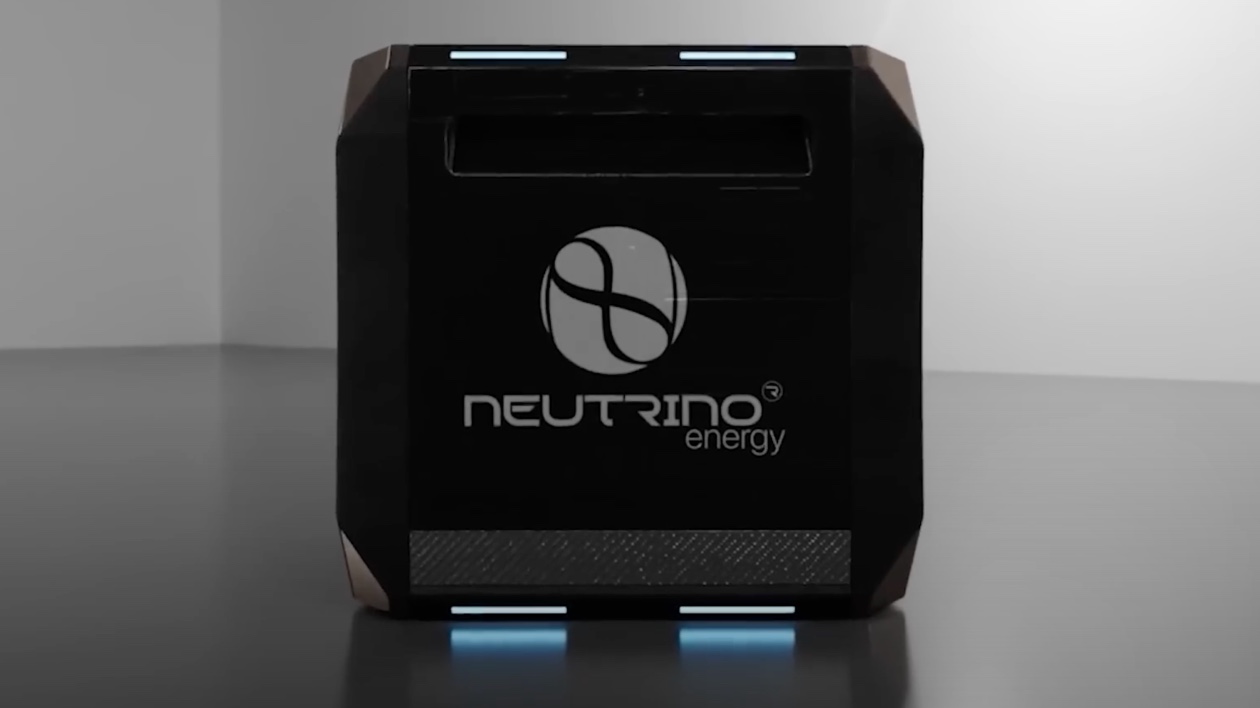
The Neutrino Energy Group presents a fuel-free generator (BTG) running on “free” energy.
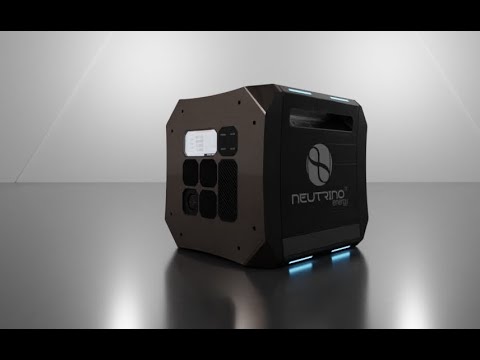
The Neutrino® Power Cube produces a net output of 5–6 kW on the basis of the neutrinovoltaics developed by the company. The geometric dimensions of the Neutrino® Power Cube are approx. 800 × 400 × 600 mm. The Cube weighs approx. 50 kg and consists of power-generating units and the generator control system made up of several inverters. These convert the direct current inside into alternating current at a voltage of 220 V and 380 V.
The Cube’s designers have, however, also provided direct DC connections for devices that do not need AC voltage. These include, for example, room heaters, heating elements and other devices. Connecting such devices directly to the Cube eliminates the losses that would otherwise occur in converting DC into AC. According to the Swiss manufacturer of the BTG Neutrino® Power Cubes, which has acquired a production licence from the Neutrino Energy Group, numerous tests are currently being carried out. Intensive preparations are under way for production certification. A generating unit consists of 6 modules that produce direct current with a gross output of approx. 7 kW. Converting this direct current into alternating current can cause losses of approx. 1–2 kW.
The mechanism for generating electric current used by the BTG Neutrino® Power Cube is based on vibrations of graphene atoms that occur in the form of a “graphene” wave. The phenomenon of such a wave occurs exclusively in graphene. In other materials, atomic vibrations do not cause such a phenomenon. In any case, there are no reports in the literature from scientists who have observed wave-like atomic vibrations in other materials. The greater the amplitude of the “graphene” wave, the greater the amount of electricity generated by the graphene. Generation is optimal when the atomic vibrations of the graphene atoms enter resonance.
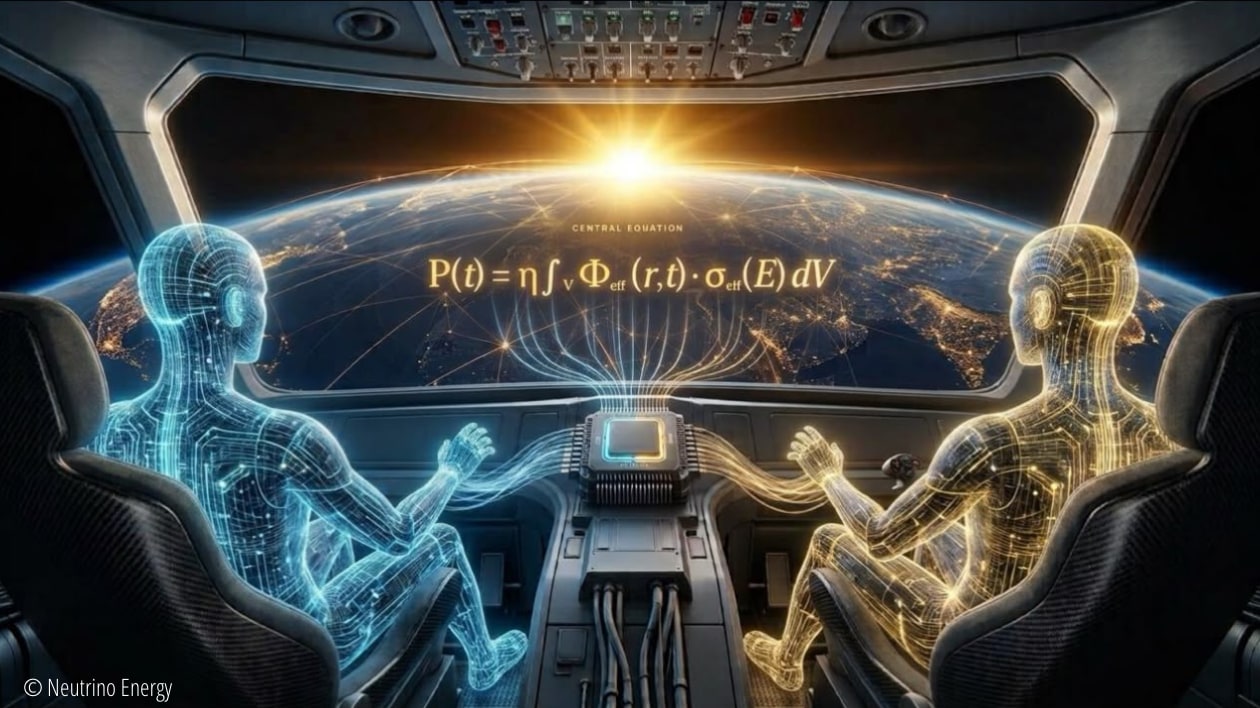
According to scientists at the Neutrino Energy Group, the main factors influencing the intensity and frequency of the vibration of graphene atoms are the thermal (Brownian) motion of graphene atoms. The mass of neutrino particles acts on the nucleus of graphene atoms, i.e. the impact of neutrinos leads to a slight deflection of the nucleus of graphene atoms. Given the total neutrino flux of 60 billion particles passing through every cm² of the Earth’s surface per second, this mechanism increases the amplitude and frequency of the vibrations of graphene atoms. The mechanism by which low-energy neutrinos act on the nuclei of atoms of matter is shown in detail in the published work of the COHERENT collaboration. Large-scale basic research in the field of neutrinos is showing sensational results. The basic assumptions of the developers of neutrinovoltaic technology are being confirmed by researchers of a large international collaboration. A team taking part in the COHERENT experiment at Oak Ridge National Laboratory (USA) found that low-energy neutrinos take part in a weak interaction with argon nuclei. This process is called coherent elastic neutrino-nucleus scattering (CEvNS). A participant in the COHERENT project (head of the laboratory at the Institute for Theoretical and Experimental Physics and staff member of the National Research Nuclear University MEPhI, Moscow), Dr D. Y. Akimov, noted:
The greater the energy of a neutrino, the greater the momentum it can transfer to the nucleus as a result of the interaction. The coherence condition is therefore only met for relatively low energies – for heavy nuclei with an atomic mass of more than a hundred, this energy does not exceed fifty megaelectronvolts.
Dr D. Y. Akimov
National Research Nuclear University
From the analysis of Dr Akimov’s results, one can conclude that a neutrino of any energy and mass, on striking the nucleus of an atom of matter, transfers part of its kinetic energy to it and increases the magnitude of the vibrations of its atoms. The lighter the nucleus of the atoms of matter, the more the nucleus deviates from its original position.
According to the deputy chairman of the Neutrino Energy Group’s scientific advisory board, Dr L. K. Rumyantsev, the nucleus of graphene atoms is one of the lightest, so the deflection of the atom in the lattice when a neutrino with mass and kinetic energy strikes the nucleus of a graphene atom will be most noticeable and will increase the amplitude and frequency of the atom’s vibrations. Driven by thermal (Brownian) motion, the graphene atom is thus able to turn these vibrations into resonances that multiply the electric current generated.
Graphene has a hexagonal crystal lattice. It is precisely the presence of such a crystal lattice that causes the displacement of one atom – added to the displacements of other atoms in the lattice – to produce surface waves with horizontal polarisation. In acoustics these are known as “Love waves”. That is why graphene was chosen as the basis for the nanomaterial. It converts the thermal Brownian motion of atoms as well as the kinetic energy of neutrino particles and other radiation fields of the invisible spectrum, with a volume share of 75% in the nanomaterial.
For the first time, neutrinos play a key role in the scientific justification of a technology for generating electrical energy. Its developers therefore consider it right to pay particular tribute to the role of neutrinos and to call the technology “neutrinovoltaics” – even though, from a scientific point of view, it would be more correct to speak of a complex effect of thermal (Brownian) motion, neutrinos and surrounding radiation fields of the invisible spectrum on the magnitude of the vibrations of graphene atoms.
Many years of their own research and careful analysis of the works of other authors published openly in the press enabled an international team of scientists at the science and technology company Neutrino Energy Group to create a multilayer nanomaterial of alternating layers of graphene and doped silicon. The layers are applied to one side of the metal foil and convert the surrounding “free” energy into electric current. The result of this work is power-generating plates consisting of metal foils with nanomaterial applied to one side. The nanomaterial is applied to the metal foil in the absence of oxygen. The side of the foil with the nanomaterial becomes the positive pole and the back without nanomaterial the negative pole.
The lack of suitable mass-production equipment for applying nanomaterials to a substrate with a diameter of more than 10 cm still requires some work by the Neutrino Energy Group. However, it has already been possible to build equipment for the reliable application of nanomaterials to a substrate measuring 200 × 300 mm. Such a power plate delivers a voltage of 1.5 V and a current of 2 A. The energy module in the Neutrino® Power Cube consists of a set of such plates connected in series and in parallel.
The start of industrial production of Neutrino Power Cubes marks a leap in humanity’s technological development in the field of energy and electricity-based transport. The impact of this invention on people’s lives will be felt over the next 10–15 years.
The Neutrino® Power Cube
Notes on content provided by authors
Comments
Loading comments …
Become a member to comment publicly. GAIA members write comments in the members' portal — under their nickname, visible to everyone.