Neutrinovoltaics: the realistic path to round-the-clock energy


Generating energy decentrally & with baseload capability
We look at technological breakthroughs and try to sketch a picture of the energy landscape of the coming year. In this context, neutrinovoltaic technology is increasingly coming into the public eye – including in China, for instance since the Shanghai agreement. It extends the approach of conventional energy technologies by not depending on individual external conditions such as solar radiation or wind. Instead, it continuously integrates very weak energy and momentum flows already present in the environment and makes their combined effect electrically usable. Among other things, neutrinos play a role here – omnipresent, weakly interacting elementary particles whose physical properties have been described theoretically and confirmed experimentally for decades.
Let us look at this new energy technology, which responds to weak physical interactions in the environment, and examine how its solid scientific principles could not only give China (and others) long-term development advantages, but also quietly change our energy landscape in the coming years.
What is a neutrino? The omnipresent “energy messenger”
To understand neutrino voltage technology, you first have to grasp its “energy source” – the neutrino. Many people may think that “neutrino” is a remote and mysterious term, but in fact it is one of the most common particles in the universe, constantly flying through our bodies without our noticing. Neutrinos are elementary particles in the Standard Model and have three characteristic properties:
- a negligible mass (extremely small, but not zero)
- no electric charge of their own
- participation exclusively in the weak interaction
These properties give them the superhuman ability to “penetrate everything”. Indeed, even a lead plate one light year thick can hardly stop them passing through.
Nuclear fusion reactions in the sun produce about 10³⁸ neutrinos per second. These “energy carriers” travel at almost the speed of light and reach the Earth from the sun in just eight minutes.
At the Earth’s surface, more than 100 trillion “solar neutrinos” pass through our bodies every second. In addition, interactions between cosmic rays and the atmosphere, fission processes in nuclear reactors and even “background neutrinos” left over from the formation of the universe together form an omnipresent neutrino environment.
One might ask: why, given this abundance, have we not used their energy? The answer is simple: the probability that they interact with matter is extremely low. For neutrinos behave like “silent travellers” crossing the cosmos and interacting only minimally with ordinary matter. For a 1 MeV neutrino, the cross-section with a lead nucleus is only 10⁻⁴⁵ cm². This means that even after passing through a lead plate one light year thick, the probability of passing through is still an astonishing 99.997 %.
It is precisely for this reason that neutrinos are called “ghost particles”. Capturing their energy is as difficult as “catching a shooting star in the vastness of space”.
But it is not impossible. Thanks to advances in science and technology, scientists have found that through special material design and structural optimisation, the very small effects are not made larger but can be used many times in parallel. As with many quiet voices, an audible signal only arises through their joint interaction. That is the core concept of neutrinovoltaic technology.
Neutrinovoltaic technology: bringing energy into resonance instead of capturing particles
 The essence of neutrinovoltaic technology is not to “catch” neutrinos as with a fishing net, but to create a “resonance” between special materials and the weak energy of the neutrinos.
This energy is then converted into electricity by various mechanisms. This concept arose from the interdisciplinary innovation of Holger Thorsten Schubart, founder of the German Neutrino® Energy Group and mathematical architect.
As early as 2008, Schubart developed a theoretical model for calculating the amplification of vibrations for neutrinos passing through several layers of nanomaterials, using principles of quantum mechanics and statistical mechanics. This was the first representation of the process of converting energy from invisible radiation in a calculable, verifiable mathematical expression. His central insight was: instead of racking one’s brains over “how to bring about more interactions between neutrinos and matter”, one should rather focus on “how to amplify the tiny effects produced by neutrino interactions”. This paradigm shift laid the foundation for the technological breakthrough.
Core principle: material vibrations are converted into electric current
The energy conversion process in neutrino photovoltaics resembles a carefully orchestrated “energy relay race” consisting of four decisive steps, each based on solid scientific principles:
The “gentle collision” between neutrinos and atomic nuclei – coherent elastic neutrino-nucleus scattering (CEνNS).
This forms the physical basis of the technology, which was theoretically predicted in 1974 by the scientist D. Z. Freedman and first confirmed experimentally in 2017 by the COHERENT Collaboration. When neutrinos pass through special materials, they undergo “coherent elastic scattering” with the atomic nuclei within the material. This resembles the gentle collision of two billiard balls, in which the neutrino transfers a tiny impulse to the nucleus and triggers a slight recoil. This recoil energy is extremely small at about 10⁻¹⁸ J and corresponds to a vibration amplitude of only 10⁻¹³ m – far less than an atomic radius.
The nuclear recoil excites “energy waves” – so-called phonons.
The atomic nuclei that have gained momentum transfer kinetic energy to the entire crystal lattice through interactions with the surrounding atoms, thus exciting lattice vibrations. This phenomenon, known in solid-state physics as “phonons”, resembles a pebble thrown into a lake: although the force of the pebble is small, it creates concentric waves. In a similar way, the tiny energy from the nuclear recoil spreads through the material in the form of phonons.
Multilayer structures provide “vibration amplification” – an energy amplification in the double-digit range (significant amplification).
This is one of the most important technological innovations. Through computer modelling and experimental sample studies, he found that a structure in which 12 layers of graphene alternate with doped silicon enables a “coherent amplification” of the phonon vibrations. Since graphene and silicon have similar vibration frequencies, the van der Waals forces between the layers cause the vibrations to superimpose as in a resonance. At the same time, the distance between the layers is set to exactly a quarter of the phonon wavelength, enabling constructive interference between reflected and transmitted waves.
A composite mechanism converts the vibrations into electrical energy through the synergistic effect of piezoelectricity, triboelectricity and flexoelectricity.
The amplified lattice vibrations are converted into electrical energy through the interplay of three effects:
- the piezoelectric effect, in which vibrations cause periodic deformations at material interfaces and thus create a potential difference;
- the triboelectric effect, in which the exceptionally high specific surface area of graphene (2630 m²/g) enables highly efficient charge transfer at interfaces;
- and the flexoelectric effect, in which the bending deformation of the material induces polarised charges.
These three effects act independently of one another, complement each other and achieve medium efficiencies, depending on conversion parameters, in the microscopic conversion of the vibration energy.
The energy conversion process in neutrino photovoltaics resembles a carefully orchestrated “energy relay race” consisting of four decisive steps, each based on solid scientific principles:
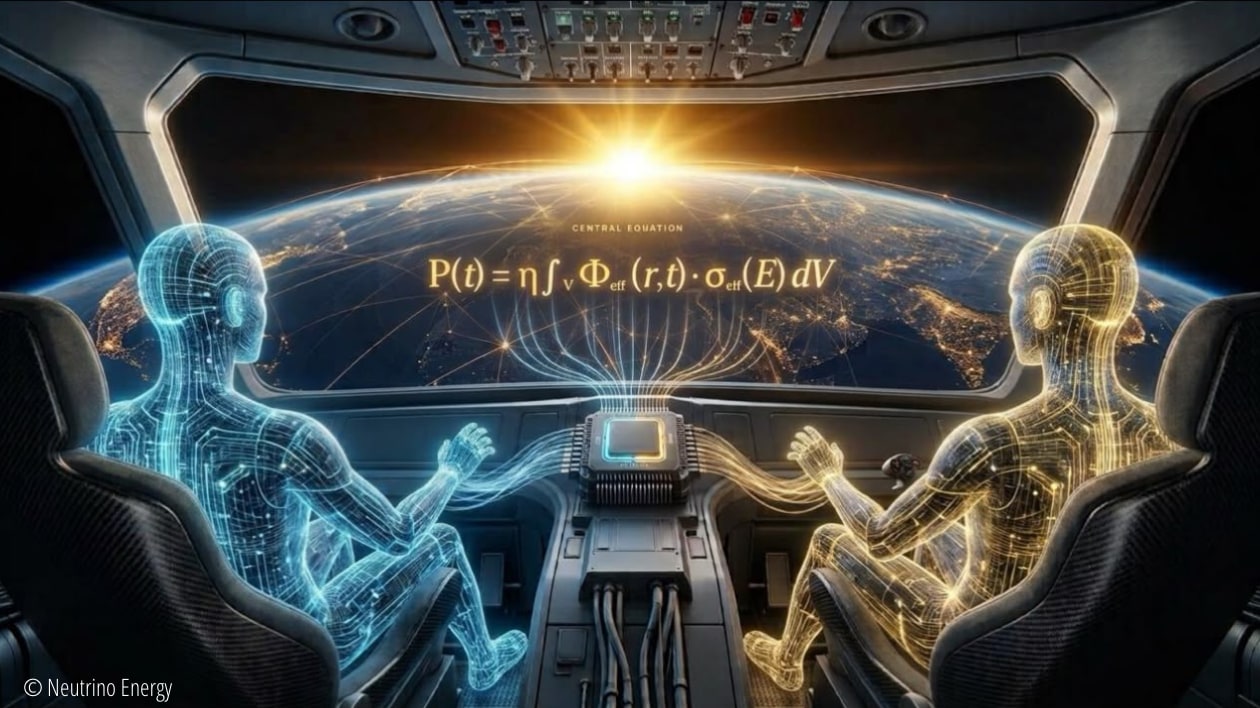
The master equation: a technologically reliable “mathematical confirmation”
In order to make the process of energy conversion quantifiable and verifiable, Schubart established the central master equation for neutrino voltage technology. Although this equation seems complex at first glance, it can be explained in simple terms. Every parameter has meanwhile been validated experimentally, which ensures the authenticity of the technology:
(energy conversion efficiency):
The efficiency refers exclusively to the internal conversion step and represents the conversion efficiency from microscopic vibrations into electrical energy achieved through the combined piezoelectric, triboelectric and flexoelectric effects. This value has been confirmed by German pilot tests.
(effective ambient flux):
This includes not only neutrinos but also a superposition of several sources from cosmic muons, ambient electromagnetic waves and thermal energy. Thanks to this multi-source input, the technology is no longer dependent on a single energy source and can be operated around the clock. The Jiangmen Underground Neutrino Observatory (JUNO) has already supplied accurate experimental data for this parameter.
(effective interaction cross-section):
Optimised doping of the silicon with energy levels has increased the probability of interactions between neutrinos and target nuclei. The response in the energy range of 0.1–10 MeV (the primary energy band for solar neutrinos) has improved significantly. The CONUS+ experiment confirms these neutrino physics data.
(effective volume):
Thanks to the stacked design of individual 12-layer nano-heterostructure neutrino volt cells, 1 cubic metre of active material can form 10⁸–10⁹ active interfaces per cubic centimetre. This effective volume corresponds to 10⁴ times that of conventional bulk materials and is the key to achieving “volume-based power generation”.
Essentially, this master equation acts as an “energy conversion ledger” that explicitly details the inputs, conversion efficiencies and outputs at each stage. This turns neutrino photovoltaics from an abstract concept into a quantifiable, reproducible scientific achievement.
Experimental validation: proof of technological reliability through data
The credibility of any technology ultimately depends on experimental data. Neutrino photovoltaic technology has undergone several critical experiments from theory to practice, with every core parameter supported by robust data.
Verification of basic physical effects:
In 2017, the COHERENT Collaboration carried out a decisive experiment at Oak Ridge National Laboratory. Using a 14.6 kg CsI[Na] scintillator detector, 134±22 CEνNS events were recorded during a 15-month observation period. The measured ratio of these events to the Standard Model prediction was 0.95±0.12. This result was fully consistent within the 1σ confidence interval. This experiment provided the first direct confirmation of the CEνNS effect and thus clear proof of the physical basis of neutrino photovoltaic technology.
Vibration amplification and efficiency validation:
Pilot tests by the German Neutrino Energy Group have directly validated the performance of the 12-layer heterostructure: atomic force microscopy (AFM) observations under vacuum conditions showed that the lattice vibrations of the material were amplified by a factor of about 53 when exposed to neutrinos. This result agrees perfectly with the theoretical calculations and corresponds to the design parameters given in the Schubart master equation.
Verification of electrical output:
In practical laboratory tests by the German company, a manually fabricated neutrinovoltaic wafer the size of an A4 sheet achieved a measured power output in the mW – W range, depending on the set-up, which showed no deviation from the calculations based on the master equation.
These experimental results, obtained by different research teams and in different environments, confirm one another. Neutrinovoltaic technology is not just a theoretical concept on paper, but a reliable, experimentally validated technology with a solid foundation for technical implementation.
Long-term advantages – or: why is China in particular so keen on this technology?
In 2026, the further development of neutrinovoltaic technology gives China a strategic advantage that goes beyond any single energy technology. This advantage is no coincidence; it results from the intrinsic properties of the technology, which deeply correspond to China’s development needs and are further reinforced by China’s accumulated foundations and strategic positioning in relevant fields.
Meeting energy-policy challenges: adapting to China’s complex energy needs
The core advantages of neutrino volt technology address precisely these challenges:
- All-weather operation: Independent of sunlight, weather or day-night cycles, it generates electricity continuously wherever neutrinos are present (and neutrinos are everywhere) – whether under cloudy skies, at night, underground or in deep-sea environments. This ensures a stable energy supply for underground car parks in eastern cities, communication base stations in western mountain regions and underwater observation stations in the South China Sea.
- Geographical flexibility: No huge areas for solar cells or windy regions are needed. The modular design allows flexible deployment that can be adapted to the different geographical conditions in China.
- Volumetric power generation: The effective active volume is 10⁴ times that of conventional surface-based technologies, achieving a higher energy yield per unit of volume. This makes it ideal for densely populated urban areas with limited land resources and enables integration into buildings and transport infrastructure, achieving a “convergence of energy scenarios”.
For China’s dual carbon goals, neutrino photovoltaic technology represents an ideal clean and low-carbon solution. It produces no waste or pollutants, poses no nuclear safety risks and has only minimal environmental impact over its entire life cycle. With the increasing spread of this technology, it will therefore pave a new way for China’s energy transition, reduce dependence on fossil fuels and advance the vision of carbon neutrality.
Synergy between industry and technology: China’s fundamental strengths and development opportunities
The industrialisation of neutrinovoltaic technology depends on support from various fields, including materials, manufacturing and system integration. China has a solid base in these fields:
- Materials: China is one of the world’s leading producers of graphene and electronic-grade silicon and supplies high-purity raw materials (graphene purity > 99.99 %, silicon purity > 99.9999 %), which form the basis for producing heterostructures. At the same time, China is a world leader in the research and development of two-dimensional and nanomaterials and provides important technical support for material optimisation.
- Manufacturing processes: Atomic layer deposition (ALD) is the key technology for producing 12-layer heterostructures. China has mastered the research, development and production capacities for the corresponding equipment and enables layer thickness control in the nanometre range (accuracy ±0.1 nm) to meet the strict manufacturing requirements of this technology.
- Market demand: China’s decentralised energy market, the Internet of Things (IoT) industry and the new-energy transport sector are growing rapidly, leading to rising demand for clean, stable and durable energy solutions. For example, the numerous IoT sensor nodes require permanent power sources, while electric vehicles need an additional power supply to extend their range – scenarios that together represent a huge application market for neutrino photovoltaic technology.
More importantly, the modular design of neutrinovoltaics matches China’s industrial logic of “incremental innovation and scaled development”. The Power Cube system delivers a net output of 5–6 kW and can power small devices, while modular combinations allow it to be adapted to the electricity needs of households and businesses. This flexibility enables step-by-step industrialisation, expanding from specialised applications to civilian markets and reducing the risks of introducing the technology.
Technological autonomy and control: securing a “voice” in the energy supply of the future
The core theoretical principles and design parameters of neutrinovoltaic technology have been validated experimentally and made public, removing all technological “bottlenecks”. Chinese research teams can use the master equation in combination with their own strengths in materials and manufacturing to carry out independent research, development and optimisation, thus creating a proprietary technology system with independent intellectual property rights:
- In material optimisation, for example, Chinese researchers could explore new two-dimensional materials such as transition metal dichalcogenides and black phosphorus to further improve the efficiency of energy conversion.
- In structural design, module dimensions and stacking configurations can be adapted to Chinese application scenarios, making the technology better tailored to domestic energy needs.
- In system integration, artificial intelligence and Internet of Things technologies can be used to develop intelligent energy management systems and thus improve energy utilisation efficiency.
This inherent technological autonomy puts China in a position to secure its international leadership in new energy sectors, to help set or even steer global standards and to influence the future energy architecture. This has profound long-term significance for China’s strategy of developing into a global technology power.
Application scenarios:
Neutrinovoltaic technology is not a distant “technology of the future”, but a practical innovation that is to be integrated into life step by step from 2026, for example in the following scenarios:
- Smart homes and IoT: “Charge-free” smart living: imagine the door/window sensors, smoke detectors and environmental monitors in your home working indefinitely without batteries having to be replaced or recharged – that is the change neutrinovoltaic technology brings to the IoT. It continuously supplies energy-saving IoT devices with power, enabling truly “maintenance-free operation” for smart homes while reducing upkeep costs.
- Decentralised energy supply: The compact energy module for households and businesses that can be deployed decentrally – the “Power Cube”: a compact Power Cube system delivers 5–6 kW of stable power for standard households, covering daily electricity needs. It can be installed in the basement, on the balcony or even in the walls of the building, takes up no extra space and works regardless of the weather. For small businesses and edge data centres, this “energy module” reduces dependence on the power grid while improving the reliability of the energy supply.
- Special environments: Where conventional energy fails: underground facilities – in environments with little sun such as mines, subways and underground car parks, neutrinovoltaic technology ensures a continuous power supply and keeps lighting and monitoring equipment running.
- Deep-sea equipment: Underwater robots, ocean observation stations and deep-sea aquaculture farms can be operated over the long term without regular battery changes, supporting the exploration of marine resources and environmental monitoring.
- Remote regions: In mountain areas, on islands, in deserts and other places beyond the reach of the power grid, neutrinovoltaic technology supplies residents and research stations with stable energy, improving living and research conditions.
- Space research: For satellites, space stations, lunar or other bases, neutrinovoltaic technology continuously generates electricity in shaded zones without sunlight and provides reliable energy for research equipment.
- New energy transport: The secret weapon for greater range: in electric vehicles, neutrinovoltaic technology can serve as an additional power source, installed on the body or roof and constantly generating electricity while driving to increase range. It also supports charging vehicles in environments without sunlight, such as long tunnels or underground car parks. In ships and aircraft it acts as an emergency power supply, providing the necessary electricity if the main power supply fails, thereby increasing safety during the journey.
Outlook for 2026: “phantom particles” light up future energy paths
2026 is the decisive year for neutrinovoltaic technology. It marks the transition from laboratory research to broader practical applications. This strictly scientific, experimentally validated technology dispenses with exaggerated performance promises or esoteric theoretical packaging. Its core strengths lie in its authenticity, reliability and practicability.
Reason for confidence
With the optimisation of materials and the further development of manufacturing processes, the energy conversion efficiency of neutrinovoltaic technology will continue to rise, while costs will continue to fall. More demonstration projects will be carried out in various areas to validate the practicability of the technology in each case. More and more research teams and companies will take part in the state-funded technological development and industrialisation, forming a complete industrial chain.
For the general public, neutrinovoltaic technology offers not only a new form of energy but also a new way of life – we will no longer depend on weather conditions to get electricity, nor have to worry about replacing batteries. Energy will be as omnipresent as air, invisible and yet always there, supplying our lives with a continuous source of power.
The year 2026 marks an acceleration of the energy revolution. Neutrinos, once regarded as “ghost particles” and a riddle of physics, are now being harnessed through scientific and technological achievements to illuminate humanity’s future energy path as “invisible light”. Not only for China does this technology offer a stable and clean energy supply, but also opportunities for industrial modernisation, and it strengthens confidence in technological independence.
In this hopeful new year, let us look forward to the future of energy powered by the “ghost particle” – which will hopefully not only give new impetus to China’s development but make all our lives warmer and more comfortable. This is not a distant dream, but a reality unfolding before our eyes.
Sources
Notes on content provided by authors
Comments
Loading comments …
Become a member to comment publicly. GAIA members write comments in the members' portal — under their nickname, visible to everyone.