Record prices thanks to the "energy transition"


Technical faults at the European power exchange EEX in Leipzig
Konrad Veritas, tkp.at (German)
Something’s happened again … thinks the author, an interested layman. Because of as yet unknown technical faults at the European power exchange EEX in Leipzig on 25.06.2024, the true impact of the completely misguided energy transition, especially in Germany, has become visible. What happened?
The usual, purely virtual coupling of the national electricity markets and exchanges did not work for price formation, so the EEX had to auction electricity for the following day, 26.06.2024, country by country. This overwhelmed the (most probably not only human) players and, for Germany in particular, painted an astonishingly clear and alarming picture of the actual situation. “Flutter power” (electricity from wind and solar plants) from so-called renewable sources at the lowest or even negative prices when the sun shines and perhaps the wind blows. Artificially exorbitant prices from frowned-upon thermal power plants – which nevertheless rescue the situation on the exchange – of over 2,000 euros per MWh for the majority of the hours, because a day still has 24 of them. The result was an astronomical average price of almost 500 euros per MWh! Companies and consumers on flexible tariffs actually have to pay that.
In France, the loss of demand from Germany shows in a price of 0.6% (!!!) of the German price – almost exactly the production cost of the nuclear power plants, which don’t care whether the sun shines or the wind blows.
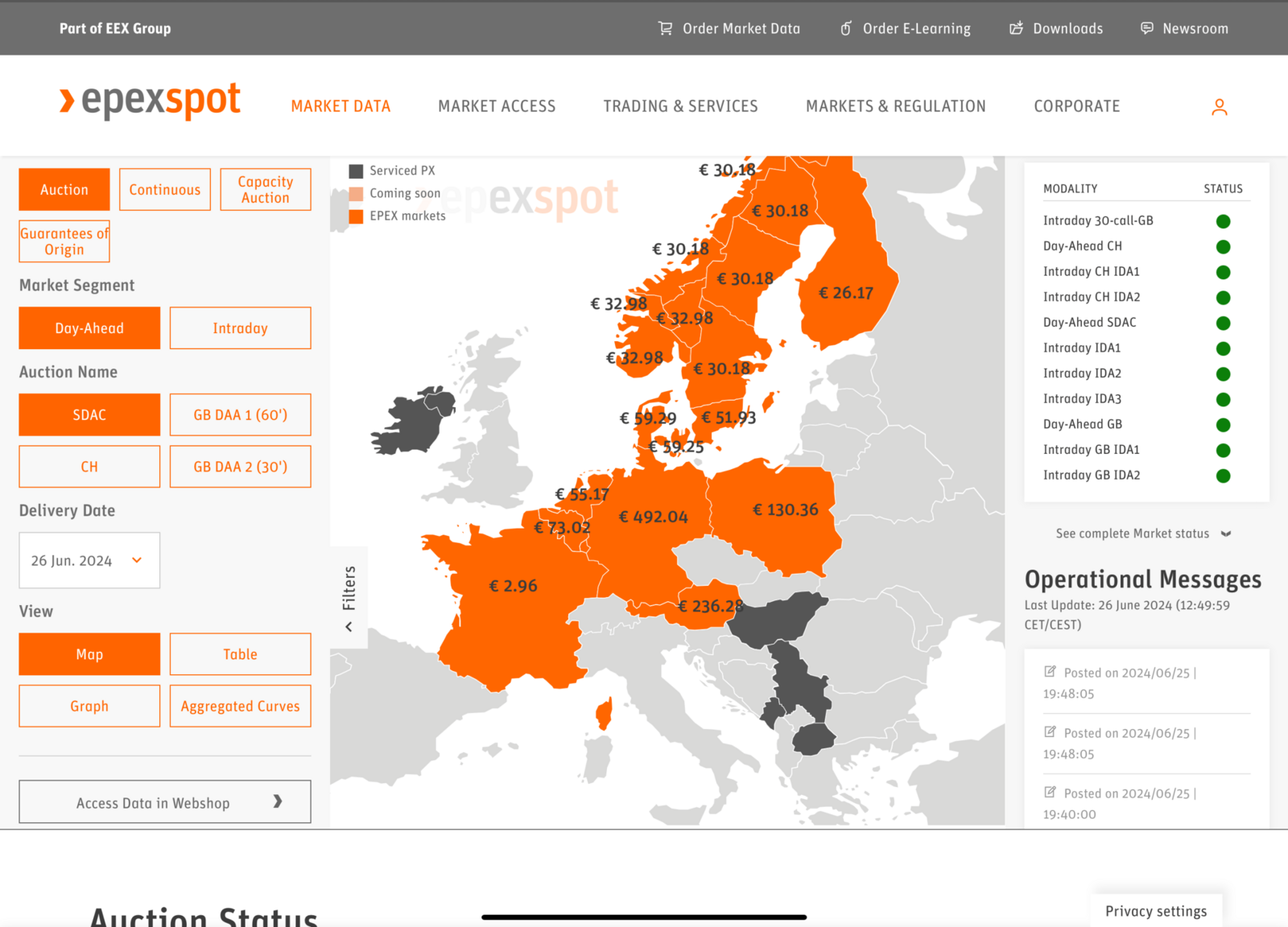
The small size of the Austrian market is probably the reason why the huge hydropower surplus, much of which is currently being exported, did not lead to a price development similar to France’s; two peak values pull the average far up. Removing those alone would bring the price down to market level (inflated by strong German demand). By the last third of the day everyone had caught on, and the price turned completely negative (unlike in Germany).
The coupling for 27.06.2024 worked as usual again, and prices are roughly back where they have recently always been – far too high for the time of year, but that’s the market. So all the surrounding countries are diligently paying their share of the energy transition into the German nowhere.
The ideologically decreed restructuring of German electricity generation, which completely ignores the laws of physics, has led to higher CO2 emissions, dramatic supply gaps (already now, in summer!) and high prices. And this is only the beginning. Soon many of the thermal power plants that were still producing electricity at full load last winter, to compensate for the loss of the last three, most modern nuclear power plants, will be gone. With around 30 TWh, those nuclear plants produced as much as the Austrian Verbund with over 100 hydropower plants.
Unfortunately, the motto is still: more photovoltaics and wind, but Europe is (fortunately) no longer an empire on which the sun never sets. An alarming number of players seem not to know this, but annoyingly people still switch on the light when it gets dark and the photovoltaics go idle.
Incidentally, the much-lauded, truly powerful storage systems for flutter power are guaranteed not to exist for the foreseeable future, but that’s another story.
Original article on tkp.at (German)


BASELOAD-CAPABLE RENEWABLE energy
There are various technologies that can help stabilise the availability of weather-dependent power sources such as wind and solar energy:
-
Storage systems are an important building block for bridging fluctuations in electricity production. For example, private photovoltaic systems can be combined with batteries to make better use of solar power. Larger storage systems working with hydrogen or gases will be needed in future to store larger amounts of electricity as required.
-
Neutrinovoltaics can help reduce fluctuations in the grid in future: as a baseload-capable renewable energy source, it reduces the amount of electricity end consumers draw from the grid. This relieves the power grid.
When weather-independent renewable energy sources arrive and are complemented by intelligent electricity storage, the effort needed to regulate our power grids decreases.

Notes on content provided by authors
Comments
Loading comments …
Become a member to comment publicly. GAIA members write comments in the members' portal — under their nickname, visible to everyone.