Scholé news July 2019

Dear friends of Scholé, this time I am asking all of you for your commitment and your help:
I feel it is time to step outside the small circle of the like-minded and to win solidarity with home-schoolers and unschoolers among open-minded people who are interested in education! They urgently need moral support, because the mass media are mobilising against anything that shakes the foundations of the current neoliberal social system – the very system that regular school is supposed to prepare our children for as well as possible.
Tried and tested ways of defaming unpopular minorities are confusing the terms and deliberately restricting the debate to the same negative arguments over and over again – known in the jargon as framing. The aim is to put trusting media consumers, who have not been able to form their own picture of the matter, off engaging with the subject at all. Whenever educational paths outside school are discussed, every report in the mass media is commented on by representatives of a church or state cult advisory service, which naturally creates the impression that we are dealing with a dangerous sect. To reinforce this negative impression, experts are always invited who express their concern that unschooled children would be left at the mercy of “sovereign citizens” and other religious or ideological extremists, that they would grow up as antisocial people in a closed bubble and would have no chance on the labour market… Unfortunately, this deterrence campaign is extremely successful!
That is why it seems so important to me to make people aware of the deliberate framing behind it, and to clarify the terms that have been muddled, whether deliberately or out of sheer mental laziness, so that a constructive conversation about the subject – in private or with the authorities – becomes possible at all: WHAT ARE WE TALKING ABOUT?
Ordinary parents (the vast majority)
- Consider early learning important and necessary;
- Call for institutions where their children are stimulated intellectually and socialised in a group as early as possible;
- Buy their children educationally valuable toys;
- Take them to swimming, painting, language and music classes;
- Try to regulate their use of mobile phones and computers in an age-appropriate way;
- Turn to experts when they have problems with upbringing;
Exceptionally good parents (a growing minority)
- Respect their children as unique human beings from birth;
- Are guided by the individual needs and interests of each of their daughters or sons and try to organise their time accordingly;
- Make an effort to provide healthy food and offer them as much closeness, warmth, emotional stability and personal attention as possible;
- Give them regular opportunities for exercise, experiences in nature and free play with others or alone;
- Wait for the moment when they want to go to a kindergarten or a school – or not.
- Leave it to the children themselves to decide when they learn to read, write and do sums, whether and which books they read, and which classes they want to attend;
- Keep their sons and daughters away from the distraction of electronic media for as long as possible;
- Encourage them to become aware of their feelings and to see through patterns of human behaviour;
- Develop such a close relationship with them that they can sense exactly what is wrong when their child has problems.
Ordinary teachers
- Love their profession;
- Make an effort to be fair and to treat all pupils equally;
- Criticise as much as necessary and praise as much as possible;
- Keep discipline in their classes and give marks out of conviction, so that every child knows where it stands;
- Try conscientiously to fulfil the prescribed curricula;
- Are convinced that how much their pupils learn depends on their own teaching skills and methods;
- Stimulate their pupils’ ambition, so that they achieve more and become fit for competition at work;
- Refrain from anything that is not legally covered, so as not to get into trouble.
- Can always point out in an emergency that they conscientiously followed all the rules.
Exceptionally good teachers
- Love people;
- Make an effort to meet the needs of each individual as well as they can;
- Deliberately avoid comparisons and assessments and, when they have to give marks, play down their importance;
- Do what they can to make everyone feel good = to feel that they are completely OK as they are;
- Know that RELATIONSHIP is the key to developing potential – the relationship with oneself, with parents, teachers, classmates, the environment and the subjects the children are engaged with;
- Therefore do far more relationship work than teaching work;
- Regard the development of individual potential as the primary goal, even if this means departing from the curricula;
- Rely on the self-determination and self-responsibility of their pupils by making them aware of their individual strengths;
- Accept inconvenience and disputes in order to find individual solutions that the rulebooks do not provide for;
- Therefore sometimes get into serious difficulties and depend on superiors who cover for their “going it alone”.
Exceptionally bad teachers / exceptionally bad parents
- Act out their personal lust for power or their sexual perversions;
- Have usually been victims themselves in their childhood;
- Are haunted by fears that they do not admit to themselves but hide behind a mask;
- Are not in control of themselves and alternate between feelings of inferiority and superiority;
- Shame their pupils (their sons and daughters), favour individuals and create relationships of dependency;
- Influence those in their care in an ideological or religious direction;
- Manipulate those around them by twisting the truth, insinuations, accusations and lies;
- Are therefore very hard to pin down and, despite all complaints, can sometimes harm generations of pupils (their own and sometimes other people’s children and young people).
The target group of the education system
- Unfortunately, there are quite a few young people who are better off in any reasonably good institution (crèche, kindergarten, school) than in their violent, alcoholic, mentally ill or largely uninterested families of origin. They benefit from official measures to enforce compulsory schooling. Many of them are so psychologically impaired or so severely traumatised that they would need far more personal care than they receive today. These children also include those who are locked up at home by fanatics: compulsory schooling would certainly not be enough help for them!
- Fortunately, there are many young people who perhaps even as toddlers preferred to hold an adult’s hand and who liked doing crafts under instruction at kindergarten. At school they enjoy regularly being with children of their own age and willingly engage with the questions and tasks set by their teachers. If these teachers are friendly and well-meaning people and their classmates are reasonably good companions, these girls and boys have a happy time at school. If they come across bad teachers or are bullied by their classmates, a change of class or school may be enough. Then it depends on the parents how much understanding they show for their children and how much financial leeway they have.
- But there are also young people who need a great deal of freedom and/or a great deal of quiet from an early age. They often feel irritated even by the most well-meant instructions, because they are born experimenters and independent thinkers. They find being among many people (as in a class or a kindergarten group) stressful, even when nobody treats them badly.
Even their own parents are often overwhelmed by such children from the start, because they do not respond to conventional methods of upbringing. At kindergarten, too, they often cause offence, because they are hard to fit in and therefore cause problems. At school they attract unwelcome attention as constantly ill wallflowers or as class clowns, as cheeky know-alls or as victims of bullying, and at some point even as school refusers or dropouts. Unfortunately, most experts still tend to pathologise their behaviour and to describe it with technical terms such as pathological shyness, hypersensitivity, allergies, ADHD, autism or Asperger syndrome. The vast majority of the parents concerned adopt this view and allow all kinds of treatments and behavioural therapies to be recommended to them.
Some parents do not. They refuse to regard their sensitive and intelligent daughters and sons as ill just because they will not or cannot adapt to the demands of the regular school system. Depending on their personal, social and financial situation, these parents therefore look for alternative children’s groups or schools, free schools, or decide on home education. When young people (some of them severely traumatised by their experiences at school) show panic in exam situations, or sense so clearly from an early age what is important to them that they are busy with self-directed learning all day long, a few courageous parents even embark on the adventure of the exam-free path – and thereby deliberately go beyond the limits of Austrian law (just as, fortunately, the first women’s rights campaigners did 100 years ago).
Although they actually correspond to the ideal image of good parents, these people usually meet with rejection and mistrust from officials who interpret the notion of the child’s best interests according to purely formal legal criteria and refuse to engage with scientific findings on the advantages of free, informal paths of education.
This has led to the absurd situation that it is precisely particularly committed and respectful parents who constantly have to justify themselves to the authorities. They pay for their sons’ and daughters’ education out of their own pockets and receive neither financial nor educational support. Nevertheless, pupils in home education tend to be expected to achieve more in their external exams than those who are taught at the taxpayer’s expense! Although Austria’s Basic Law enshrines the right to home education without restriction, external pupils are disadvantaged in several respects, which contradicts the principle of equality!
Logically enough, it is even harder for those who do not take external exams and thereby break current Austrian law. Their efforts to explain the advantages of SELF-DIRECTED LEARNING – which is perfectly legal in many other countries – to the authorities have so far unfortunately fallen on deaf ears, or committed parents have even been accused of anti-state ideological activities.
All pioneers had to go through similarly difficult experiences at first. But they do not give up hope that their achievements for the community will sooner or later be recognised as such! For the pioneers of self-directed education are currently the only ones who really take seriously the buzzword of individual potential development, which has been haunting the whole educational scene for quite some time, and who put it into practice without compromise. So they are NOT IN OPPOSITION to school, but should be recognised as FORERUNNERS whose insights matter to everyone and will hopefully soon benefit every child…
Please spread this hopeful message!
Sea-blue greetings from the Aegean, Alexandra
P.S.: As newsletters are not easy to forward, here is a link where the Scholé News have been published as posts for some time now: https://gaia-energy.org/tag/schole/
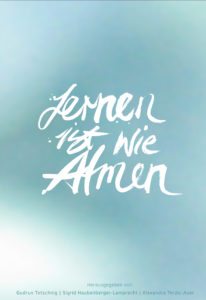
Book tip – “Lernen ist wie Atmen” (Learning is like breathing)
Together with two unschooling mothers, Gudrun Totschnig and Sigrid Haubenberger, we published it ourselves.
We all feel that the time is ripe for this many-voiced account of how unschooling can be lived in practice. Order your own copy on the GAIA marketplace, with a 10 % discount for members. The book is in German.
Notes on content provided by authors
Comments
Loading comments …
Become a member to comment publicly. GAIA members write comments in the members' portal — under their nickname, visible to everyone.