Stop Solar Expansion in Germany?


Too much solar power endangers grid stability
Dr. Peter F. Mayer, tkp.at (German)
Even Germany’s Federal Network Agency (Bundesnetzagentur) is now warning of too much solar power. That is exactly what led to the blackout in Spain. Too much solar power endangers grid stability and causes enormous costs. Stopping the expansion is unavoidable.
The change of leadership in the Ministry of Economic Affairs has apparently also brought reason into the Federal Network Agency. A policy article on SMARD (German) names the challenge of solar peaks in its very title. The figures are breathtaking: “In 2024, 16 GW of new solar installations were connected to the grid. This brought the stock of solar installations to over 100 GW.” By now, however, it is already 105 GW.
The article finally names the problem:
Some of the PV installations, especially the small solar systems, generate electricity from solar radiation regardless of current demand. The operators of these installations do not respond to price signals, but hand over the electricity they do not consume themselves to the connecting grid operator, who has to take care of marketing it.
Excerpt from the SMARD article
On 11 and 12 May it looked like this:
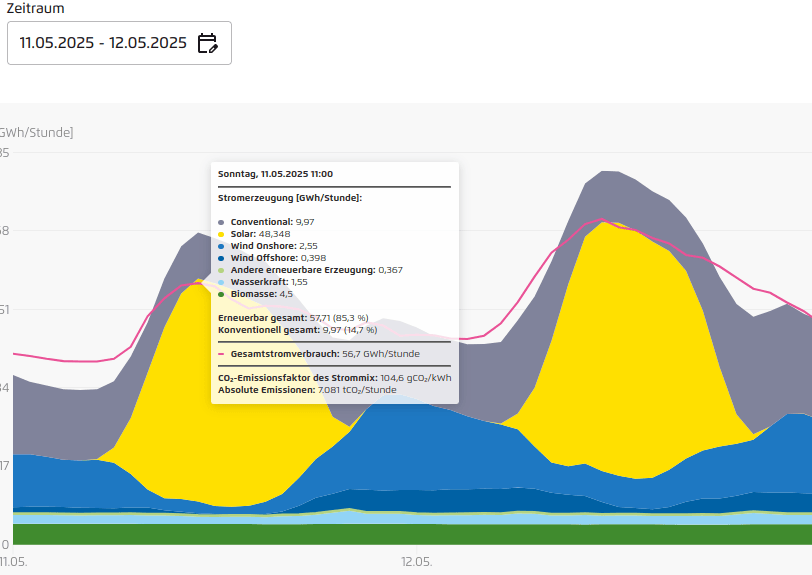
All generators that could be switched off were off the grid, but what could no longer be switched off supplied more electricity than could be consumed. The surplus had to be sold to neighbouring countries at 250 euros per MWh; the Netherlands even had to pay 462 euros to get rid of it. Austria and the others also had a surplus, however; only France was able to throttle the output of its nuclear plants far enough to take on energy and consume electricity from Germany and other neighbours – for a hefty payment in the millions, of course. At midday, 13 GW were produced as surplus, which is the output of about 10 nuclear plants.
Austria, incidentally, was no better. Consumption of 4,000 MW was matched by production of 6,500 MW.
Meanwhile, the days on which solar power that cannot be switched off exceeds demand are becoming more frequent. There will be more of them as the sun climbs higher. All the more urgent, then, to stop the further addition of solar installations immediately. The example the article mentions has by now even been surpassed. But it shows the problem:
A vivid example of the scale PV generation has already reached today is Easter Sunday 2025. Between 12 noon and 3 pm, the so-called grid load (incl. pumped storage) – i.e. the entire electricity consumption drawn from the grid in Germany – was almost entirely covered by renewable electricity. Between 12 noon and 1 pm, at the peak of solar production, the feed-in from renewable installations alone exceeded total demand by more than 1 gigawatt, mainly due to photovoltaic systems. Since conventional power plants were also feeding in, total generation was more than eight gigawatts above German grid withdrawal. This amount of electricity was physically exported to neighbouring countries via electricity trading.
Example from the article
The costs of this misguided energy policy are positively exploding. TKP reported on the village in Tyrol (German) where 1 million euros had to be invested to carry away the surplus electricity from solar installations; for the whole of Tyrol the costs are 3 billion euros, for the whole of Austria around 60 billion and for Germany 1,000 billion (German) euros.
The reasons, again explained by the Federal Network Agency: “In regions with high solar radiation, a high density of PV installations and at the same time low load density, regional grids can reach their capacity limits. The local grid infrastructure is not designed everywhere to carry away the large amounts of locally generated electricity when at the same time little electricity is consumed regionally. Bottlenecks can occur at midday, especially in rural areas, for example on public holidays when industrial and commercial businesses consume little.”
For years now, grid operators have been struggling to keep the grids stable in the face of unreliable solar and wind power. In Portugal and Spain they no longer succeeded, and a blackout occurred. These measures are called redispatch. “In the event of line overloads, they take so-called redispatch measures. The feed-in of PV electricity in the areas before a bottleneck is reduced (so-called negative redispatch). At the same time, other generating plants behind the bottleneck are ramped up (positive redispatch). The operators of the affected installations receive compensation for these interventions that puts them in the position they would have been in had the intervention not taken place.”
So the installations are switched off and the same sums continue to be paid as if they were still supplying electricity. And thanks to the EU Green Deal and the measures of the Green energy and economy ministers – Habeck in Germany and Gewessler in Austria – the number and scale of these measures have literally exploded in recent years.
SMARD again: “In 2024, the volume of negative redispatch measures with photovoltaic installations amounted to around 1,400 GWh, an increase of almost 100 percent compared with 2023 (706 GWh).”
It is also worth reading the rest of the article. Apparently the new energy minister Katherina Reiche, who is an expert in the field, has removed all the Green dreamers from the ministry and the Federal Network Agency. You can tell that the text was written by people who understand the subject and have suffered badly under the ideological dictates of the Greens in recent years.
By the way – the shut-down solar panels heat up even more than usual and generally have a very strong greenhouse effect. Solar expansion has already contributed to global warming. Studies (German) have shown that even the Sahara would become warmer due to large-scale solar installations.
Outdoor Chiemgau once again explains the problems and last weekend’s events very well:
tkp.at original article (German)
Comment on power outages by Wolfgang Löser
The power outage in Spain (not a blackout, that is something completely different) is due solely to the conflict between old grid structures and energy monopolists. Nuclear power plants, too, can never stabilise the grid in a decentralised structure; on the contrary, they destabilise it further – a huge topic of discussion … and explained brilliantly by Hermann Scheer:
Which energy is used
“But the question of which energy […] is used has […] – and few people are aware of this, above all not energy scientists […] – a decisive influence on everything that happens. On economic development, on cultural development, on the way industry takes shape, on questions of international politics. […] At its core, the energy debate is […] a debate between nuclear and fossil energies on the one hand and renewable energies on the other. Many want to keep quiet about this debate by pretending that energy is energy. That is where the great error begins, and the great obfuscation too.
Energy is not just energy
Between these two basic energies […] conventional energies […] and renewable energies […] lie worlds. And they are not only ecological worlds, they are sociological worlds, they are political worlds. And those who do not want to see this, because they remain stuck in the old, familiar energy world, systematically divert attention from it through […] very superficial debates about energy markets and energy prices. These are debates that are fundamentally dishonest, because they do not even remotely tell the economic truth […].” One of the most astonishing and at the same time most important insights about energy systems is the following statement:
The energy source itself determines everything that happens afterwards!
Why? Behind this simple thesis lies a very complex connection. On the basis of his clear analysis, Hermann Scheer draws several conclusions at once. One of them is: there is an energy system conflict that arises solely from the choice of energy source. The choice of energy source determines the energy system. Once the energy source has been chosen, an automatism follows that dictates what will happen – inevitably, so to speak unavoidably. The conventional energy system requires a whole range of things, for example in the case of oil: extraction licences, extraction and processing technology, pipelines, a transport infrastructure costing billions, refineries and so on. It thereby also determines the shape of the corporate structures needed to move and maintain all this. Owing to competition, concentration and in the end even monopolistic structures inevitably develop. This “conventional energy system” made technical progress possible for us, and it thereby also determined the form of our technical development.
Hermann Scheer
Notes on content provided by authors
Comments
Loading comments …
Become a member to comment publicly. GAIA members write comments in the members' portal — under their nickname, visible to everyone.