CERN: neutrinos detected in a particle accelerator


Neutrinos detected in a particle accelerator for the first time
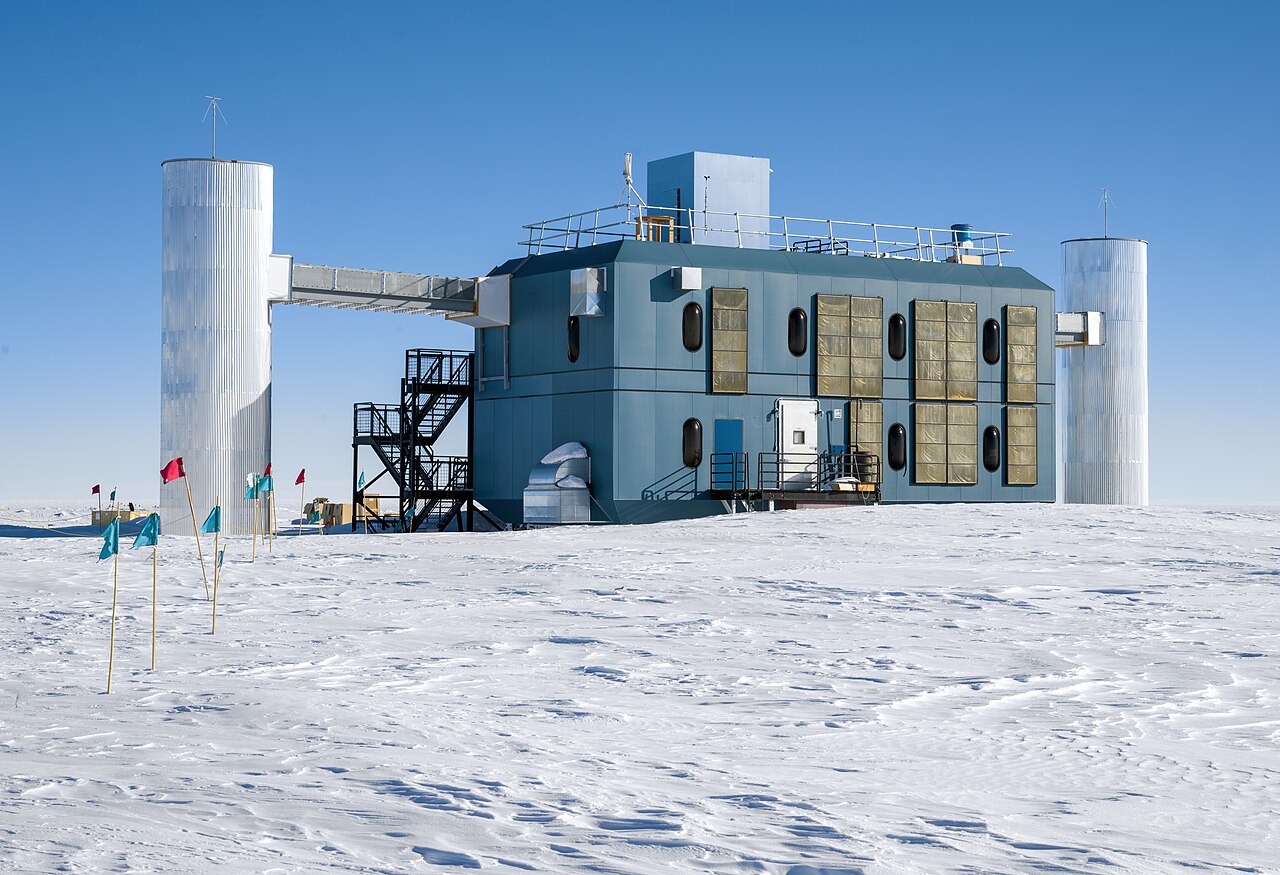
The smaller a particle, the larger the equipment needed to observe it. This seems to apply to neutrinos in particular. Huge installations are needed to detect these fleeting, almost massless particles. The IceCube Observatory near the Amundsen-Scott South Pole Station, for example, essentially consists of a cube of ice one kilometre on each side, interspersed with 5,160 highly sensitive light sensors.
Neutrinos are produced in the sun, in high-energy cosmic events or in the atmosphere. Neutrinos are also released in nuclear reactors, and last but not least these so-called ghost particles can also be produced in particle accelerators by colliding two particle beams of extremely high energy.
In the FASER experiment we study neutrinos produced by the LHC at CERN with very high energy. […] The aim is to find out how these neutrinos are produced, to study their properties and to search for new elementary particles. […] This discovery is a milestone, as we are opening up a neutrino source with unexplored properties.

Prof Dr Akitaka Ariga University of Bern
Neutrinos from the LHC
Proof that neutrinos are actually released in such collisions was, however, missing – until now, the particles, which hardly interact with matter, had always escaped the accelerators’ detectors without leaving a trace. That has now changed: a team including the University of Bern has for the first time used the FASER particle detector to detect neutrinos produced by the Large Hadron Collider (LHC) at the CERN nuclear research centre near Geneva.
Detectors such as IceCube or the Deep Underground Neutrino Experiment (DUNE), currently being built in the USA, are designed to study many different properties of neutrinos from different sources. However, these experiments are not tailored to high-energy neutrinos.
FASER collaboration
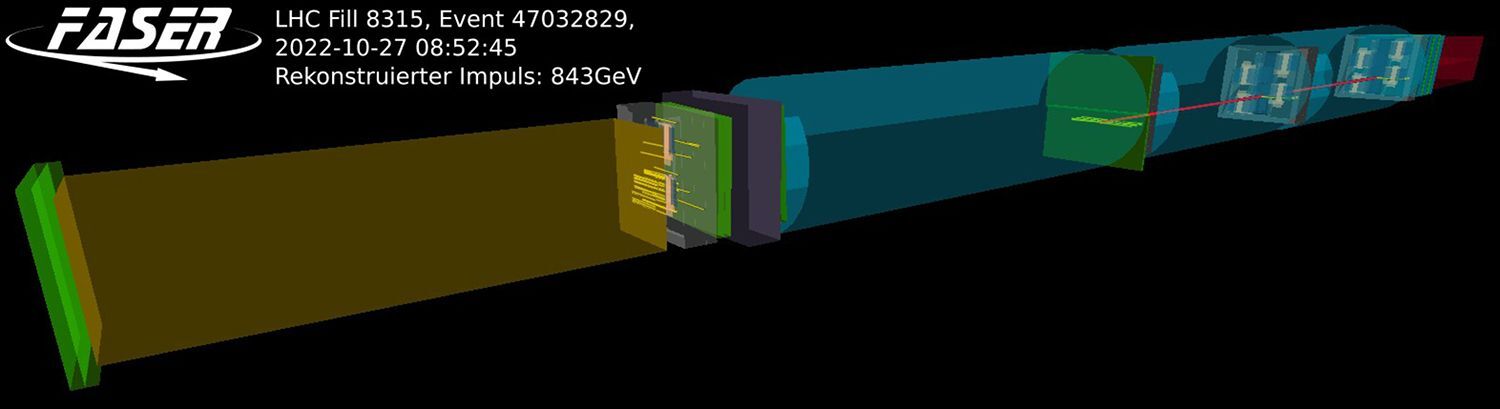
The FASER experiment (Forward Search Experiment) was intended to close this gap. “In the FASER experiment we study neutrinos produced by the LHC at CERN with very high energy,” said Akitaka Ariga, head of the FASER group at the University of Bern. “The aim is to find out how these neutrinos are produced, to study their properties and to search for new elementary particles.” The neutrino candidate in the FASER detector: a muon (red line) can be seen, produced by a neutrino in the tungsten/emulsion detector (yellow). Secondary particles are also produced and detected in the interface tracker (yellow lines).
153 events
For the current observation of neutrinos, the FASER team analysed data recorded at the LHC in 2022. The team identified 153 events that are extremely likely to be neutrino interactions. These neutrinos are the most energetic ever produced in a laboratory.
They resemble the neutrinos that strike the Earth as cosmic radiation and trigger so-called particle showers in the atmosphere and underground. “This discovery is a milestone, as we are opening up a neutrino source with unexplored properties,” said Ariga. And this is only the beginning: the FASER experiment is to keep collecting data until the end of 2025.
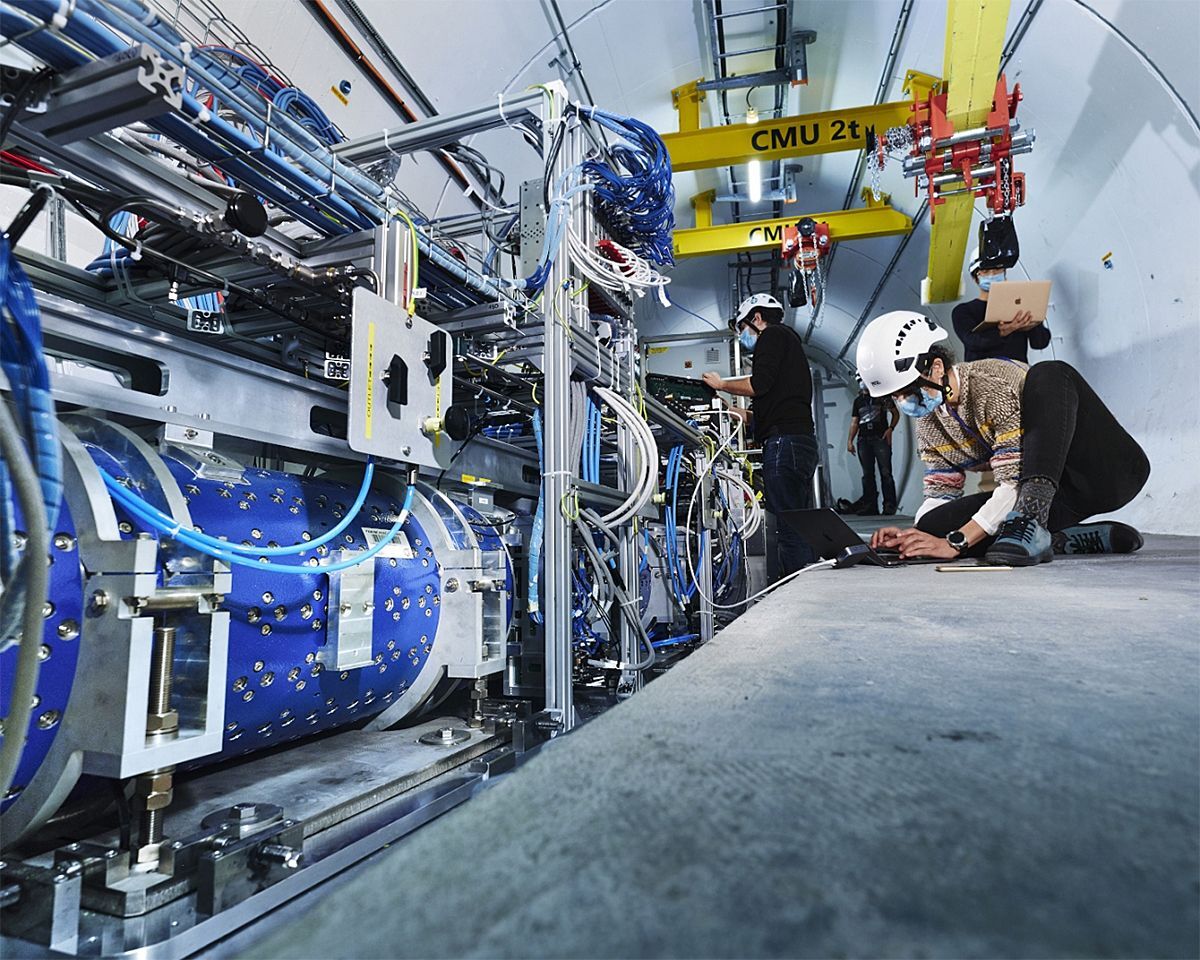
The FASER experiment at the CERN nuclear research centre is designed to track down high-energy neutrinos, but also to search for other light, weakly interacting elementary particles.
Notes on content provided by authors
Comments
Loading comments …
Become a member to comment publicly. GAIA members write comments in the members' portal — under their nickname, visible to everyone.