Harnessing the energy of cosmic radiation


Solar energy is expected to overtake all other forms of energy by 2040, but so far it cannot work when the sun is not shining.
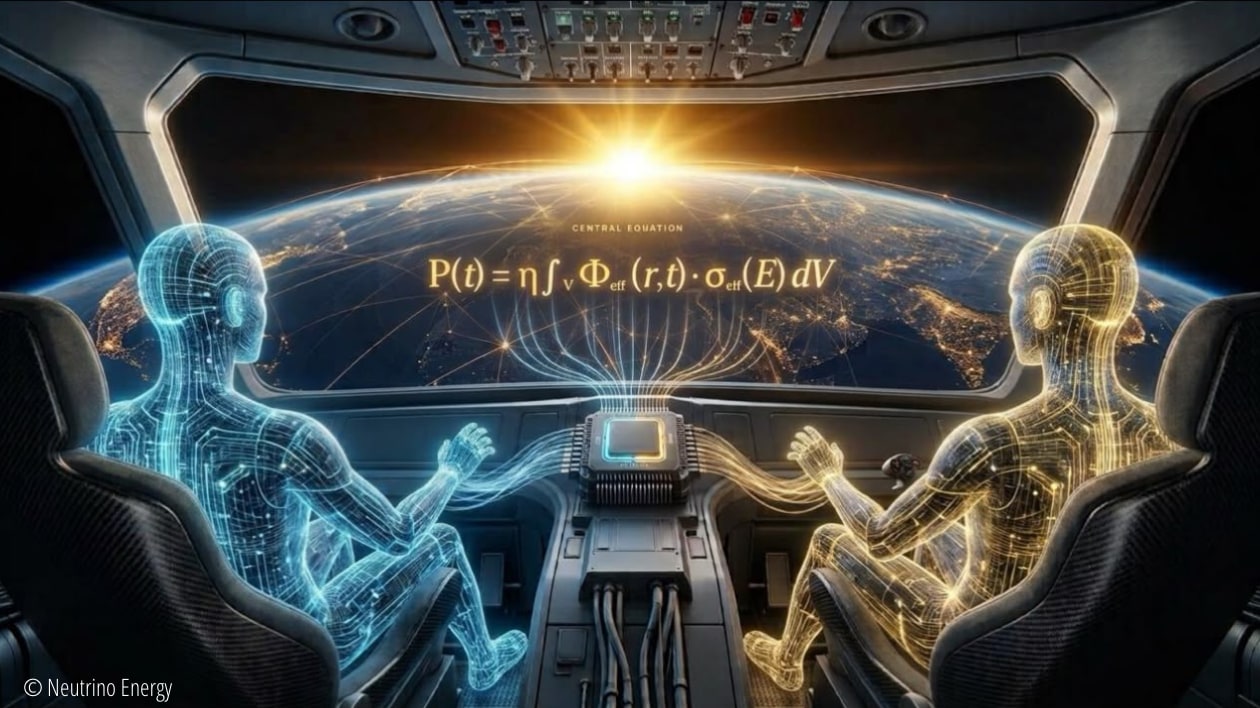
This is where neutrino energy and its autonomous neutrinovoltaic “cosmic radiation converters” will come into play in future: they can provide electricity from invisible radiation even in complete darkness.
In 2015, two scientists, Takaaki Kajita from Japan and Arthur McDonald from Canada, proved that neutrinos – tiny cosmic elementary particles that penetrate practically everything in the cosmos – do have mass. And according to Einstein’s theory of relativity, E = mc², i.e. everything that has mass contains energy. The two scientists were each awarded the coveted Nobel Prize in Physics for their discovery.
The next step taken by scientists of the Neutrino Energy Group was to create a technical converter – something previously considered impossible – that now makes it possible to use this energy to generate electricity.
Put simply, using neutrinos and other invisible radiation as an energy source is comparable to using a photovoltaic (PV) solar cell. The neutrinos are of course not captured; instead, part of their kinetic energy is extracted and converted into electricity with the help of a unique quantum-mechanical working instrument. The Neutrino Power Cell consists of layers of doped silicon and carbon derivatives (graphene) applied to a metal substrate with surgical 2D precision. This leads to atomic vibration in these nanomaterials, which, with the right geometry, is amplified in resonances when, for example, neutrinos and other invisible radiation strike them.
With neutrinovoltaic technology, thermal energy is also converted into electrical energy, and an electric field into a magnetic field with the help of transduction materials. There are countless uses for the technical devices of the future in which energy converters made of such meta- or matrix materials can be used. In principle, these energy cells can be built into any device that needs electricity.
The old, inefficient infrastructure will be replaced by NEUTRINOVOLTAICS within a few decades
One of the most difficult aspects of introducing neutrino energy will be renewing the current power generation and transmission infrastructure, which was built to deliver high-capacity electricity over long distances.
“We have to convert the system with the help of neutrino energy over the next few decades. We currently have a vulnerable centralised system. There are huge power stations somewhere in the countryside, and the energy is delivered via high-voltage lines with hundreds of thousands of volts of alternating current over hundreds of kilometres with huge losses, and then it is transformed down to supply the individual devices with direct current,” Schubart adds.
“This is a system that was introduced 150 years ago. Today, however, we can reform the system and thereby significantly reduce energy costs and consumption. The latest scientific findings allow this. Such high voltages are no longer needed, as electrical devices consume less and less energy these days. Only those who have to transport electricity through their grids need high voltages and high power. It makes much more sense, and is more environmentally friendly and cost-effective, to generate the energy needed at low voltages directly where the electricity is needed. The sum of the energy provided by these many small energy converters can be scaled up at will without hitting the limits of grid infrastructure capacity. It also protects you against power cuts of all kinds, which could occur anywhere at any time today – and do occur regularly and increasingly.”
But what about the price of using neutrino energy compared with other energy sources?
“That will surely surprise you,” Schubart adds. “We have calculated that the costs are much less than half of what energy would cost today – so much cheaper than the energy we use now. Because the raw material, radiation, of course does not have to be mined or burned, nor does it have to reach the consumer via costly grids.”
An environmentally friendly source of energy
The new technology can help future generations to meet their energy needs without continuing to require inefficient infrastructure, without competition or even armed conflict over the remaining natural resources, and without the environment continuing to be burdened so dramatically – which requires rapid action worldwide if a climate catastrophe is perhaps still to be prevented.
Are there any disadvantages to neutrinovoltaic technology?
“Yes, unfortunately there are: all those who today earn a lot of money at the expense of the environment and the general public will have to look for a new business model. Because neither the sun nor the cosmos sends us a bill.”
TODAY’S SCIENCE IS TOMORROW’S TECHNOLOGY

Holger Thorsten Schubart CEO of the Neutrino Energy Group
The Neutrino® Energy Group works with a worldwide team of scientists and various international research centres. They research applications for converting invisible radiation spectra of the sun, including neutrinos – high-energy particles that reach the Earth incessantly and can be converted into electrical energy.
The image rights lie with the author of the press release.
Notes on content provided by authors
Comments
Loading comments …
Become a member to comment publicly. GAIA members write comments in the members' portal — under their nickname, visible to everyone.