Impulses for fuel-free energy and transport technologies

A “chance” discovery is the impulse for developing new fuel-free technologies
Only a few scientists consider that the space around us is filled with infinite energy. Very few of them have worked seriously on ways to make such forms of energy usable. Why is that?
One reason could be that a scientist working in isolation cannot really manage it alone. Another reason may be that energy from the radiation fields that surround us and are distributed across the globe is not an area that can be researched exclusively, and it is hard to monetise. That is a big difference from forms of energy obtained by burning fossil fuels or from nuclear power stations. So it seems logical that scientists initially worked, and continue to work, on energy technologies associated with spatially limited forms of energy. Such a choice of research also seems more rewarding in terms of dissertations, career growth and possible economic benefits in the form of dividends from implementing their developments.
The discovery
Scientific discoveries that lead to the development of a fundamentally new technology for generating energy are rather rare. Their path from discovery to mass implementation is expensive and can easily take more than a decade. The very idea of obtaining energy under the influence of surrounding radiation fields is therefore unprofitable for most scientists and energy industry experts, and often economically unacceptable. Fortunately, neutrinovoltaics “turned up by chance” during research into materials for optimising solar modules and increasing their efficiency.
The technology was further developed by an international team of scientists at the Neutrino Energy Group led by the mathematician Holger Thorsten Schubart. They investigated the effects of applying thin-film coatings of various nanomaterials on the efficiency of solar modules. It turned out that some coatings led to a reduction in efficiency. The cause was increased vibration of the atoms of the materials studied. The explanation was eventually found in the results of work carried out in the laboratories of Professor Wood at ETH Zurich and at the Swiss Spallation Neutron Source at the Paul Scherrer Institute. These were also published in the journal Nature. This publication shows that when materials with a layer thickness of less than 10–20 nanometres are produced – that is, 5,000 times thinner than a human hair – large vibrations of the outer atomic layers occur on the surface of the nanoparticles. These play an important role in the production of these materials. “For some applications such as catalysis, thermoelectrics or superconductivity, these large fluctuations can be positive, but for other applications such as LEDs or solar cells, these fluctuations are undesirable,” says ETH professor Vanessa Wood.
For some applications such as catalysis, thermoelectrics or superconductivity, these large fluctuations can be positive, but for other applications such as LEDs or solar cells, these fluctuations are undesirable

Prof Vanessa Wood
ETH Zurich
Technical background
In the Neutrino Energy Group’s experiments, graphene atoms showed the most striking fluctuations. Atypical behaviour of graphene was found in contrast to the other materials studied. With a high-resolution microscope, the appearance of a “graphene” wave was clearly visible. This eventually aroused the scientists’ interest in the practical use of this behaviour of graphene. It took several years and numerous experiments before the scientists succeeded in producing a multilayer nanomaterial of alternating layers of graphene and doped silicon. This material is deposited layer by layer on one side of a metal foil and generates a direct electric current. Such a plate measuring 200 x 300 mm produces a voltage of 1.5 V and a current of 2 A at room temperature. This finding marks the start of the industrial implementation of neutrinovoltaic technology and the development based on it of fuel-free generators of various capacities and purposes.
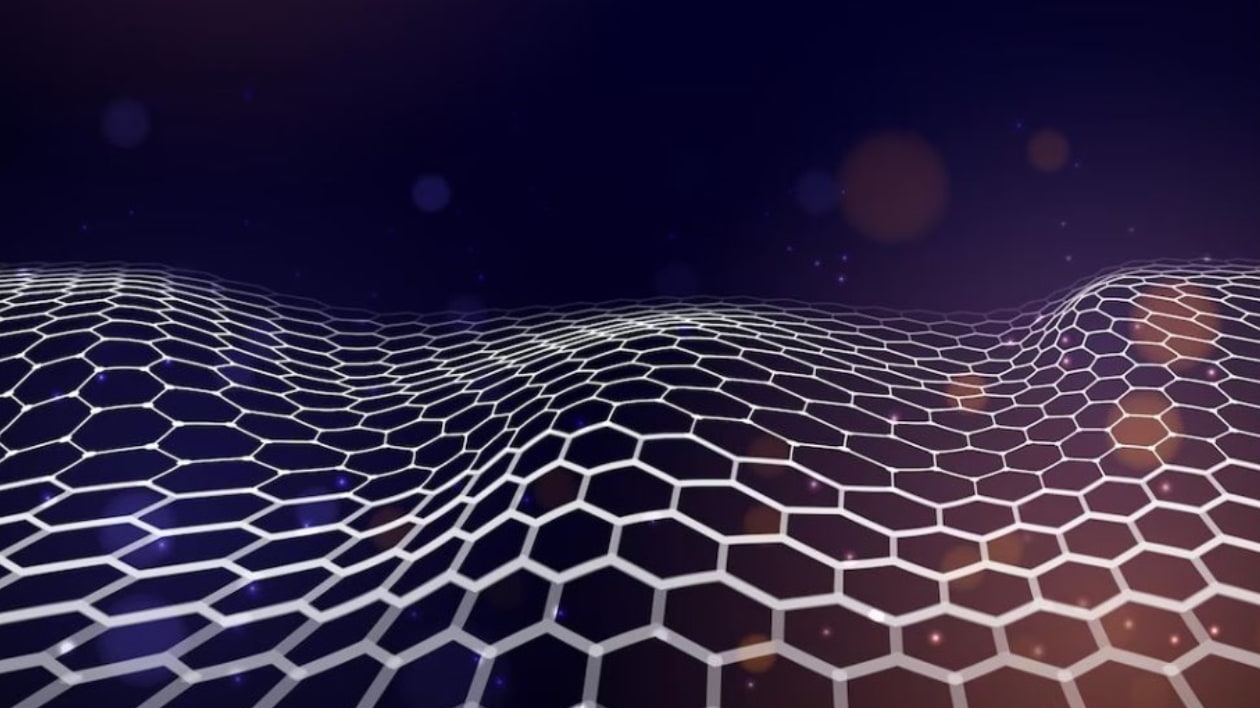
“Graphene” waves
Experiments have shown that the power output depends on the amplitude and frequency of the vibrations of “graphene” waves, i.e. on the amplitude and frequency of the vibrations of graphene atoms. This required a physical explanation of the process by which energy from surrounding radiation fields is converted into electric current, and the identification of factors that influence the vibrations of graphene atoms.
Experiments carried out under different conditions – for example at different temperatures – have shown that it is mainly the thermal (Brownian) motion of graphene atoms that influences the amplitude and frequency of their vibrations. In addition, the graphene (carbon) atom has atomic number 6 in the periodic table of the elements and an atomic weight of 12.011. In other words, carbon is one of the simplest elements. Since the weight of an atom is concentrated mainly in its nucleus, the kinetic energy of neutral neutrino particles with mass can only be transferred to the nuclei of graphene atoms when they collide with them.
In this case, some low-energy neutrinos can lose their speed completely or change direction. This process resembles the collision of a large ball (the nucleus of a graphene atom) and a small one (the neutrino) at different angles, resulting in a barely noticeable deflection of the nucleus of a graphene atom. The greater the energy of the neutrino particle, the stronger the deflection of the nucleus. This mechanism of interaction is described in detail in the results of the work of the COHERENT collaboration at Oak Ridge National Laboratory (USA). Despite the small size of the nucleus of a graphene atom compared with the size of the atom itself, this interaction is very important for increasing the amplitude and frequency of the vibrations of the “graphene” wave.
Energy sources
To emphasise the importance of the influence of neutrinos on power generation, the technology was given the name “neutrinovoltaics”. However, the vibrations of graphene atoms are also influenced by other energy fields. These include electrosmog, various communication frequencies, Wi-Fi, other electromagnetic fields and the antineutrino flux near nuclear power stations. The scientists concluded that the vibrations of graphene atoms are in a kind of resonance that considerably amplifies the power generation effect.
Graphene has an extremely high electrical current density and charge carrier mobility. In graphene, each atom is bonded linearly (2D, in a plane) to 3 other carbon atoms, leaving one electron in the third dimension freely available for electron conduction. The vibrations of the “graphene” wave cause an electromotive force to arise in each graphene layer, of which there can be between 12 and 20. Thin films of alloying elements are used to direct the flow of charged particles in one direction. This creates a p-n junction that lets the current pass in only one direction.
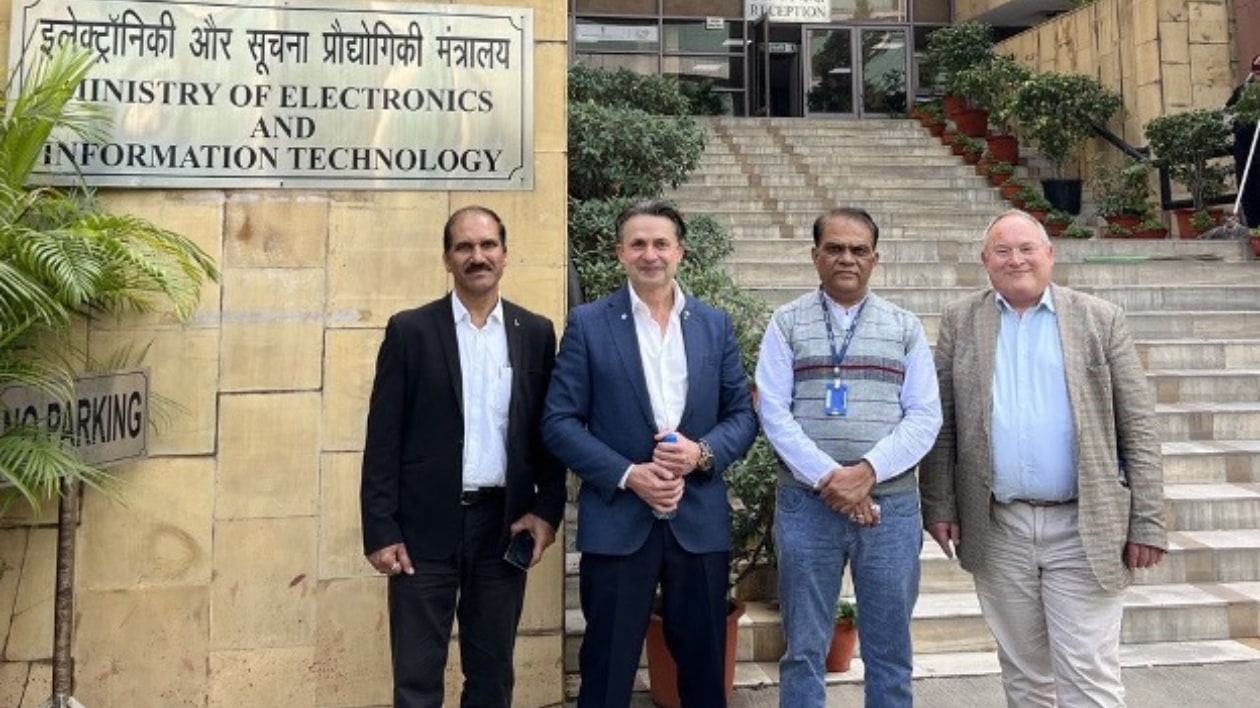
From left to right: Rajendrakumar Sharma, CEO, SPEL Technologies • Holger Thorsten Schubart, President of the Neutrino® Energy Group • Bharat Bhanudas Kale, CEO Centre for Materials for Electronics Technology • Thorsten Ludwig – CTO Neutrino® Energy Group
Outlook
At the beginning of 2024, the world’s first plant in Switzerland will start series production of fuel-free generators – so-called “Neutrino® Power Cubes” with a net output of 5–6 kW. Technical certification is currently under way so that the products can be brought onto the EU market. Construction of a plant to produce Neutrino® Power Cubes in Korea will also begin this year. This plant is due to start production at the end of 2024 and reach an annual output of 30 GW by 2029. In about 3 years, the launch of a self-charging “Pi electric car” is planned, whose body will have energy collection points and a capacitor system. Such an electric vehicle is being developed by the Neutrino® Energy Group together with the Indian Centre for Materials for Electronics Technology (C-MET) in Pune, a leading government laboratory of the Ministry of Electronics and Information Technology (MeitY), under the leadership of its CEO Dr London. He is one of the world’s best-known scientists in the field of energy and materials. SPEL Technologies Pvt. Ltd. is also involved. This company is the first and currently only manufacturer of supercapacitors and their advanced versions in India. Dr Rajendrakumar Sharma, CEO of SPEL Technologies, is known as the “father of supercapacitors”.
Conclusion
In this way, a chance result of research from parallel scientific fields became the basis of a disruptive new technology: energy generation through neutrinovoltaics. It is capable of positively changing the foundations of the world’s traditional energy system and the way humanity lives on the planet as such.
Notes on content provided by authors
Comments
Loading comments …
Become a member to comment publicly. GAIA members write comments in the members' portal — under their nickname, visible to everyone.