Challenges and opportunities of neutrinovoltaics


Challenges and opportunities of neutrinovoltaics
The world is constantly looking for new, sustainable and clean energy sources, because demand for electrical energy keeps growing. One of these new technologies is neutrinovoltaics. This technology has the potential to revolutionise the way we generate and consume energy today.
Neutrinos are subatomic particles produced in large quantities by the sun and other celestial bodies. They are permanently abundant: for millions of years, billions of them have been passing every second through our Earth and everything on its surface. The idea of making the energy of these particles usable with an “intelligent converter” has been around for decades. But only recently has the technology been developed to the point where it has become a realistic option for baseload-capable energy generation.
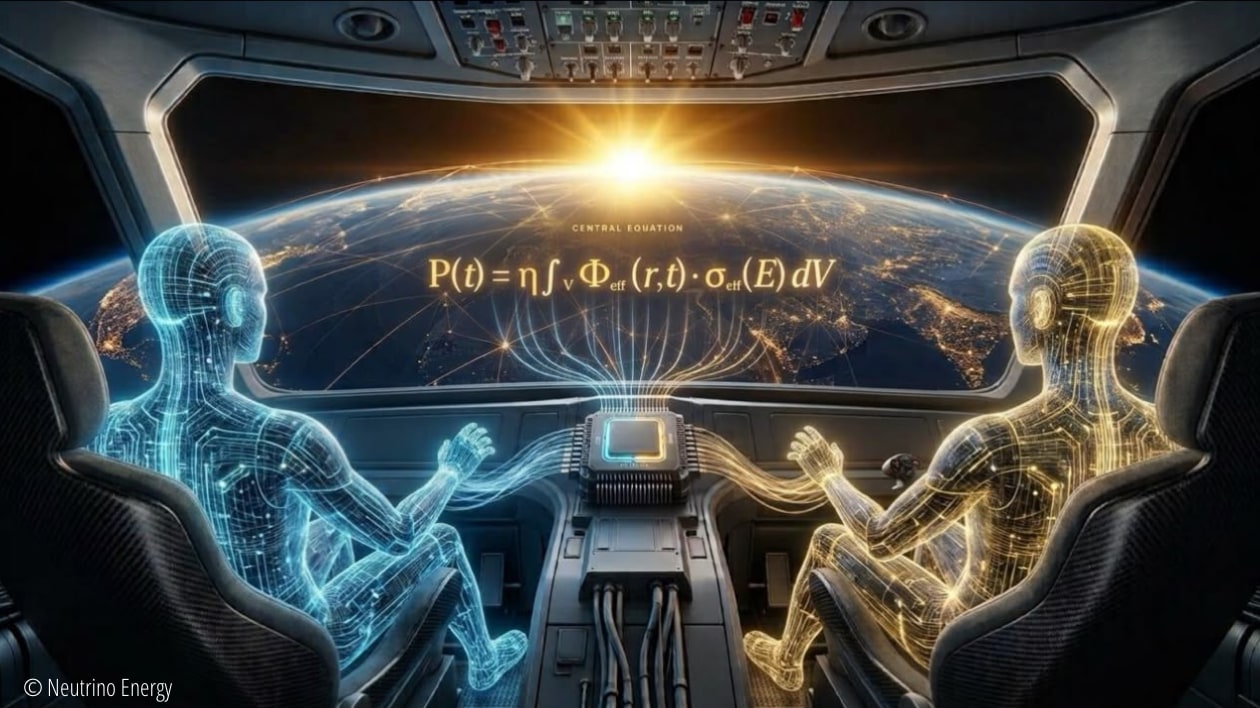
Neutrinovoltaic technology is based on the principle of converting the energy of neutrinos and other invisible thermal radiation into usable electricity. Let us take a closer look at the process known as “neutrino oscillation”: neutrinos are able to change their type as they travel through space. When a neutrino interacts with a material, for example, it can transfer part of its energy to the atoms of that material. This makes the material vibrate. These vibrations, in turn, can generate electrical charges under the slightest mechanical stress with the help of piezoelectric materials such as silicon and graphene in the right layer arrangement. And these charges can be converted into usable electrical energy.
One of the biggest challenges in developing neutrinovoltaics was the extremely low probability of neutrino interactions. Neutrinos were commonly known only as “ghost particles”, as they rarely interact with matter. This has made it difficult so far to convert their energy in any way. Recent advances in materials science and nanotechnology, however, have finally led to these new materials with demonstrably better neutrino interactions. These materials, above all graphene, and the progress made in neutrino detection and measurement methods are now paving the way for more efficient energy conversion.
Another challenge was the relatively low energy output of the systems used at the time to obtain energy from neutrinos. Although the potential energy contained in neutrinos is in principle enormous, the actual amount of energy that could be obtained from them was relatively small compared with other renewable energy sources such as solar and wind. Through the efforts of numerous scientists led by the Neutrino® Energy Group, it has been possible to improve the efficiency of such energy generation systems considerably. That makes them a promising option for decentralised 24/7 power generation on a large scale.
The current state of the technology offers many possibilities and advantages. One of the most important is that neutrinos and thermal radiation are essentially unlimited and, above all, constant energy sources. Unlike solar and wind energy, which depend heavily on weather conditions and the time of day, neutrinovoltaics remains available around the clock – completely independent of external factors. The possible uses of electrical energy “harvested” directly where it is consumed are infinitely varied. The smallest continuous amounts of energy are enough, for example, to run small electrical or electronic devices independently, once industry implements these solutions. And the first steps in this direction have already been taken. Larger solutions such as the Neutrino® Power Cube are already in the making. They will enable end consumers to generate part of the electrical energy they need locally and decentrally. Neutrinovoltaics is thus an attractive option for providing a stable, continuous, decentralised energy supply.
Neutrinovoltaics has the potential to become a truly clean and sustainable energy source. Neutrinos and other invisible thermal radiation are entirely natural energy sources. Using them produces no harmful emissions, leaves no waste and essentially does not wear out their “harvester” (converter). This makes neutrinovoltaics a superior, environmentally friendly alternative to conventional, mostly centralised methods of generating electricity based on fossil fuels.
Ultimately, neutrinovoltaics could have a significant impact on the global energy landscape, because it reduces all of our dependence on fossil, non-renewable energy sources. As the world’s population can be expected to keep growing and demand for energy to keep rising, developing new, sustainable, decentralised energy sources to meet this demand is essential. Neutrinovoltaic technology can play a decisive role here. It is clean, abundant and constant.
Let us state here and now: neutrinovoltaics still has challenges to master in industrial manufacturing. But technologically, the path to its use is already clear, researched, controllable and scalable. This opens up considerable opportunities for shaping the future of global energy generation.
Notes on content provided by authors
Comments
Loading comments …
Become a member to comment publicly. GAIA members write comments in the members' portal — under their nickname, visible to everyone.