The energy transition cannot be achieved through self-deception
Austria is investing 600 million euros in expanding PV systems. But is that the right way?
In 2023 the Austrian government is providing around 600 million euros in subsidies for the expansion of photovoltaic (PV) systems and aims to accelerate the energy transition considerably. More and more people want to take part, not least because of the extremely high electricity prices. What many are not aware of are simple physical relationships that could thwart the whole plan.
The whole problem begins with the fact that electricity is a very sensitive commodity: at every moment exactly as much electricity must be generated as is being consumed. In the previous large-scale technical system this was relatively easy, because there was, on the one hand, the instantaneous reserve in the rotating mass of the generators and, on the other, the storage in the primary energy. The instantaneous reserve continuously evens out fluctuations for purely physical reasons. But for well-known reasons, conventional power stations are no longer wanted and are to be replaced by generating plants such as PV and wind turbines – which has already happened on a large scale.
There are, however, two fundamental problems. First, the new renewable energy plants have no instantaneous reserve that could balance out fluctuations. There are approaches using power electronics and large battery storage systems, but so far almost only at the pilot stage. Yet the existing plants are already being switched off on a large scale or are less and less on the grid at certain times when a lot of renewable electricity is available. This increases the vulnerability of the power supply system to major disruptions. In certain circumstances, the buffers to absorb larger failures or fluctuations are then missing. And no one knows exactly where the limit of resilience lies.
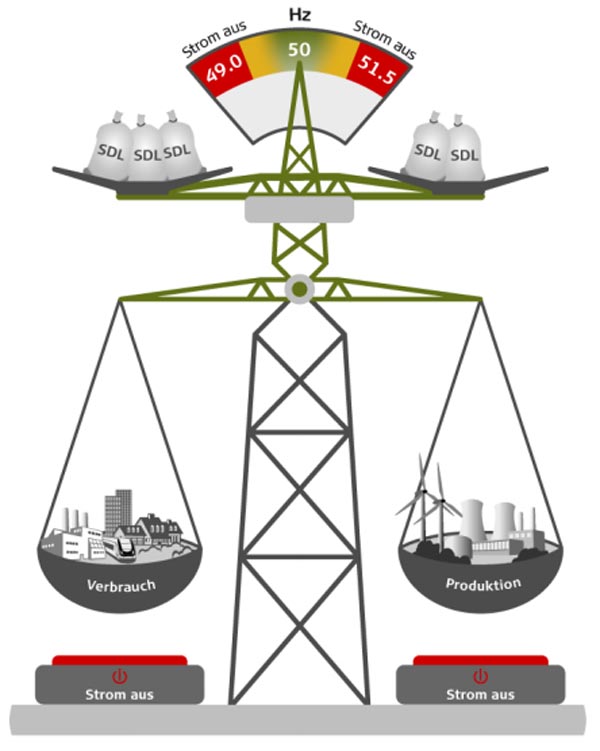
As in every complex system, there are tipping points at which, from one moment to the next, a phase transition can occur and, in the worst case, the system or larger parts of it can collapse. This is then called a blackout, which we have fortunately been spared so far. The second big problem is that the large power stations used so far could balance fluctuations in consumption relatively easily by using the energy stored in the primary energy sources coal, gas, uranium or water. We take this for granted too, even though wind and sun cannot be called up flexibly. In the current mixed system this still works quite well, but it also leads to considerable and expensive balancing measures. In Austria, for example, the costs of congestion management to maintain system stability exploded from 2 to 718 million euros between 2011 and 2022. All customers pay for this through grid charges. At the same time, there has so far been hardly any expansion of storage to tackle this problem on the renewable side as well. Of course there are more and more home storage systems and even larger battery storage in electric cars. But none of this is on any scale compared with our daily electricity consumption.
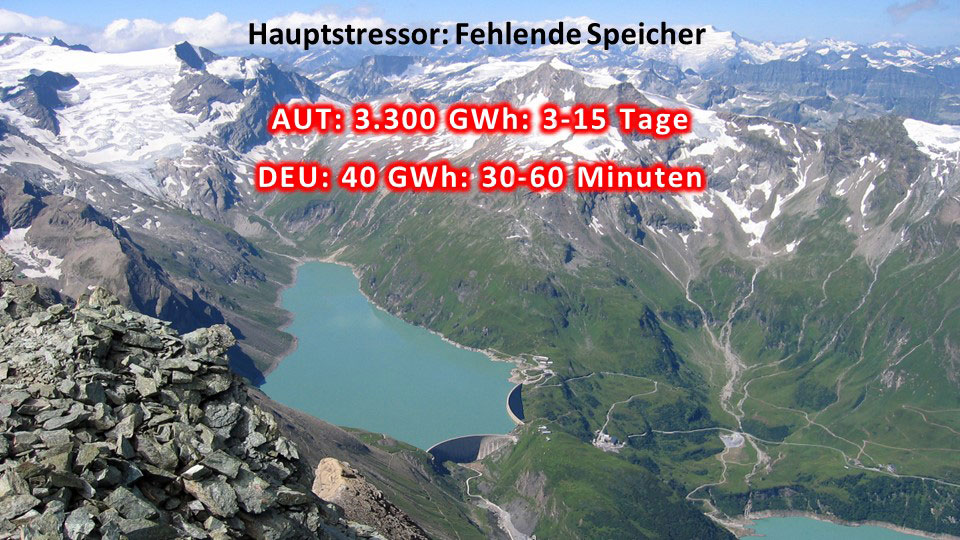
Currently the most effective and efficient storage technology with the highest efficiency is pumped-storage power stations. In Austria we have a theoretical storage capacity of 3,300 gigawatt hours (GWh). By comparison, Germany has a storage capacity of only 40 GWh. With these storage capacities, depending on the season, Austria could theoretically supply itself with electricity from the reservoirs alone for 3 to 15 days. Germany could do so for 30 to 60 minutes at most. The potential for expansion is limited and usually fails because of local opposition.
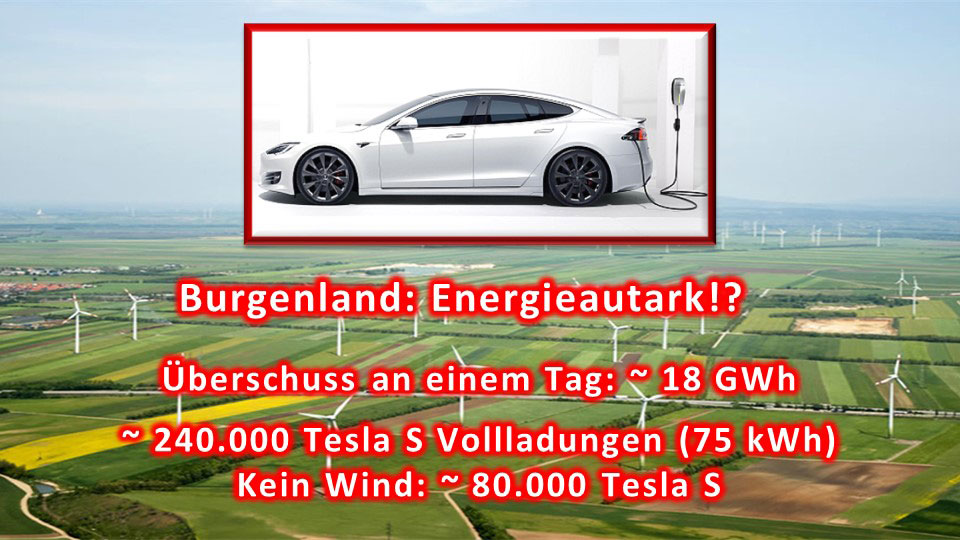
When the wind blows optimally in Burgenland today, so much surplus electricity is generated from wind power in one day that around 240,000 large electric cars could be charged from empty to full. When the wind dies down again the next day, you would need 80,000 electric cars just to supply Burgenland, with its roughly 300,000 inhabitants, with electricity. Today’s home storage systems have about one seventh of the capacity of car batteries. In addition, batteries can never be fully discharged, nor would coordination work today.
On top of that, apples are often compared with oranges here. For example, the maximum output of a PV system possible in the laboratory is sold as installed capacity. But this says little about the output actually available, which for PV is zero at night and usually hardly more than 70% of the maximum output (kilowatt peak, kWp). Then there are seasonal fluctuations. Yet the balance in the system must be maintained at every moment.
The same is done with the storage capacity of battery systems. Here, too, the maximum values are added up and presented as the capacity actually available. But neither are all storage systems always full, nor are they configured to serve the system. So you can deceive yourself very well with statistics. In fact, it is even more problematic: most storage systems behave very similarly, charge at the same time and are full at the same time – usually around midday, when the need for storage would be greatest. And in the evening they all discharge in a similar way, so that consumers often have to draw electricity from the grid again at similar times. This puts additional strain on the system instead of relieving it.
An orchestrated approach is missing here. Something we unfortunately often see in the energy transition at present: it is almost only about optimising individual parts and hardly about optimising the system, which makes the system more prone to disruption and, above all, makes costs explode.

The third essential component is the infrastructure that connects everything and provides balance at all times: the grids, but also the necessary equipment such as transformers. This is where the next self-deception happens. At first glance, many PV system owners rightly believe that they do not want to pay the infrastructure costs, because they generate most of their electricity themselves or even more than they can use. In other product segments that would not be a problem – you could simply store it. With electricity it is not so easy, because it is a just-in-time product. Yet every customer wants to be able to flip the light switch at any time, even when the sun is not shining or the storage is already empty. And even if this is only necessary a few times a year, people expect it to be possible at any time. But for these few moments a shadow infrastructure has to be kept available, which then becomes very expensive. Moreover, the existing infrastructure was never built for large consumers such as electric cars or heat pumps, or for large PV systems. As scaling increases, there will therefore be more and more local and regional problems and overloads, especially if politics continues to set framework conditions that cannot be reconciled with physics. If PV expansion alone is subsidised, without accompanying grid and storage expansion – which takes considerably more time and resources – disruptions will foreseeably increase and, in the worst case, lead to a (partial) system failure.
In conclusion
To conclude, a few thoughts on self-sufficiency: self-sufficiency at the level of individual buildings usually makes little sense and is very expensive. Moreover, energy supply is a community task. What we would need instead is an energy cell system in which generation, storage and consumption can be balanced locally or regionally and a defined fallback level can be kept available for emergencies. Unfortunately, we are still a long way from this, because our thinking is still trapped in the hitherto very successful large-scale technical system, even though at the same time we are massively increasing the framework conditions and the complexity. This makes it essential to think beyond the previous system boundaries and to include other energy domains such as heat or mobility. Even if there is some movement in this direction, regulation still largely moves within the old frame of thinking and prevents new approaches. A systemic approach is hardly discernible. So there is still much to do. The first step begins with understanding the system, where the rule is: only those who know and understand the whole also understand the details, and not the other way round. I hope this article can put a few myths into perspective and provide some new impulses.
Kind regards Herbert Saurugg

For years I have been publishing extensive analyses of what happens in the event of a blackout on my website.
Since 2019 I have also been cooperating with GAIA. Besides guest articles, my newsletters are also passed on to interested readers as they appear.

Notes on content provided by authors
Comments
Loading comments …
Become a member to comment publicly. GAIA members write comments in the members' portal — under their nickname, visible to everyone.