The future of the Pi-Car has begun

Pi technology is making rapid progress and is about to take a decisive step.
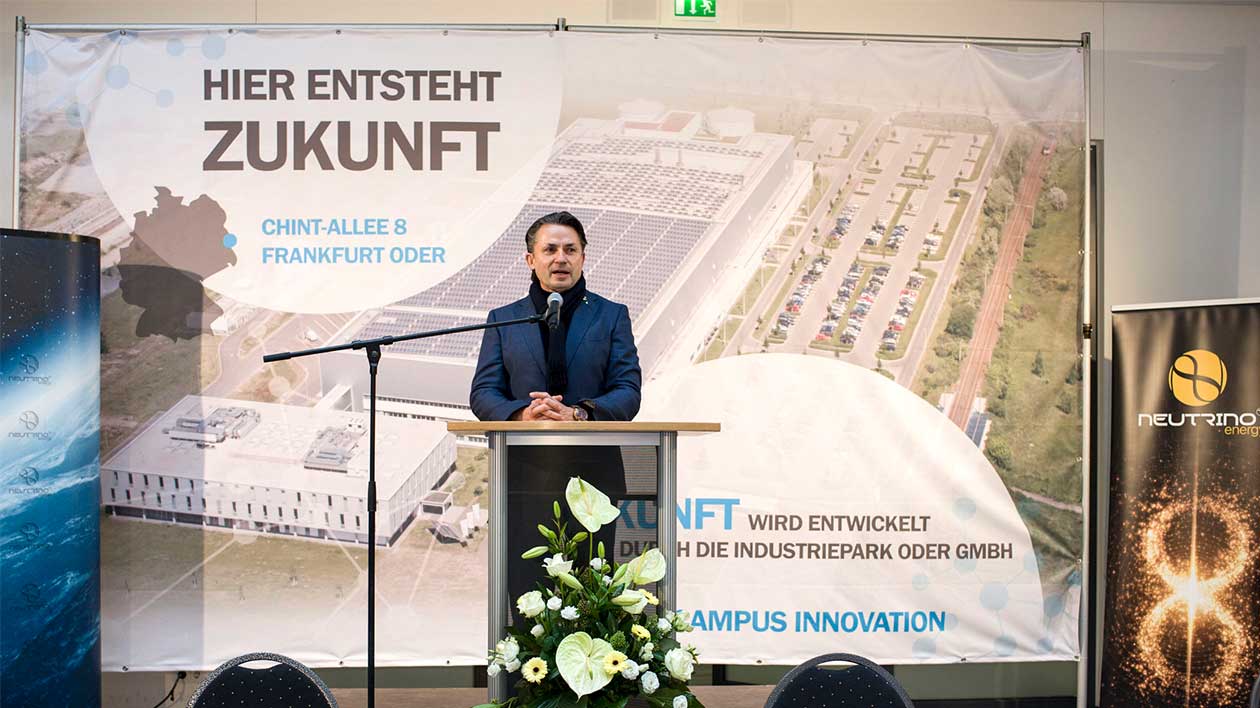
The future of honest electromobility has begun: the generous production space for future manufacturing is already owned by the German-American research company Neutrino Energy Group – on Brandenburg soil and without any subsidies or public funding.
“After technical development had so far been driven mainly in India with the C-MET institute there, it is important to us to make a statement in Germany as well.”

Holger Thorsten Schubart
CEO of the Neutrino Energy Group
Future mobility without fuel pumps or charging stations
The patents surrounding the worldwide registered Pi brand have been filed, and the plans are technically mature: Pi electromobility, as an absolute leap innovation, is on the verge of realising the vision of mobility without fuel pumps or charging stations in the coming years.
The so-called Pi-Car will be the world’s first electric vehicle whose body consists entirely of the ultra-light and super-hard wonder material carbon, in which the neutrinovoltaic cells are directly integrated. The energy converters are worked into the body, as it were, in all cavities, so as to make the Pi-Car independent of charging stations, battery changes or filling stations.
The technological innovation – collecting energy of the most varied origins from the surroundings – can, if consistently thought through and scaled up, help solve global energy problems and achieve the climate targets in Germany and worldwide.
Questionable environmental friendliness
Current electric vehicles are regarded as particularly environmentally friendly. However, that is a questionable claim, because environmental friendliness is determined primarily by how the electricity for charging is generated. If the electricity is produced by burning fossil fuels, electric cars can only be regarded as pseudo-ecological. Without an exhaust, the electric car produces no direct exhaust gases, but the chimneys of the power stations generating electricity by burning fossil fuels smoke all the more.
“It would be more accurate to say that the e-vehicles currently being produced are the starting point for the switch from cars with combustion engines to carbon-free transport in the future. But even in the initial phase, switching to electric vehicles already makes ecological sense in two cases,” says Schubart, “namely if the vehicles are charged mainly with electricity generated without CO2 emissions, or if the electric vehicle provides its own electricity, as is the case with Pi technology.”
A mobile cosmic charging station
Prof. Dr R. Strauss, member of the scientific advisory board of the Neutrino Energy Group, explains the idea impressively: every day, invisible radiation energy reaches us that would cover more than 5,000 years of the world’s energy needs – a completely untapped potential so far, and incidentally more energy in a single day than all the fossil fuels still remaining on Earth put together. Pi technology will make technical solutions available in which the body of a vehicle contains the technology to convert part of this radiation, and also temperature differences, into electricity – like a solar cell, but one that also works in complete darkness. This is made possible by a quantum-mechanical 2D working tool, a converter consisting of multilayer doped silicon, in whose interstices special graphene layers are set into vibration and resonance by external influences.
Pi-Car: a trademark protected worldwide
The Neutrino Energy Group has secured the name Pi-Car worldwide as a brand name. In future, however, Pi will stand not only for endless driving, but also for endless energy conversion in the housings of electrical devices of basically any size. It is about autonomous, decentralised, baseload-capable energy supply.
“We want to continue testing and optimising extensively what is possible over the next few years. The new site in Frankfurt (Oder) gives us space for a state-of-the-art research and development centre.”
Holger Thorsten Schubart
CEO of the Neutrino Energy Group
In addition, the Neutrino Energy Group, together with an Australian partner, is starting a new type of dry-cell battery production in the existing three-storey industrial facility: environmentally friendly energy storage units with up to 25,000 charging cycles that are ideally suited as buffer storage for Pi technology.
On the third floor, so-called smart tuning parts for existing electric vehicles will be developed in future – components that can convert energy for additional range. The former solar cell production facility offers excellent spatial conditions for this.
“In addition to the purchase price for the facility, we have made around 500 million euros available in order to drive further developments forward independently and calmly over the next few years.”
Today it is still difficult to predict exactly when the first series of the Pi-Car electric car will be produced, but there is no doubt that the decisive steps towards introducing the new Pi technology – the most ambitious vision of infinite green energy – have already been taken. “The market potential of this technology is as infinite as the number pi itself.”
Holger Thorsten Schubart
CEO of the Neutrino Energy Group
The Neutrino® Energy Group works with a worldwide team of scientists and various international research centres. They research applications for converting invisible radiation spectra of the sun, including neutrinos – high-energy particles that reach the Earth incessantly and can be converted into electrical energy.
The image rights lie with the author of the press release.
Notes on content provided by authors
Comments
Loading comments …
Become a member to comment publicly. GAIA members write comments in the members' portal — under their nickname, visible to everyone.