ZDFinfo: graphene as the energy storage of the future?


ZDFinfo: mobility as the epitome of freedom and the challenge of the future
“The combustion engine is so successful that it leads to an ecological crisis – a crisis that we may fortunately be able to solve with two things everyone has in their drawer,” the narrator tells viewers from minute 37 of the documentary, which we are happy to share. But let us start at the beginning.
In the last century the car became the epitome of freedom. Ever since Henry Ford began replacing horse-drawn carts with automobiles in 1912, mass motorisation has shaped our living space globally. Today we face the challenge of reinventing the car, because combustion engines emit 3.8 billion tonnes of CO2 every year. So reports the German public broadcaster ZDF on its documentary channel.
That is why Edison’s idea of the electric car is becoming interesting again. Although battery technology has improved enormously since Edison’s day, the familiar problems remain: new electric cars have modern batteries that allow you to drive just under 500 kilometres. Then it takes hours to recharge them, whereas petrol can be refilled within minutes. So what we need to accelerate electric mobility are new technologies for rechargeable batteries that charge quickly and can store a lot of electricity.
High-tech revolution: graphene as energy storage in the car
Link to the ZDFinfo media library (German)
The video was available to viewers in Germany until 24.11.2023.
We ask members to log in for further information.
Not a member yet? Register now.
The answer lies in a pencil
The so-called lead is graphite, a form of carbon. Graphite has a honeycomb structure, and its individual layers are stacked on top of one another. So in a pencil there are free electrons between each layer of carbon. This creates an electrostatic charge, which is why graphite sticks to paper.
Graphite conducts electricity exceptionally well, but only when it consists of a single layer of carbon – so-called graphene. Graphene is therefore “the” wonder material. It is 200 times stronger than steel, conducts electricity extremely well and has a large surface area. This opens up countless possibilities for its use. One of them is storing energy. Graphene is robust, so it can turn the entire body of a car into a battery.
In 2004, two physicists first had the idea of using the wonderful properties of graphene. They used adhesive tape, which they stuck together again and again after contact with graphite, and achieved the impossible: they reduced the graphite to a single layer and so achieved the breakthrough.
Of course, a great deal of graphene is needed for use in cars, and this method would not work for that. But this is where chemistry comes in. Richard Kaner and his assistant discovered that they could turn thin layers of graphite into graphene with a simple laser from a DVD burner, and they burned patterns into a DVD that are meant to store electrical charges.
“I charged the graphene for just a few seconds, and the LED was already lighting up for more than 5 minutes. What an impressive experiment,” he reports.
Graphene simply changes everything: Car Pi
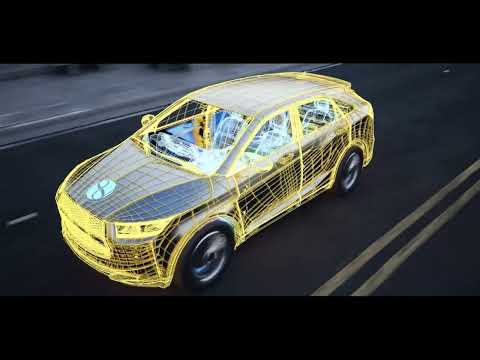
Graphene changes everything. It allows a car to be charged as quickly as filling up with petrol. And it is compostable – and therefore environmentally friendly. Together with new technologies for autonomous driving, this opens up new horizons for safety and range – a new revolution in automotive engineering. These insights into the special properties of graphene underlie the Car Pi project.
The project is part of an international collaboration between the renowned C-MET institute in Pune, India, and the Neutrino® Energy Group in Berlin, Germany. Its aim is to create a unique car that no longer draws its energy from a charging station but from the environment – independently of electricity from fossil fuels. Through the collaboration with C-MET’s mathematicians and physicists, the Neutrino Energy Group can combine its expertise in neutrino technology with developing the materials needed to build the Car Pi.
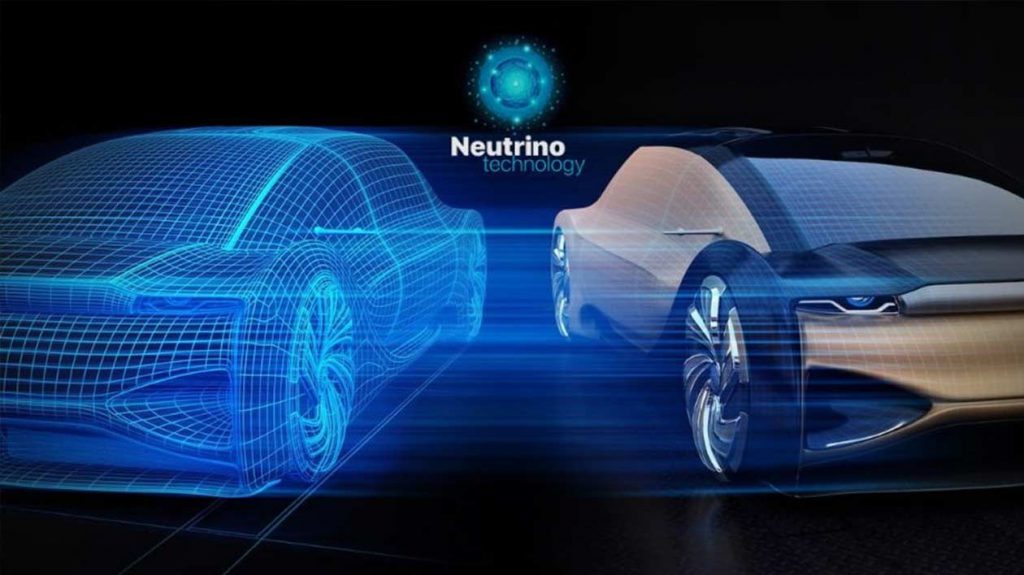
This project is one of the most ambitious undertakings of modern times and is getting ever closer to realisation. The Car Pi generates its own energy with the help of neutrinos and other invisible radiation, whose energy is stored in graphene. It will be the first car to supply itself with energy and no longer depend on external charging stations. Depending on the surroundings, one hour outdoors will be enough to charge it for a range of up to 100 kilometres. The energy storage in the Car Pi’s bodywork consists of environmentally friendly nanomaterials such as doped graphene, Kevlar and carbon fibre. This is how the transition from fossil fuels to clean energy sources succeeds.
 Holger Thorsten Schubart, founder of the Neutrino® Energy Group, is working with a multinational coalition of scientists and engineers in the USA, India and other countries to make the Car Pi a reality. The group is in the process of mastering one of the great challenges of the present, because with the Car Pi concept there is no longer any reason to ban electric vehicles from the roads. Rather, the electric future will be shaped at a new level by innovations like this.

Car Pi • Neutrinovoltaics • Neutrino® Power Cube
The Car Pi: invisible radiation converted with the help of graphene and other metamaterials will power the electric vehicles of tomorrow.
Neutrinovoltaic® information page
People all over the world are being encouraged to buy electric cars on the grounds that they are better for the environment. That is only partly true if the cars are charged via conventional power grids that mainly use fossil raw materials to generate energy. For some time now the Neutrino® Energy Group has been trying to develop a completely new method of mobility – a solution that, like the infinite number π, uses endless neutrino energy instead of coal-generated electricity or fossil fuels.
Notes on content provided by authors
Comments
Loading comments …
Become a member to comment publicly. GAIA members write comments in the members' portal — under their nickname, visible to everyone.