Neutrino® Power Cube – first technical details


“Neutrinos are humanity’s only hope of escaping a looming energy crisis,” said the physicist Stephen Hawking († 2018)
This energy crisis threatens to end the history of human progress for ever. Neutrino radiation is invisible, but a potentially unlimited source of energy. And scientists have already taken the first steps to make it usable for applications.
Can neutrinos be converted into electricity?
Until recently, no concrete answer could be given to this question, despite extensive research by scientists in various countries. This is although scientists believe that neutrino particles – which pass through the Earth every day at about 60 billion particles per second per cm² of the Earth’s surface – contain more energy than all remaining fossil fuels put together. Solving the problem of converting neutrino energy into electricity would provide access to unlimited amounts of clean, renewable energy.
Nikola Tesla, the discoverer of alternating current, remote control and asynchronous motors, was one of the first scientists to suggest that there was an invisible and infinite source of power beyond the reach of our technical development. Much time has passed since then, and science has gained many insights that allow neutrinos to be considered as a power source. Nevertheless, scepticism still prevails, not only among laypeople but also among many scientists, about the success of work on converting the radiation of the invisible spectrum into electricity.
Let’s bring the “ghost particles” to life!
Recent research has confirmed that neutrinos have mass. This is a fact that can affect the lives of everyone on Earth. A partnership between German and US scientists in the field of neutrino research, which in 2008 pooled intellectual resources and strong financial support through the German-American Neutrino® Energy Group, has led to the development of devices that use invisible particles of the light spectrum, such as neutrinos and other invisible radiation, to generate energy.
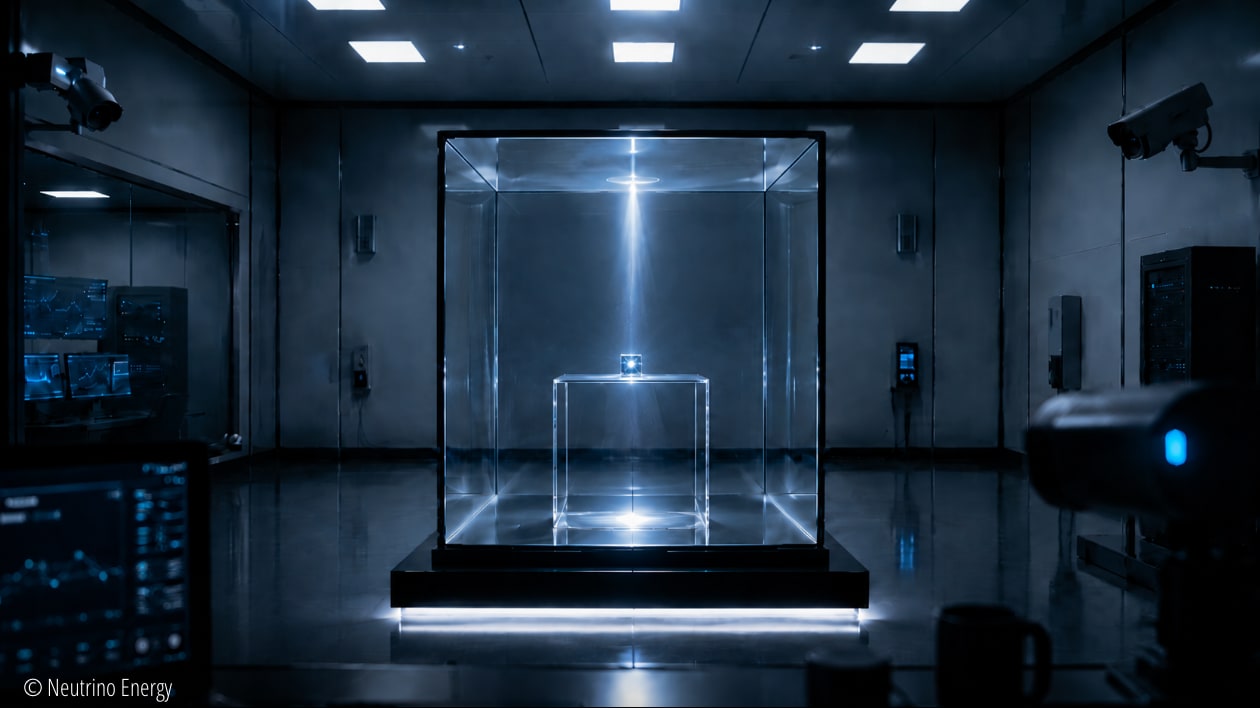
The company has now developed such a device for supplying households with energy: the Neutrino® Power Cube.
At present, the electricity generated in power stations is transported over hundreds of kilometres through power lines, which leads to considerable energy losses. The Neutrino® Power Cube can be installed directly where the energy is consumed, which avoids energy losses. The current prototypes of the Neutrino® Power Cube with its 7 generation units produce 7 kWh of electricity, of which, however, up to 2 kWh are used for internal needs. The Neutrino Power Cube has several outputs with different capacities for both direct and alternating current (220 V and 380 V).
The dimensions of the Neutrino® Power Cube allow it to be placed easily within a residential unit. The cube comprises 7 generation modules, the control elements and the electronics for converting the electricity generated. If necessary, the output can be increased by connecting further generation modules.
Holger Thorsten Schubart, mathematician and president of the international Neutrino® Energy Group, describes the Neutrino Power Cube:
A generator unit is a set of compressed power-generating plates housed in a separate casing. The power-generating plate consists of a metal foil with a multilayer nanomaterial of alternating layers of graphene and silicon, with alloying elements added, on one side. The coated side of the metal foil is the positive pole. The uncoated side is the negative pole.
The vibrations of the graphene atoms under the influence of Brownian motion are amplified by the external influence of the surrounding radiation fields – including the neutrino flux. This causes a resonance of the vibrations of the graphene atoms, which is captured in the form of a direct electric current.
The atomic vibrations in resonance allow increased electron recoil in contact with doped silicon. In this structure, graphene is the material that converts the energy of radiation fields – including the neutrino flux – into electric current.

Holger Thorsten Schubart
Mathematician and President of the Neutrino® Energy Group
The effect of the radiation fields of the invisible spectrum on the nanomaterial found by the scientists of the Neutrino® Energy Group has another important feature: the neutrino is only one of the many factors that influence the strength of the vibrations of the graphene atoms that make up the multilayer nanomaterial, even if it is a very important one. There are many different kinds of radiation in the environment that also affect the vibrations of the graphene atoms, such as the temperature of the air at the place where the Neutrino® Power Cube is installed.
Even if a technological leap of this magnitude seems too unlikely to be believed, people all over the world will begin to use neutrino energy to generate electricity on a large scale within the next few decades. In February 2018, the US Department of Energy published a statement confirming that neutrinos can interact with other material objects. This provided proof that neutrinos have the potential to change the world.
While some still see a future in the use of fossil fuels, others have already begun to develop technologies that will have a global impact on the world as we know it today.
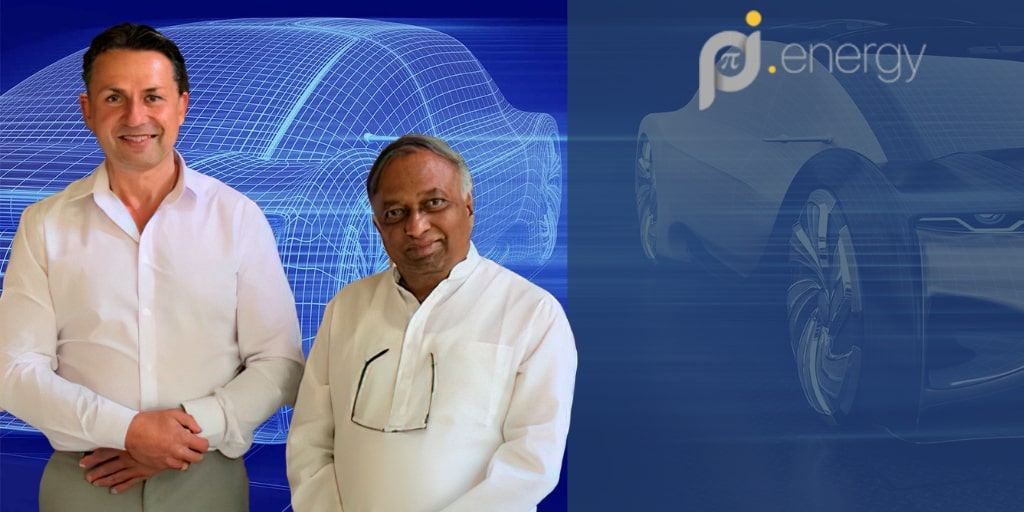
For example, the Centre for Materials for Electronics Technology (C-MET) in Pune (India), one of the world’s leading centres for metamaterials, has announced deeper cooperation with the Neutrino® Energy Group. The aim of the cooperation is to develop “The Car Pi”, an electric vehicle whose body is based on a novel metamaterial that converts the energy of neutrinos – electromagnetic waves – as well as temperature fluctuations, electrosmog and other natural and artificial invisible radiation. The original budget for the cooperation was $2.5 billion. This revolutionary innovation in the automotive industry will change mobility for ever.
The Neutrino Energy Group
The Neutrino Energy Group is a German-American research group. Its aim is to find ways to harness the power of the invisible radiation spectrum. As fossil fuels are limited and climate change requires the development of alternative and CO2-neutral energy sources, this research group is dedicated to an urgent problem. It has succeeded in creating a dense substance that can interact in a specific way with neutrinos and other invisible radiation. This unique substance is used to build the first neutrino photovoltaic cells for power generation. Vapour-deposited layers of silicon and doped graphene are applied to the carrier layer to make the end product. The thickness of these layers is in the nanometre range. When neutrinos and other invisible radiation strike this substance, they generate both horizontal and vertical impulses. It is crucial that the doped materials have the right layer thickness. At the optimum layer thickness, the atomic vibrations caused by the impulses are brought into resonance. As a result, an electric current can be detected in the substrate material. The hypothesis states that the amount of energy that can be harvested depends on the distance travelled in the process. With this approach it will soon be possible to charge electrical devices anywhere in the world without needing a socket or a cable. Simply “collecting” energy from the environment is a viable option. As a result, humanity will have access to an endless supply of clean energy, which will help to slow or halt global warming.
The Neutrino® Energy Group works with a worldwide team of scientists and various international research centres. They research applications for converting invisible radiation spectra of the sun, including neutrinos – high-energy particles that reach the Earth incessantly and can be converted into electrical energy.
The image rights lie with the author of the press release.
Notes on content provided by authors
Comments
Loading comments …
Become a member to comment publicly. GAIA members write comments in the members' portal — under their nickname, visible to everyone.